
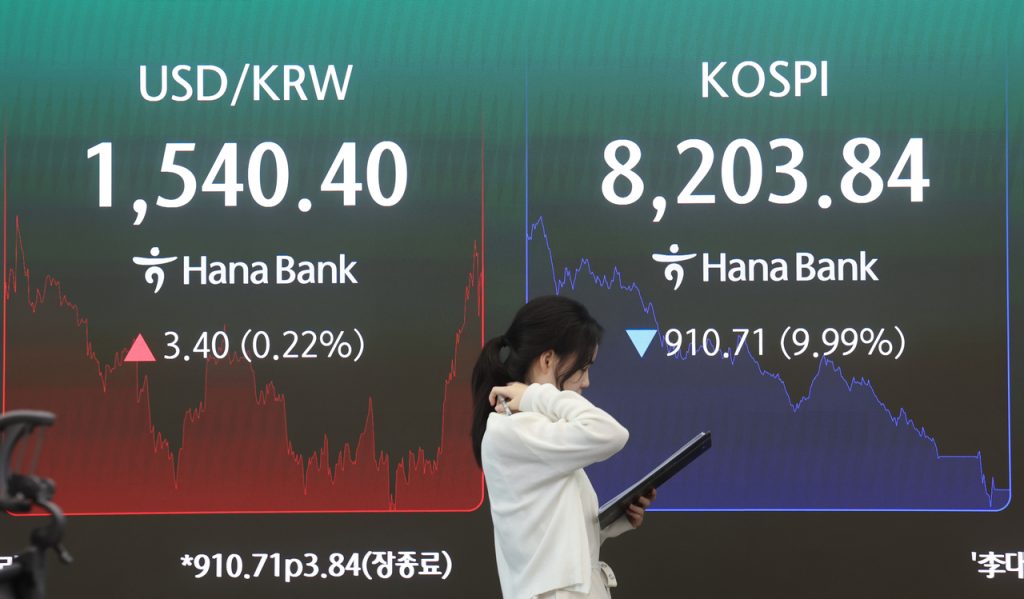
South Korean equities experienced a sharp decline of nearly 10 percent on Tuesday, as foreign investors engaged in significant profit-taking, offloading major semiconductor stocks and other market heavyweights. This sell-off closely mirrored overnight losses observed in US technology stocks, while the local currency also weakened considerably against the US dollar.
Following a session of volatile trading, the benchmark Korea Composite Stock Price Index (Kospi) plummeted by 910.71 points, marking a 9.99 percent drop, to close at 8,203.84. During the day, the index had briefly touched an intra-day high of 9,175.45 before its dramatic fall.
The severity of the market downturn prompted the Korea Exchange, the national bourse operator, to activate a circuit breaker at approximately 2:33 p.m. This intervention occurred after the Kospi had plunged more than 8 percent from its previous session’s closing level.
This incident marked the fourth activation of the circuit breaker this year and the tenth time on record that the KRX has temporarily halted trading across all stocks for a 20-minute period.
Market activity was exceptionally high, with a heavy trade volume of 483.7 million shares exchanged, totaling 59.9 trillion won ($38.9 billion). The trading session saw a significant imbalance, with 856 losing stocks compared to just 46 gainers.
Foreign investors were net sellers, offloading a substantial 4.13 trillion won, while institutional investors also sold a net 4.55 trillion won. In stark contrast, retail investors emerged as significant net buyers, acquiring 8.58 trillion won worth of shares.
Adding to the global market narrative, US Vice President JD Vance had stated overnight that a “very good foundation” was laid for negotiations aiming for a final agreement with Iran. Mediators also indicated progress in these diplomatic talks.
However, these diplomatic developments did not prevent US stocks from closing mixed, with the tech-heavy Nasdaq Composite experiencing a 1.3 percent decline. This fall was attributed to renewed concerns surrounding major technology companies.
Notably, shares of SpaceX plummeted over 16 percent following reports that the company is issuing bonds as part of a substantial fundraising initiative, primarily aimed at funding its ambitious artificial intelligence projects.
According to Seo Sang-young, an analyst at Mirae Asset Securities, “Valuation concerns have intensified for major South Korean semiconductor stocks. Their rapid ascent to repeated record highs in a short timeframe has triggered substantial selling pressure from foreign investors, thereby escalating market volatility.”
Seo further elaborated that the nearly 1 percent dip in Nasdaq futures also contributed significantly to dampening investor sentiment specifically towards domestic South Korean chipmakers.
Reflecting the broader market slump in Seoul, the majority of large-capitalization shares concluded the trading day in negative territory.
Leading chipmakers bore the brunt of the sell-off: Samsung Electronics saw its shares tumble 12.31 percent to 310,000 won, while SK hynix plummeted 12.47 percent to 2.55 million won.
SK Square, the parent company of SK hynix, also experienced a significant decline, falling 7.01 percent to 1.83 million won.
Samsung Electro-Mechanics, an electronic components manufacturing affiliate within the Samsung Group, shed 9.6 percent, closing at 1.99 million won.
Beyond the tech sector, top carmaker Hyundai Motor saw its stock decrease by 12.05 percent to 511,000 won, and leading battery manufacturer LG Energy Solution dipped 6.1 percent to 362,000 won.


