Korea Herald correspondent
SHANGHAI, China – In a strategic move to capitalize on surging Korea-China air travel demand, the Korea Airports Corporation (KAC) is forging stronger partnerships with the Shanghai Airport Authority (Avinex) to significantly expand the aviation network linking Korea’s regional airports with Shanghai.
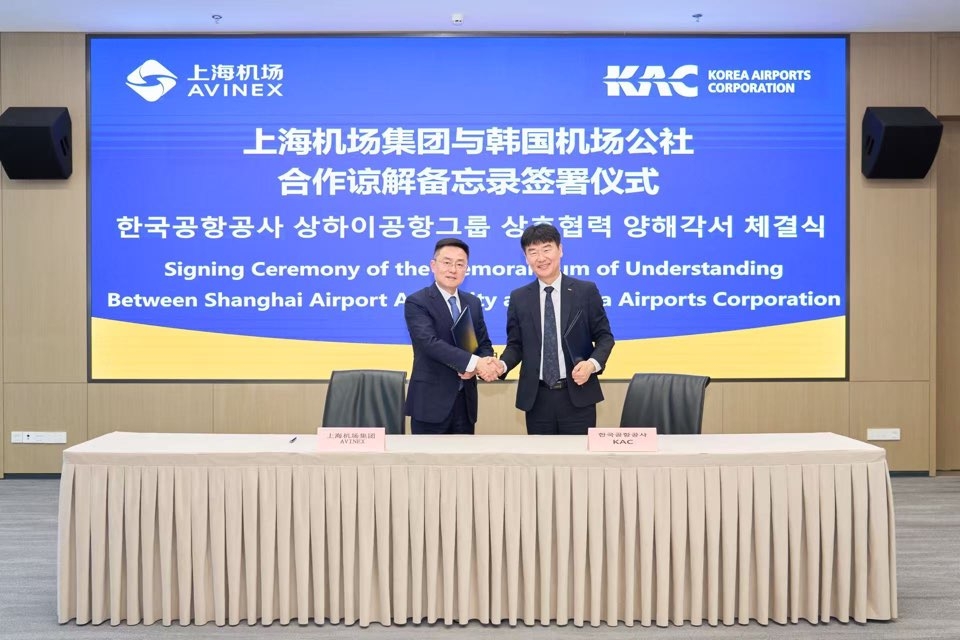
KAC officially announced the signing of a memorandum of understanding (MOU) with Avinex this Tuesday. The landmark agreement was formalized at Shanghai Hongqiao Airport, one of the two key aviation hubs, including Pudong Airport, operated by the state-owned Shanghai Airport Authority.
This new partnership outlines a comprehensive plan for both entities to boost air services connecting Shanghai with various Korean regional airports. Efforts will focus on establishing new routes and increasing flight frequencies. Beyond connectivity, the collaboration extends to enhancing passenger amenities and jointly exploring innovative smart airport technologies.
A critical aspect of this technological alliance involves leveraging Shanghai’s extensive expertise in airport digitalization. This includes advanced AI and cutting-edge digital-twin systems, which are currently under development and rigorous testing at a specialized research facility located within Hongqiao Airport.
During the signing ceremony, Avinex President Zhou Hao emphasized the potential for growth. “While Shanghai currently connects to five regional airports in Korea, such as Cheongju and Daegu, we identify significant opportunities to broaden this connectivity to even more Korean cities,” Zhou stated, underscoring the strategic importance of these links.
President Zhou also highlighted the imminent launch of new China Eastern Airlines services to Cheongju, commencing in July. He further noted the strong influx of Korean travelers, stating, “Korean travelers constitute the largest demographic among international visitors arriving in Shanghai,” reinforcing the necessity for enhanced air links.
Park Jae-hee, acting president of KAC, reiterated the benefits for local economies. He affirmed that “expanding air links between Shanghai and Korea’s regional airports is crucial for boosting local tourism.” Park also expressed KAC’s commitment, adding, “We anticipate close collaboration with Avinex on critical traffic rights and slot allocations, which are vital for supporting future route expansion and growth.”
This pivotal agreement follows a broader aviation accord reached in May between Seoul and Beijing. That accord significantly expanded bilateral traffic rights, consequently creating new opportunities for airlines to introduce additional routes and increase flight frequencies between the two nations.
Reflecting the growing demand, air traffic on routes connecting Shanghai with Korea’s regional airports has experienced a sharp increase in recent years.
Quantifying this growth, passenger volumes at key Korean regional airports such as Gimhae, Jeju, and Cheongju surged from approximately 920,000 in 2023 to an impressive 2.2 million in 2025. This upward trajectory is clearly visible in the latest summer schedule, with airlines boosting frequencies on popular routes like Gimhae-Pudong and Jeju-Pudong, alongside Cheongju initiating brand-new services to Shanghai.
Shanghai’s two primary international gateways, Hongqiao and Pudong airports, collectively manage an enormous annual passenger throughput of roughly 130 million. These formidable hubs provide connectivity to nearly 290 destinations across 49 countries, firmly establishing Shanghai as one of Northeast Asia’s preeminent aviation hubs.
Looking beyond mere route expansion, KAC also indicated that this strategic partnership is poised to foster broader economic and tourism cooperation. Both Korea Airports Corporation and Avinex will jointly explore innovative promotional campaigns, passenger incentives, and collaborative initiatives specifically designed to draw more Chinese visitors to Korea’s diverse regional destinations.