In a strategic move to leverage Uzbekistan’s rich cotton resources, advantageous export access, and burgeoning manufacturing capabilities, Youngone Corporation is significantly expanding its presence in the Central Asian nation. The renowned Korean firm aims to establish a comprehensive textile and apparel value chain, solidifying its commitment to the region.
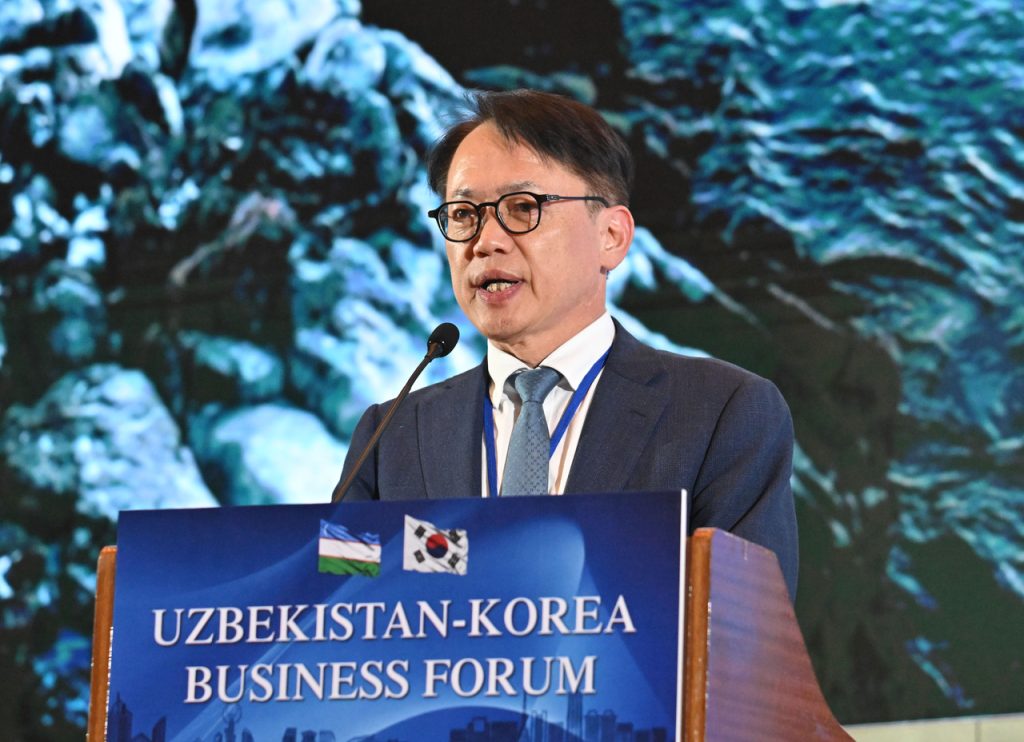
During his address at the prestigious Korea-Uzbekistan Business Forum 2026 in Tashkent, Youngone President Park Jae-yong highlighted Uzbekistan’s unique position, offering substantial trade advantages and robust long-term growth potential for the leading Korean textile and apparel company.
Park elaborated on Uzbekistan’s compelling appeal, particularly its significant trade benefits. He noted, “It allows products to be supplied duty-free to Europe, which is one of our main markets, and also unlocks extensive opportunities within the neighboring Commonwealth of Independent States (CIS), Russian, and broader Central Asian markets.”
As one of Korea’s largest textile and apparel companies by revenue, Youngone Corporation commands a formidable global presence. The company not only operates The North Face brand in Korea under a license agreement but also serves as a critical OEM and ODM manufacturer, supplying premium outdoor and sportswear products to world-renowned brands such as Lululemon, Patagonia, and Arc’teryx.
Underscoring the company’s vast operational scale, President Park stated that Youngone employed over 100,000 individuals globally by the end of last year, producing approximately 100 million garments annually across its extensive manufacturing network. Key production hubs currently include Bangladesh, Vietnam, El Salvador, and Uzbekistan, with ambitious plans for further expansion into Kenya.
Youngone’s robust financial performance was evident with global sales reaching approximately $3.5 trillion last year, as reported by Park. Beyond its core apparel manufacturing business, the diversified corporation also proudly owns the esteemed Swiss bicycle brand, Scott.
President Park emphasized Uzbekistan’s inherent strength as a premier cotton-producing nation, positioning it as an exceptionally promising foundation for Youngone’s vision of a deeply integrated textile business.
He further detailed, “Uzbekistan is traditionally rich in cotton, and our strategic goal is to construct a fully vertically integrated business model here, encompassing every stage from cotton-based yarn production to weaving, knitting, and final garment manufacturing.”
Demonstrating its strong commitment to the region, Youngone has already invested approximately $22 million in Uzbekistan, with President Park projecting this figure to escalate to $40 million within the next three years.
Currently, Youngone operates a primary manufacturing facility in Samarkand. The company is set to significantly expand its value chain into broader textile production capabilities starting early next year.
Sustainability is a core tenet for Youngone, and Park affirmed the company’s dedication to pursuing environmentally friendly operations across all its manufacturing locations. This includes integrating renewable energy solutions such as solar power, biomass, and various other green energy sources.
Beyond its manufacturing endeavors, Youngone is deeply committed to local community support within Uzbekistan. President Park shared that the company actively intervened to take over and ensure the continued operation of a traditional performance theater facing financial hardship. Furthermore, Youngone collaborates with Seoul National University’s social responsibility group on various impactful community service activities.
Initially, Youngone aims to produce high-quality cotton-based textile products in Uzbekistan. However, Park outlined a clear progression plan: to transition into developing higher-value performance apparel, mirroring the advanced products it engineers for The North Face brand in Korea.
Concluding his remarks, President Park affirmed, “We will actively support and provide comprehensive training to local workers, ensuring Uzbekistan can emerge as a formidable leader in the global textiles, apparel, and fashion industries.”