TASHKENT, Uzbekistan — The Korea Overseas Infrastructure and Urban Development Corp. (KIND), a leading Korean state-backed infrastructure investor, is actively advancing significant airport, bio-cluster, and smart city projects across Uzbekistan. This strategic push underscores KIND’s commitment to expanding its crucial role within the rapidly developing Central Asian market.
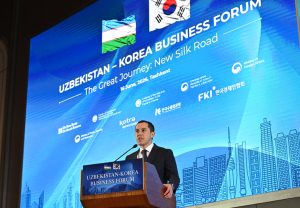
During the recent Korea-Uzbekistan Business Forum 2026 held on Tuesday, KIND CEO Kim Bok-hwan highlighted Uzbekistan’s unparalleled strategic location. Positioned at the very heart of Central Asia and along the historic Silk Road, the nation’s robust infrastructure development is deemed essential for its projected future growth trajectory.
“Uzbekistan’s central position in Central Asia and along the Silk Road grants it immense geopolitical significance,” stated CEO Kim. He further emphasized, “Given this, the development of modern airport projects holds paramount importance for the region.”
Elaborating on these initiatives, Kim confirmed KIND’s active involvement in the development of a new international airport for Tashkent, alongside a separate key airport project situated in Urgench.
Established in 2018, KIND serves as a vital enabler for Korean builders and investors engaged in diverse overseas ventures, including infrastructure, plant construction, and public-private partnership (PPP) projects. Kim noted the evolving global infrastructure market trend, which increasingly favors PPP and investment-development models as governments worldwide grapple with fiscal constraints and widening funding disparities.
KIND’s comprehensive support encompasses every stage of project lifecycle: from initial development and meticulous planning to efficient operation, complemented by significant equity investment and robust financing solutions.
CEO Kim also disclosed that KIND is progressing with the ambitious Tashkent Smart Bio Cluster project. This planned state-of-the-art complex is designed to foster innovation and growth within the pharmaceutical, biotechnology, and medical device industries.
Regarding the bio-cluster initiative, KIND successfully finalized its master plan last year as part of the Korean government’s renowned K-City Network program. A critical feasibility study is slated for this year, with the project targeting a groundbreaking ceremony in the latter half of 2027, Kim confirmed.
Additionally, KIND is meticulously evaluating the Tashkent Smart Aerocity project, which is strategically envisioned to integrate seamlessly with the new Tashkent airport. CEO Kim detailed the project’s goal: to develop an expansive 750-hectare complex surrounding the airport, designed to merge logistics and complementary industries within an innovative airport-linked urban development framework. A comprehensive master plan for the Aerocity is anticipated to be drafted in 2026 via the K-City Network program, subsequently followed by a thorough feasibility study.
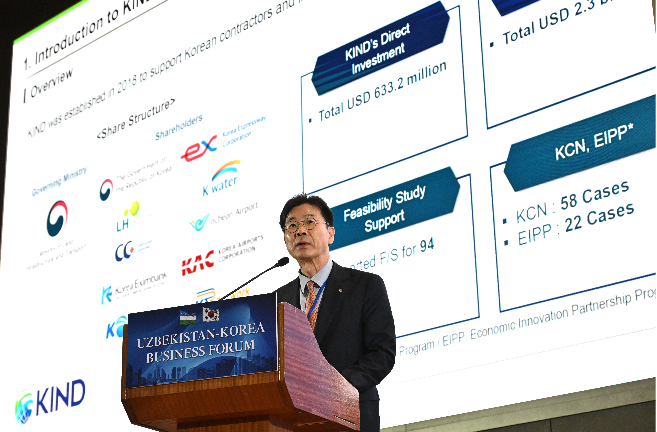
Since its inception, KIND has demonstrated a robust investment record, directly allocating approximately $600 million across 28 projects spanning 15 countries. When factoring in the policy funds it expertly manages, the corporation’s total investment reaches an impressive $3 billion, distributed among 85 projects across 20 nations, Kim reported.
KIND’s impressive portfolio of major projects includes the Upper Trishuli-1 hydropower initiative in Nepal, the Trumbull combined-cycle power plant in the U.S., the Hung Yen industrial park in Vietnam, and the Nakkas-Basaksehir motorway in Turkey. In 2025, the company secured the prestigious Facility E independent water and power project in Qatar, a cutting-edge gas-fired combined-cycle power and desalination plant. This year alone, KIND has already formalized a contract for a significant floating liquefied natural gas (FLNG) production facility offshore plant project in Louisiana, Kim added, showcasing its diverse global reach.
Kim clarified that KIND primarily employs an equity participation investment model. This approach enables the corporation to share project risks more actively and collaboratively with sponsors, distinguishing it from traditional lenders. Furthermore, KIND diversifies its investment avenues by utilizing funds and bonds, strategically deploying both its proprietary capital and managed policy funds to bolster overseas infrastructure projects.
He further elaborated that KIND is responsible for managing a substantial 2.6 trillion won fund, specifically earmarked for supporting international plant, infrastructure, and smart city developments. This includes a dedicated green infrastructure export support fund, underscoring their commitment to sustainable projects.
“KIND is steadfastly committed to the successful execution of these pivotal projects, leveraging the strong foundation of Korea-Uzbekistan cooperation,” Kim affirmed. “Simultaneously, we are actively identifying and developing new initiatives to further strengthen our bilateral cooperation and achieve mutual prosperity.”