Combined margin loans tied to the two chipmakers approach 9.1 trillion won
The South Korean stock market is signaling signs of overheating, driven by a surge in debt-funded investing from retail investors. As the Kospi index climbed to a record 9,000, outstanding margin loans have reached an unprecedented 38 trillion won ($24.8 billion), prompting leading brokerages to implement stricter margin lending rules.
Data from the Korea Financial Investment Association reveals that outstanding margin loans across the domestic stock market hit 38 trillion won as of Thursday, a 200 billion won increase from the previous day. This balance marks a significant surge of over 10 trillion won since the end of last year, when it stood at approximately 27 trillion won.
Breaking down these figures, margin loans directed towards the Kospi market totaled 28.9 trillion won, while the Kosdaq accounted for 9.1 trillion won. The Kospi index consequently represents 76 percent of the total outstanding margin loan balance.
These margin loans, a crucial indicator of South Korean retail investors’ leveraged trading activity, initially surpassed 38 trillion won on May 29th and have persisted at elevated levels, mirroring the sustained Kospi rally.
A substantial portion of this margin financing has been channeled into key market leaders: Samsung Electronics and SK Hynix. These two major chipmakers have been primary drivers of the market’s recent gains.
Specifically, outstanding margin loans associated with Samsung Electronics reached 4.76 trillion won as of Thursday. Similarly, SK Hynix saw its linked margin loans total 4.33 trillion won. Together, these two technology giants represent a staggering 9.1 trillion won in margin borrowing, a substantial leap from approximately 2.53 trillion won recorded at the close of last year.
Over the last six months, margin financing directed at Samsung Electronics surged from 1.65 trillion won to 4.76 trillion won. Concurrently, margin loans tied to SK Hynix experienced an even more dramatic increase, jumping from 884.1 billion won to 4.33 trillion won.
Collectively, these two prominent stocks alone account for roughly 6.56 trillion won of the total increase in margin borrowing witnessed this year. Their outstanding balances saw significant growth: nearly tripling for Samsung Electronics and expanding almost fivefold for SK Hynix.
Amidst this heightened market volatility, the pace of forced liquidation has also accelerated, raising further concerns about investment risk.
Between June 1st and June 9th, actual forced sales linked to unpaid margin accounts surpassed 550 billion won. Alarmingly, forced liquidation hit a record high of 169.8 billion won on June 9th alone.
Financial analysts are issuing warnings that an escalation in forced sales could initiate a dangerous vicious cycle. This scenario involves declining share prices triggering collateral shortfalls, which in turn leads to further selling pressure. There are growing concerns that a market correction, particularly among leading stocks, could significantly amplify broader market volatility across South Korea.
“Margin trading inherently amplifies buying demand during stock market rallies but intensifies selling pressure via margin calls during market downturns,” stated the Korea Capital Market Institute in a report published in May. The institute further cautioned that concentrated forced liquidation events could ignite a wider deleveraging cycle, posing systemic risk to financial markets.
In response to escalating concerns regarding excessive debt-funded investing, South Korean brokerages have initiated measures to tighten their risk controls and margin requirements.
Specifically, stocks classified as Group F, which are subject to a 100 percent margin requirement, now face stringent restrictions on both new margin loans and the extension of existing maturities.
KB Securities announced on Tuesday that it would temporarily restrict margin-financed buy orders. This decision aims to ensure compliance with stringent credit exposure limits mandated by the Capital Markets Act.
Meritz Securities, on Thursday, significantly increased margin requirements for three specific stocks, including Jeju Semiconductor and Jusung Engineering, elevating them to 100 percent from their previous range of 30-50 percent.
Also on Thursday, Mirae Asset Securities reclassified ten stocks, including major players like Doosan Enerbility, Samsung Electro-Mechanics, Samsung SDI, EcoPro BM, POSCO Holdings, and Hanwha Ocean, moving them from Group E to the more restrictive Group F.
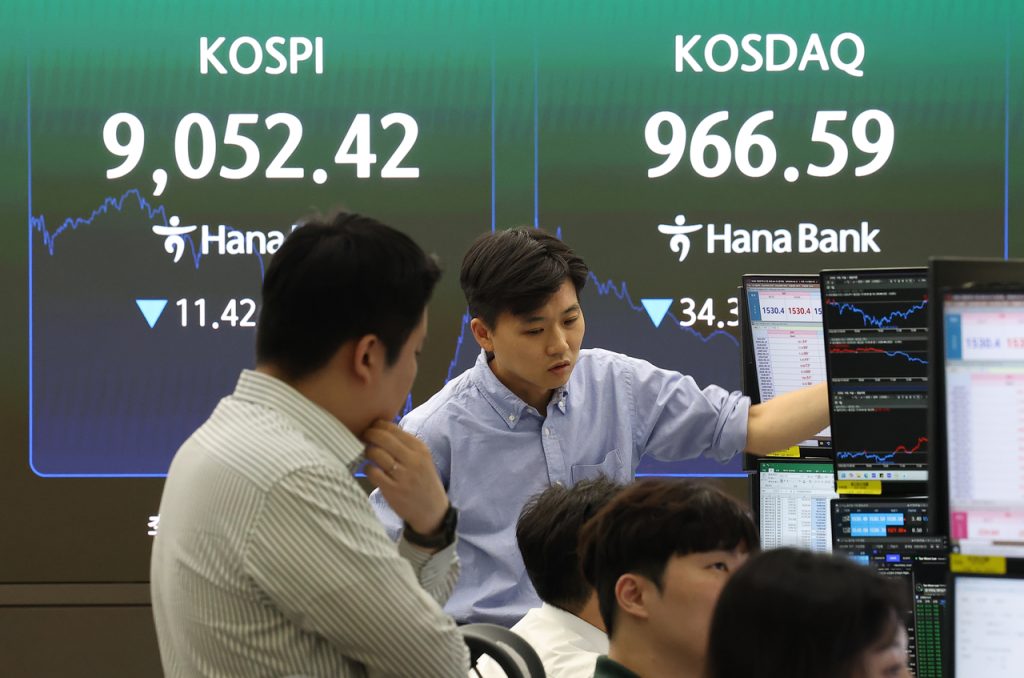
The Kospi index ultimately closed at 9,052.42 on Friday, reflecting a slight decrease of 0.13 percent from its prior session, as reported by the Korea Exchange. Notably, the South Korean benchmark index had briefly surged by as much as 2.48 percent, reaching 9,288.89 during the trading session. This rapid ascent saw the index climb from 8,000, first surpassed on May 26th, to above 9,000 in a remarkable span of just 16 trading days.
ch0221