The ambitious pursuit of humanoid robotics by Hyundai Motor Group is rapidly progressing, with Boston Dynamics’ Atlas robot reportedly approaching the crucial level of autonomy required for widespread industrial deployment, as detailed by KB Securities.
A recent report from KB Securities, authored by analyst Kang Sung-jin, highlights significant strides made by Boston Dynamics, Hyundai Motor Group’s leading US robotics subsidiary. New videos demonstrate remarkable advancement in developing ‘general intelligence’ for their cutting-edge humanoid robots. This ‘general intelligence’ capability enables these advanced machines to dynamically adapt to novel situations and execute diverse tasks, moving beyond mere preprogrammed sequences.
Kang further notes that Boston Dynamics has revolutionized its development process. The company can now conduct simulations equivalent to millions of hours of intensive robot training in just one day. Crucially, these complex learned capabilities are then efficiently transferred to the Atlas humanoid in approximately an hour, thus dramatically accelerating both the development cycle and potential deployment timelines for these advanced industrial robots.
This rapid progress is attributed partly to strategic collaborations with industry leaders: Google DeepMind for cutting-edge AI technologies and Nvidia for powerful accelerated computing solutions, vital for next-generation robotics.
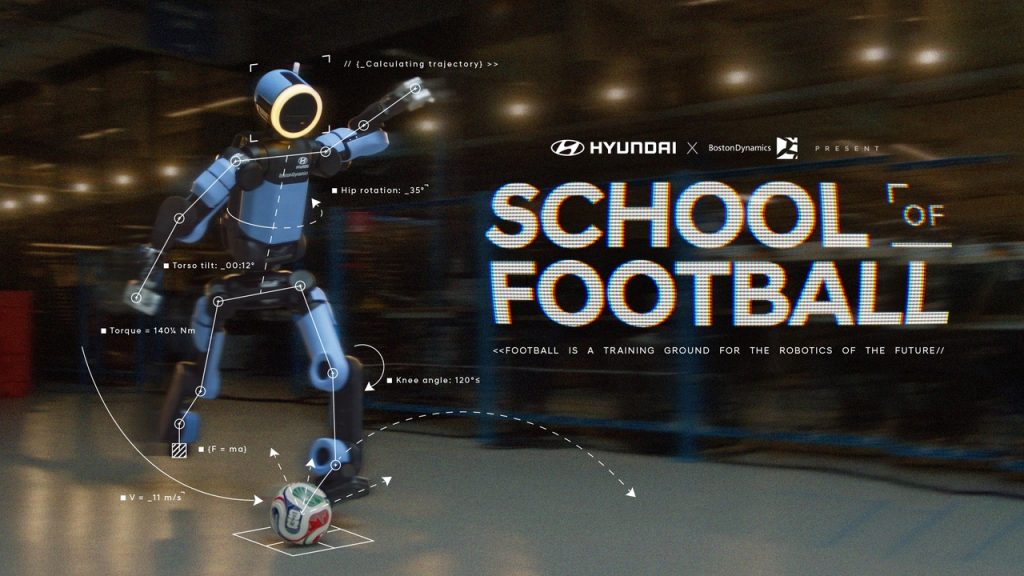
Moreover, the latest production-ready iteration of the Atlas humanoid robot showcases impressive advances in physical performance and agility. A compelling demonstration featured the robot deftly moving a heavy refrigerator through coordinated whole-body movements. In another display, Atlas performed dynamic kicks, vividly illustrating significant enhancements in its balance, overall mobility, and precise body control, critical for complex industrial applications.
These remarkable technological advancements unequivocally underscore Hyundai Motor Group’s unwavering commitment to the successful commercialization of industrial humanoid robots. Such progress is poised to significantly strengthen Boston Dynamics’ leadership position within the burgeoning global market for advanced robotics.
Looking ahead, Kang projects that Boston Dynamics is well-positioned to capture a substantial 15 percent of the overall global humanoid robot market by 2035. Furthermore, their dominance in the premium industrial humanoid segment could soar, potentially reaching an impressive 60 percent market share, solidifying their role as a key innovator in the future of automation.
hyejin2