South Korean stocks experienced a significant rebound on Thursday, closing higher despite an earlier sharp decline. This market rally was primarily fueled by robust performance in major semiconductor shares, following compelling export data. However, persistent uncertainties surrounding the US-Iran conflict continued to cast a shadow over investor sentiment.
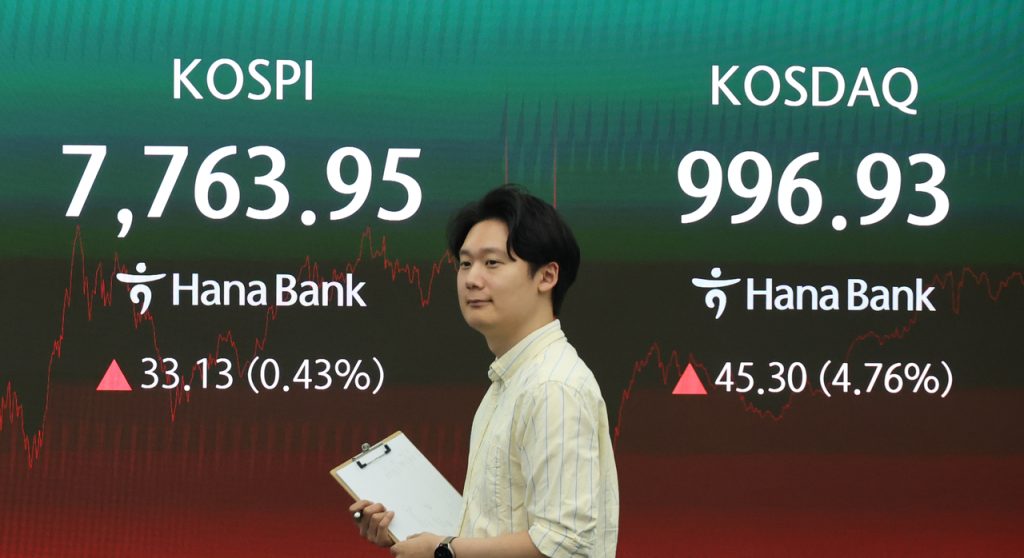
Following a day of choppy trading, the benchmark Korea Composite Stock Price Index (KOSPI) successfully added 33.13 points, marking a 0.43 percent increase to settle at 7,763.95. This positive close represented a strong recovery, especially after the KOSPI had initially opened nearly 3 percent lower.
The secondary Kosdaq index also demonstrated remarkable strength, surging by 4.76 percent to conclude the day at 996.93. Such significant momentum even led the bourse operator to issue a sidecar for the index around 1:58 p.m., temporarily halting program trading for five minutes to manage volatility.
Overall, KOSPI’s trade volume remained moderate, tallying 472.6 million shares valued at 45.2 trillion won ($29.5 billion). Market breadth was positive, with 575 advancing stocks comfortably outnumbering 318 declining ones.
Retail investors played a pivotal role in driving up the main KOSPI index, net purchasing 2.07 trillion won worth of local shares. Conversely, foreign investors extended their selling streak to a 24th consecutive session, offloading a substantial net 1.47 trillion won. Institutions also contributed to the selling pressure, divesting 755.4 billion won.
Initially, the KOSPI opened with weakness, tracking an overnight tech slide on Wall Street. However, the market sentiment shifted positively as investors capitalized on the robust outlook for the semiconductor sector. This optimism was strongly supported by government data revealing that South Korea’s chip exports more than tripled year-over-year in the first 10 days of June, reaching an impressive $11 billion.
This strong performance in semiconductors contributed to the country’s overall exports for the same period, which surged by 86 percent year-on-year to reach a new record high of $28.6 billion.
Adding to the positive momentum, the eagerly anticipated US Consumer Price Index (CPI) for May, a critical inflation indicator, came in softer than market expectations. This favorable development further helped to alleviate the market’s prevailing risk-off sentiment, as noted by Kang Jin-hyuk, an analyst at Shinhan Securities.
Contextually, global markets had faced headwinds on Wednesday. The Dow Jones Industrial Average closed 1.87 percent lower, the S&P 500 declined 1.62 percent, and the tech-heavy Nasdaq composite saw a 1.98 percent drop. This broader sell-off was driven by investors unloading technology shares amid growing concerns about the elevated valuations of artificial intelligence (AI) stocks.
Prominent AI chipmakers were particularly affected, with industry leader Nvidia dipping 3.73 percent, Broadcom sliding 5.12 percent, Super Micro Computer tumbling a significant 28 percent, and AMD dropping 4.86 percent.
Despite the domestic market’s recovery, ongoing geopolitical risks, specifically uncertainties surrounding the Middle East crisis and recent additional strikes by the United States against Iran, continue to be closely watched by investors, Kang further cautioned.
Focusing on individual stock performance in Seoul, market heavyweight Samsung Electronics initially saw a decline of over 3 percent but managed to pare its losses, closing down just 1.16 percent at 299,000 won. Its key chipmaking competitor, SK hynix, demonstrated a stronger reversal, gaining 2.59 percent to reach 2.1 million won.
Meanwhile, AI investment firm SK Square also showed robust gains, jumping 3.8 percent.
Performance across other key sectors like automotive, battery, and electrical shares presented a mixed picture.
Leading automaker Hyundai Motor experienced a slight dip, closing down 0.83 percent at 597,000 won, and its affiliate Kia also slipped 2.32 percent to 156,000 won. In contrast, auto parts manufacturer Hyundai Mobis showed resilience, increasing 1.05 percent to 576,000 won.
In the battery sector, leading producer LG Energy Solution saw a marginal decrease of 0.26 percent, ending at 384,500 won, whereas its competitor Samsung SDI recorded a modest gain of 0.4 percent.
Samsung Electro-Mechanics remained flat at 1.8 million won, yet HD Hyundai Electric posted a significant surge of 4.77 percent, closing at 1.03 million won.
Shipbuilding stocks presented a divided performance; HD Hyundai Heavy registered a gain of 0.78 percent to 646,000 won, while Hanwha Ocean faced a sharp decline of 5.17 percent, ending at 104,500 won.
Finally, power plant manufacturer Doosan Enerbility retreated 2.74 percent to 88,600 won, and defense industry leader Hanwha Aerospace pulled back 1.65 percent, closing at 1.01 million won.