South Korea’s Crypto Market Slows as Retail Investors Fuel KOSPI’s Record Equity Rally; Samsung Nears Bitcoin in Market Value
South Korea’s cryptocurrency market has experienced a significant slowdown, with trading volumes sharply declining as retail investors redirect their capital into a booming equity market, spearheaded by the benchmark Kospi’s historic rally.
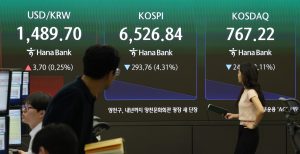
As the Kospi continues its robust performance, reaching an intraday record high above 8,800 on Monday, retail investors are actively shifting their funds from virtual assets towards traditional stock investments.
Concurrently, investor interest in cryptocurrencies has waned following Bitcoin’s retreat from its peak last year. This diminished appetite is further exacerbated by ongoing geopolitical uncertainties and a global surge in AI-related stock valuations.
Data from the Korea Exchange reveals the daily trading volume on the Kospi reached an impressive 118.27 trillion won ($78.3 billion) on Friday.
In stark contrast, figures from crypto data platform CoinGecko indicate that the combined 24-hour trading volume across Korea’s five leading cryptocurrency exchanges—Upbit, Bithumb, Coinone, Korbit, and Gopax—totaled a mere 2.71 trillion won on the same day, representing just 2.03 percent of the Kospi’s overall turnover.
This disparity is particularly notable given that in July 2025, cryptocurrency trading volumes had actually surpassed the benchmark index. During that period, Bitcoin, the world’s largest virtual asset, was trading at approximately 140 million won, roughly 30 percent higher than its current price of around 108 million won as of 1 p.m. Monday.
Indeed, in July of the previous year, the aggregate 24-hour trading volume on South Korea’s top five crypto exchanges soared to roughly 17 trillion won, exceeding the Kospi’s average daily turnover for that month, which ranged between 10 trillion and 15 trillion won.
Adding to the signs of cooling interest, the “kimchi premium”—the phenomenon where cryptocurrencies trade at elevated prices in South Korea compared to international exchanges due to its distinct market dynamics—has largely vanished. It has even entered negative territory, signalling reduced enthusiasm for virtual assets among local investors.
According to crypto data platform Cryprice, Bitcoin’s kimchi premium stood at minus 2.8 percent as of 1 p.m., indicating that the digital currency was trading at a discount within the Korean market.
These diverging market trends have propelled Samsung Electronics to a market valuation nearing that of Bitcoin, positioning the country’s most valuable listed company almost on par with the world’s premier cryptocurrency.
As of 1 p.m., Samsung Electronics’ market capitalization reached 2,040.35 trillion won, or $1.36 trillion, bringing it within close proximity to Bitcoin’s $1.47 trillion market cap. This marks the first time Samsung Electronics’ market value has exceeded 2,000 trillion won on Monday.
SK Hynix, the second-largest company by market value in the Korean market, is also rapidly approaching the cryptocurrency’s valuation, with its market cap recorded at 1,686.25 trillion won.
The current slowdown in crypto trading activity has already impacted the financial performance of domestic virtual asset exchanges. Leading Korean crypto exchanges reported first-quarter revenue declines exceeding 50 percent year-over-year, directly attributable to the substantial drop in trading volumes.
“Robust gains in the domestic stock market have effectively siphoned funds away from cryptocurrencies, leading to significantly weaker trading engagement within the virtual asset market,” commented an official from a local crypto exchange.
silverstar