
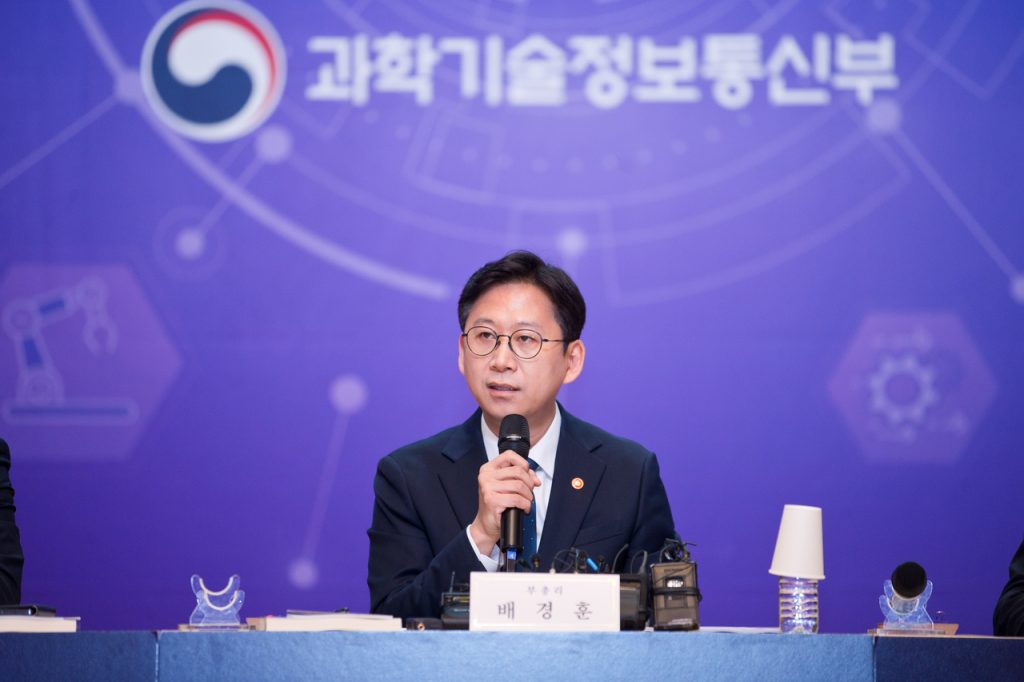
Bae Kyung-hoon Calls for Robust Investment in GPUs, Data, and Talent to Forge South Korea’s Sovereign AI Capabilities
South Korea must now intensify its efforts to develop cutting-edge artificial intelligence models, aspiring to match the capabilities of global leaders like the United States and China, asserted Deputy Prime Minister and ICT Minister Bae Kyung-hoon on Friday. He emphasized the urgent need for a more expansive national AI strategy that transcends mere industrial applications.
“We have reached a pivotal moment where Korea, too, must embrace the ambitious challenge of building frontier AI models at a caliber comparable to those spearheaded by the US and China,” Bae stated during a press conference in Seoul, commemorating the government’s first year in office.
Previously, South Korea’s AI strategy has predominantly focused on sectors where the nation already possesses significant industrial strengths, including semiconductors, advanced manufacturing, and physical AI.
“To deliver comprehensive general AI services, we now require the sophisticated capabilities found in models such as Claude, Gemini, and ChatGPT,” he explained. “The emergence of these advanced frontier models introduces a critical new dimension to our national AI agenda.”
Frontier AI models represent the most advanced general-purpose systems currently under development by leading technology firms like OpenAI, Google, and Anthropic. Their creation demands immense computing power, access to high-quality data, and a pool of top-tier talent – all crucial components in the escalating global AI competition, particularly between the US and China.
Bae, a distinguished artificial intelligence expert who previously led LG AI Research, the AI division of LG Group, has been a key architect behind the government’s vision to position South Korea among the world’s top three AI powers.
Nevertheless, he openly acknowledged that South Korea’s current investment levels do not yet rival those of leading US technology giants.
“The Korean government’s entire AI budget effectively aligns with the investment commitment of just a single major US Big Tech company,” Bae noted. “To successfully develop frontier-class AI models, technological prowess alone is insufficient. Talent, data infrastructure, and robust computing capabilities are all indispensable.”
While South Korea’s technological capabilities have undeniably advanced, he highlighted that the available computing infrastructure for local AI companies remains considerably limited.
“The computing infrastructure currently supporting companies developing sovereign AI foundation models is still far from adequate for them to truly contend with frontier models,” Bae explained. “However, with more aggressive and strategic investment in GPUs and AI infrastructure, I firmly believe South Korea can indeed rise to this significant challenge.”
This gap is particularly striking for a nation that hosts Samsung Electronics and SK hynix, two global leaders in memory chip manufacturing. Yet, training cutting-edge AI models relies heavily on extensive GPU clusters and advanced AI data centers, an area where South Korea is actively seeking to accelerate its progress.
Bae disclosed that the government is engaged in discussions regarding expanded investment in GPUs, data resources, and AI talent development, simultaneously striving to build a strong public consensus around South Korea’s ambitious entry into the frontier model race.
He further stressed that South Korea’s overarching AI strategy should not solely depend on securing foreign chip suppliers.
“Companies like Advanced Micro Devices Inc. and Intel could certainly be valuable partners,” he acknowledged. “However, rather than exclusively focusing on strengthening partnerships with specific global corporations, the paramount objective is to establish a robust system that enables the government to effectively leverage the advancements of Korean AI semiconductor companies within our existing GPU procurement strategy.”
In his opening address, Bae affirmed that South Korea is “on course” to achieve its goal of becoming one of the world’s top three AI powers. Citing the 2026 AI Index Report from Stanford University’s Institute for Human-Centered Artificial Intelligence, he highlighted that South Korea’s count of notable AI models surged to eight in 2025, a significant increase from just one in 2024, thereby positioning the country third globally.
Yet, he emphasized that international partnerships, while valuable, cannot substitute for South Korea’s own inherent AI capabilities.
“Cultivating our own sovereign AI capability is of extreme importance,” he declared. “Only then can we adapt and apply AI solutions in ways that precisely meet our specific national needs. In the critical domain of cybersecurity, securing our distinct AI capability is equally essential.”
As part of this comprehensive national effort, the ministry plans to unveil the outcomes of the second phase of Korea’s sovereign AI foundation model project in the latter half of the year and initiate the construction of a dedicated national AI computing center. Furthermore, it aims to foster wider adoption of domestically developed AI semiconductors within data centers and products manufactured by major Korean corporations.
A new public service, aptly named “AI for All,” is slated for introduction by the end of the year. Bae revealed it would be built upon Korean foundation models and offer advanced chatbot functionalities, alongside personalized AI agents, including specialized versions designed to support older adults and digitally vulnerable demographics.
The government’s objective is to provide this groundbreaking service free of charge to all citizens through 2028.


