
Analysts Say Recent Foreign Selling Reflects Rebalancing, Not Retreat in South Korea’s Market
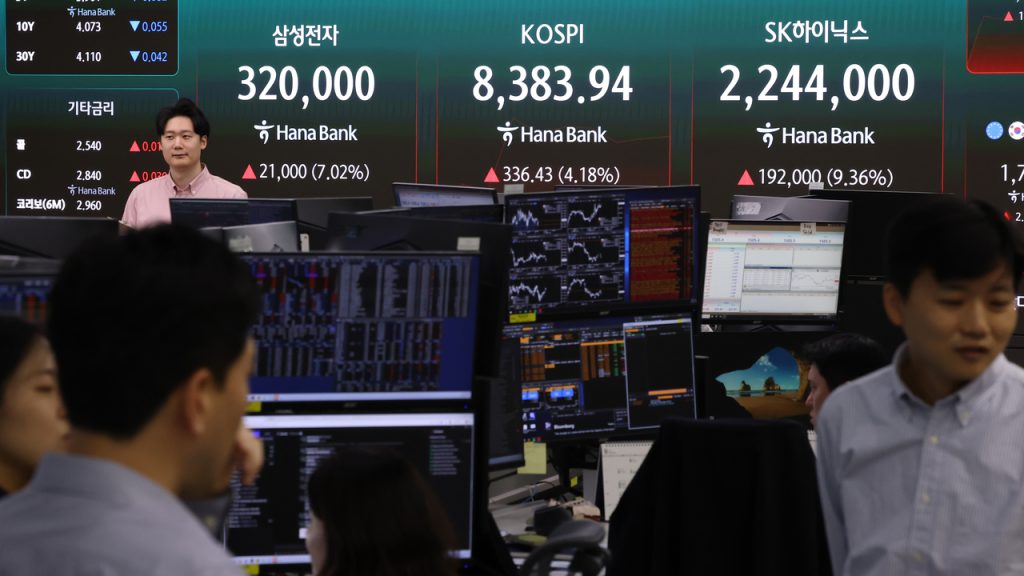
While foreign investors appear to be actively selling shares in the South Korean market, an intriguing trend shows their overall ownership slice is actually larger than before. Despite recent sessions witnessing the benchmark Kospi’s dizzying rally to a fresh intraday high of 8,457.09, overseas investors have seemingly pulled back from local equities. This year alone, offshore investors have offloaded shares exceeding 96 trillion won ($63.8 billion) on the Kospi, with over 40 trillion won sold in May, fueling concerns about a potential foreign exodus from Korean equities.
However, this substantial selling activity presents an unusual dynamic: foreign entities now own a greater proportion of the market. This reflects a significant increase in overall market valuations and concentrated gains within key large-cap stocks. Even amidst this period of considerable net selling, offshore investors’ total share of the South Korean stock market has steadily risen.
As of Tuesday, foreign investors’ holdings in the Kospi reached 39.45 percent, marking an increase of over 3 percentage points from 36.28 percent at the close of 2025. This figure also stands more than 1 percentage point higher than the 38.17 percent observed in early May, prior to the most recent wave of heavy selling pressure. This divergence in market activity and ownership is primarily attributed to overseas investors maintaining substantial stakes in South Korea’s leading blue-chip stocks.
For example, foreign ownership in major market heavyweights like Samsung Electronics and SK hynix stands at 48.37 percent and 51.62 percent, respectively. With the share prices of these prominent chipmakers nearly tripling this year, their increased weighting within the Kospi index has significantly bolstered the overall market share held by foreign investors.
Leading market analysts indicate that foreign investors are, in fact, increasing their strategic exposure to the South Korean market, rather than initiating a retreat. Lee Kyeong-su, an analyst at Hana Securities, affirmed, “Foreign investors are demonstrating a tolerance for an increased allocation to Korean equities.” He further elaborated, “Had there been no willingness to enhance exposure to Korea, foreign ownership would have remained at the 36 percent level seen at the year’s start, resulting in net sales reaching 230 trillion won this year.”
This data strongly suggests that the recent significant selling activity is primarily a result of portfolio rebalancing, prompted by the market’s substantial rally. Kwon Soon-ho, an analyst at Daishin Securities, commented, “The recent large-scale net selling appears to signify profit-taking and strategic portfolio rebalancing, rather than an aggressive reduction in market positioning.”
Foreign Investors Increasingly Bet on Korean Holding Companies
In line with the ongoing portfolio rebalancing within the Kospi, overseas investors are notably increasing their exposure to Korean holding companies. SK Inc., the holding company for SK Group, has emerged as the top choice among these stocks for foreign investors. Year-to-date, they have net bought SK Inc. shares totaling 633 billion won, consequently raising their stake in the company to 29.78 percent as of Wednesday, up from 26.95 percent at the end of the previous year.
Similarly, HD Hyundai has seen foreign ownership rise from 25.52 percent to 26.28 percent, while Doosan Corp. experienced a more substantial surge from 14.98 percent to 19.1 percent. Analysts suggest that these Korean holding companies, traditionally subject to valuation discounts, are now attracting renewed investor interest due to their robust stable cash flows and increasingly shareholder-friendly policies, which enhance their overall appeal to global investors.
Looking ahead, a potential upgrade of South Korea’s market status by Morgan Stanley Capital International (MSCI) could mark a pivotal turning point for the local stock market. Such a reclassification would likely attract a significantly larger pool of global passive capital, as passive funds, unlike active and hedge funds, consistently track benchmark indexes over the long term, allocating capital based on index weightings.
Despite years of dedicated efforts to achieve developed-market status, South Korea is currently still categorized as an emerging market within the MSCI index. However, strong expectations are growing that Korea may secure an upgrade in the near future. This development is anticipated to encourage global institutional investors to substantially increase their exposure to Korean stocks. The MSCI is scheduled to announce its reclassification decisions in June.
Should South Korea be added to the MSCI watchlist this year, the index provider would then formally announce its reclassification in June 2027, with the actual inclusion taking effect one year later. An official from a local brokerage firm emphasized, “Achieving developed-market status is a critical priority for Korea, as it holds the potential to trigger significant net foreign inflows and inject fresh momentum into the Kospi.”
silverstar


