
CMO says geopolitical shifts and AI infrastructure demand are driving global appetite for Korean industry ETFs
As the US-China rivalry reshapes global supply chains around security and resilience, global investors are increasingly viewing South Korea as a long-term manufacturing beneficiary rather than simply a China alternative.
Against that backdrop, Hanwha Asset Management is pursuing what it calls a “K-ETF export” strategy — packaging Korea’s strategic manufacturing sectors into globally listed exchange-traded funds through partnerships with overseas financial platforms.
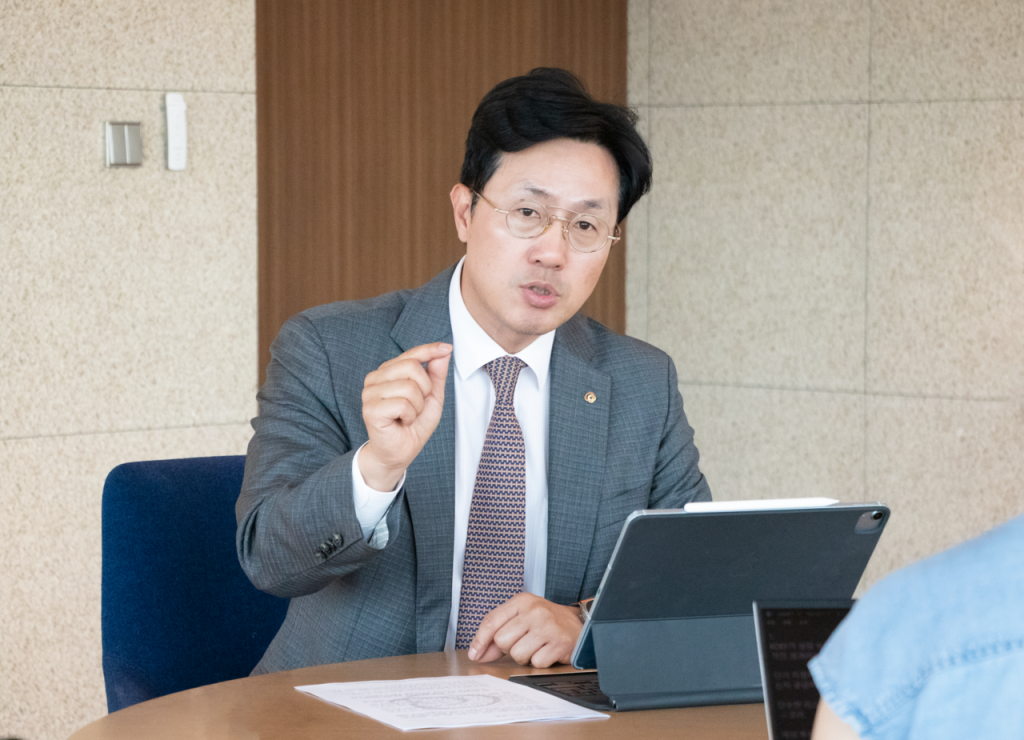
“Korea is moving beyond the long-standing Korea discount toward a genuine Korea premium,” said Choi Young-jin, chief marketing officer and executive vice president at Hanwha Asset Management, in an interview with The Korea Herald.
Choi, a key figure at Hanwha Asset Management, is renowned for leading the firm’s role as index partner in the PLUS Korea Defense Industry Index ETF (KDEF), which launched on the New York Stock Exchange in February 2025. This Korean defense industry ETF has since grown to over $200 million in assets, delivering returns exceeding 200 percent.
Hanwha’s broader strategy is built around turning Korean manufacturing into a globally investable asset class tied to long-term geopolitical and industrial shifts.
“We are not simply exporting financial products,” Choi said. “We are exporting Korea’s industrial competitiveness.”
Rather than building overseas subsidiaries, Hanwha partnered with local ETF platforms through a white-label model that relies on existing licenses and distribution networks.
“The white-label approach has been highly effective in terms of speed and efficiency,” Choi said. “We plan to continue combining Hanwha’s industrial insights with our index-design capabilities and develop products together with global partners.”
Hanwha is tailoring its expansion strategy by region. In the US, it plans to continue partnering with local ETF platforms. In Europe, Hanwha is considering investment products under the EU’s UCITS framework, which allows funds to be distributed across multiple European markets under standardized regulations. In the Middle East, it is pursuing cross-listings on exchanges such as the Abu Dhabi Securities Exchange while seeking partnerships with regional institutions.
Choi said Middle Eastern investors are showing growing interest in Korean sectors such as defense, nuclear energy, shipbuilding, and power infrastructure as Gulf economies seek to diversify beyond oil.
“The ADX listing is not simply about short-term liquidity,” he said. “It is about building a long-term pipeline connecting Middle Eastern capital with Korea’s core industries.”
Central to Hanwha Asset Management’s investment thesis is the innovative PLUS K Manufacturing Core Active ETF. This strategically designed ETF encompasses critical Korean sectors such as semiconductors, defense, nuclear energy, biotechnology CDMOs, and robotics.
The strategy also reflects Hanwha’s conviction that AI infrastructure will become one of the defining long-term investment themes.
Choi elaborated, stating, “As the AI industry expands, electricity demand will inevitably surge. The ultimate bottleneck for AI infrastructure and growth will be power and supporting infrastructure, rather than semiconductors alone.”
Choi also rejected concerns that easing tensions between Washington and Beijing could weaken Korea’s supply-chain advantage.
“The US-China rivalry is structural and long-term,” he said. “As supply chains continue shifting toward security and resilience, Korea’s manufacturing sectors are likely to see a major rerating in global markets.”
ch0221


