South Korea’s stock market opened significantly lower on Wednesday, mirroring steep losses observed on Wall Street. Investor sentiment was dampened by a sharp decline in prominent blue-chip technology shares, a faster-than-anticipated rise in US inflation, and ongoing uncertainties surrounding peace talks between the United States and Iran.
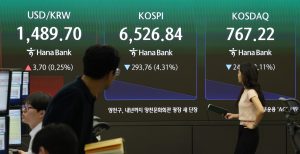
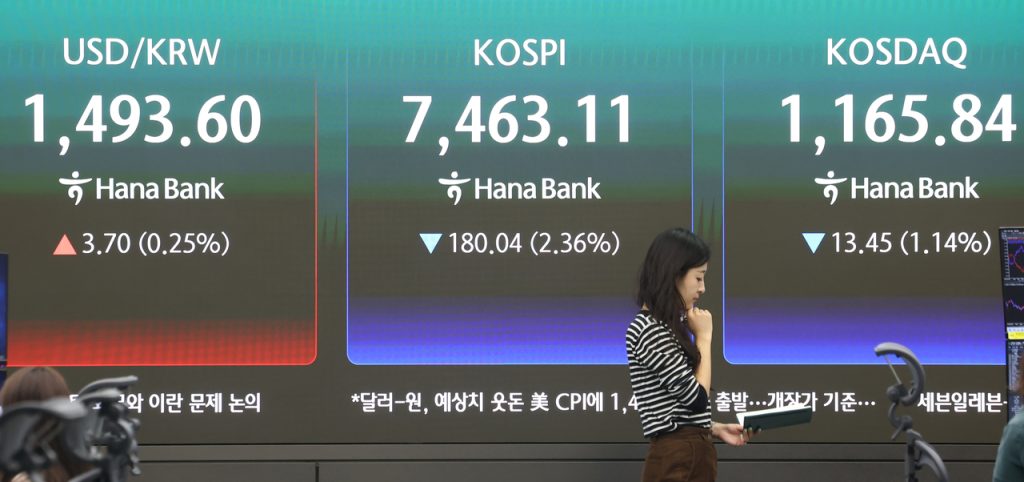
The benchmark Korea Composite Stock Price Index (KOSPI) commenced trading 1.69 percent down. Within the initial 15 minutes, the index shed 196.25 points, or 2.57 percent, settling at 7,446.9, signaling a broad market correction.
This market downturn followed the KOSPI’s robust five-day winning streak, which concluded on Tuesday. The index had previously climbed to an intraday high of 7,999.67, propelled by a record-breaking rally led by large-cap tech shares, including industry giants Samsung Electronics and SK hynix, before investors moved to secure profits.
Overnight losses in the technology sector on Wall Street further eroded investors’ risk appetite, rekindling concerns regarding the long-term sustainability of the substantial investments being funneled into the artificial intelligence (AI) sector.
On the preceding trading day, the tech-heavy Nasdaq Composite index closed 0.71 percent lower, and the S&P 500 fell 0.16 percent, even as the Dow Jones Industrial Average managed a modest gain of 0.11 percent.
Individual tech giants experienced considerable declines, with Intel plunging 6.82 percent, AMD dropping 2.29 percent, Micron dipping 3.61 percent, and SanDisk sliding 6.17 percent.
Adding to the market’s unease, investors remained preoccupied with the acceleration of US inflation in April. This rise was primarily attributed to soaring oil prices, exacerbated by the geopolitical tensions arising from the US-Israeli conflict with Iran.
Domestically, market participants also focused on the potential for a general strike by unionized workers at Samsung Electronics. This followed the breakdown of government-led mediation talks held overnight, as the company’s labor union and management failed to reconcile their differences over performance-based bonuses.
In light of these developments, market leader Samsung Electronics saw its shares slide by 5.29 percent, while its formidable chipmaking rival SK hynix also experienced a 2.18 percent decline.
AI investment specialist SK Square also felt the pressure, with its shares falling 2.75 percent.
In the crucial battery sector, leading manufacturer LG Energy Solution contracted 2.26 percent, and its key competitor Samsung SDI pulled back 3.34 percent.
Industrial stocks also faced headwinds, as power plant manufacturer Doosan Enerbility dropped 4.94 percent, and trading firm Samsung C&T plummeted a significant 7.36 percent.
The performance of electrical and automotive shares presented a mixed picture amidst the broader market turbulence.
While Samsung Electro-Mechanics achieved a gain of 1.77 percent, other prominent electrical companies like HD Hyundai Electric and LS Electric recorded respective declines of 4.89 percent and 5.02 percent.
Automotive giants showed varied results: Hyundai Motor advanced 1.08 percent, and its auto parts-making affiliate Hyundai Mobis jumped 4.56 percent, however, Kia registered a 1.49 percent loss.