
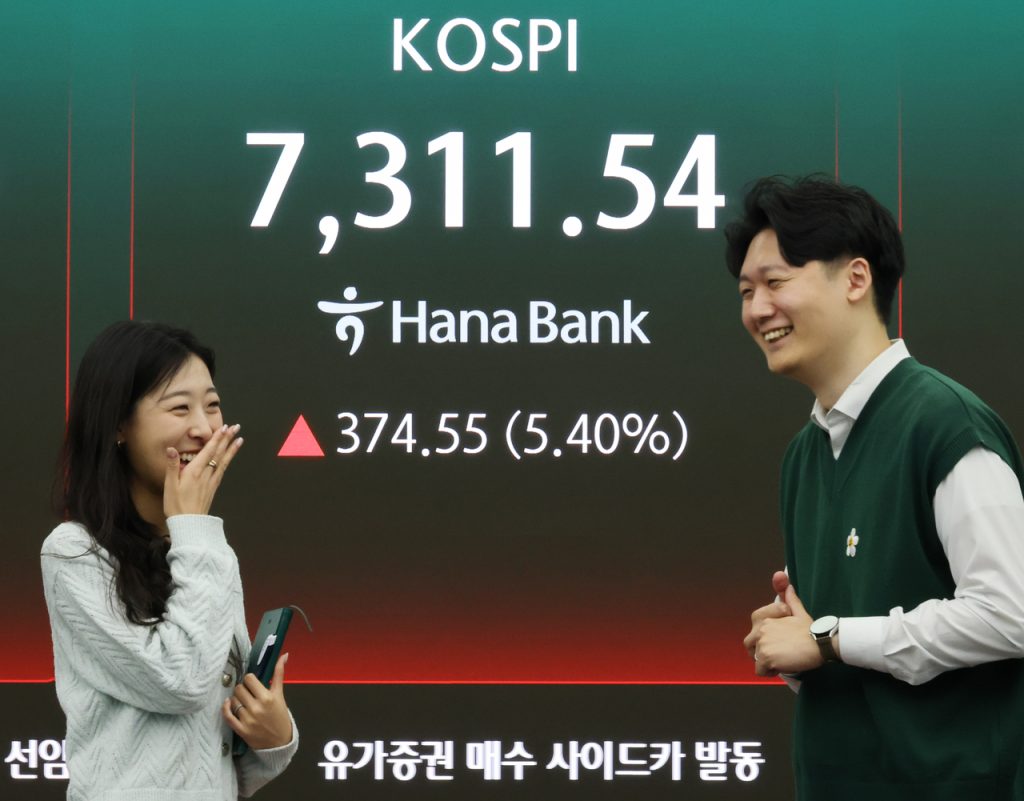
South Korean Kospi Market Cap Surges Past $4 Trillion, Propelled by Chip Sector Boom
South Korea’s benchmark Kospi index achieved a historic milestone on Wednesday, breaking past the 7,000 and then the 7,400-point threshold for the first time. This unprecedented surge, driven predominantly by the robust performance of semiconductor stocks, propelled the market’s total capitalization beyond an astounding 6 quadrillion won (approximately $4.12 trillion USD).
The bellwether index commenced trading at 7,093.01, marking a 2.25 percent increase from Monday’s closing and immediately eclipsing its prior record of 6,937 set earlier in the week.
Momentum intensified throughout the trading session, pushing the Kospi above 7,400 in afternoon trading. The index climbed as high as 7,426.6, reflecting an impressive gain of over 7 percent from the preceding trading day.
The intensity of the rally was significant enough to trigger a buy-side sidecar just six minutes after market open. This occurred after Kospi 200 futures jumped more than 5 percent, leading to a temporary five-minute halt on program sell orders. It marked the eighth buy-side sidecar implemented this year, highlighting the extraordinary market activity.
As of Wednesday’s intraday peak, the Kospi has now soared by more than 75 percent from its 2025 closing value of 4,214 points. This remarkable ascent also positioned the Korean benchmark above the S&P 500’s latest close of 7,259.22, following the US gauge’s 0.8 percent rise to a new record on Tuesday.
Semiconductor stocks were the primary catalyst for this advance, transforming the Kospi’s rally into a concentrated surge spearheaded by its most prominent companies. Samsung Electronics experienced a significant jump, rising as much as 16 percent to a record 270,000 won. This propelled its market value past 1.5 quadrillion won for the first time, making it only the second Asian chipmaker, after TSMC, to surpass the $1 trillion valuation mark.
SK hynix further extended its record-breaking run from Monday, climbing by as much as 11 percent to exceed 1.6 million won. Its market capitalization, which initially topped 1 quadrillion won earlier in the week, continued its ascent to over 1.1 quadrillion won. This places SK hynix as the 16th largest listed company globally by market value, with Samsung Electronics ranking 11th.
The robust rally also extended its influence to other related heavyweight stocks. Samsung Electronics preferred shares, which rank as the third-largest Kospi stock by market value, gained over 10 percent to reach an intraday record of 187,500 won. SK Square, the largest shareholder of SK hynix and the fourth-largest Kospi stock, surged by an impressive 26 percent to 1,149,000 won.
Collectively, these four major chip-linked stocks accounted for nearly half of the Kospi’s overall market value. Their combined strength was instrumental in pushing the benchmark index’s total capitalization beyond 6 quadrillion won for the first time in history.
Foreign investors played a crucial role in powering this rally, aggressively acquiring a net 2.1 trillion won of Kospi shares by 2:30 p.m. In contrast, institutional investors remained net sellers, offloading a net 1 trillion won. Retail investors saw fluctuating activity throughout the session, eventually becoming net sellers of approximately 800 billion won by mid-afternoon.
Market analysts interpret the Kospi’s record-setting rally as a confluence of a global chip upcycle narrative and a highly concentrated movement within Seoul’s market. Gains have been overwhelmingly driven by the performance of semiconductor heavyweights.
Kang Jin-hyuk, an analyst at Shinhan Securities, noted that the Kospi’s “melt-up continued, primarily led by semiconductors,” with easing Middle East tensions and sustained foreign inflows fueling the momentum. He highlighted that memory chip shares surged in tandem with the S&P 500 and Nasdaq extending their record runs. However, he also pointed out that the rally in Seoul remained narrow, with 680 decliners outnumbering 190 gainers.
IM Securities analyst Park Sang-hyun explained that the current semiconductor upcycle is fundamentally altering how Korea’s market absorbs macroeconomic shocks, including rising oil prices. “The biggest reason the Kospi can show a strong rally, unlike in previous high-oil periods, is that the semiconductor trade surplus is far exceeding the oil deficit,” the analyst stated. He added that the artificial intelligence (AI)-led chip cycle is providing Korea’s economy and stock market with significantly stronger momentum than during past episodes of elevated energy prices.
Conversely, the Kosdaq, Seoul’s secondary index, did not participate in the widespread rally, declining by about 1 percent to hover near 1,200 points, even as the Kospi soared.
The Korean won experienced a brief weakening at the open, starting 3 won lower against the US dollar at 1,465.8. However, it strengthened as trading progressed, stabilizing around 1,457 per dollar by 2:30 p.m.
jwc


