Apple Executives Tour Samsung’s Texas Fab as TSMC Strains to Meet AI Chip Demand
Apple is reportedly considering Samsung Electronics and Intel as potential foundry partners for its core device processors. This marks Apple’s most significant attempt in over a decade to diversify production away from Taiwan Semiconductor Manufacturing Co. (TSMC), which currently dominates chip supply for iPhones and Macs.
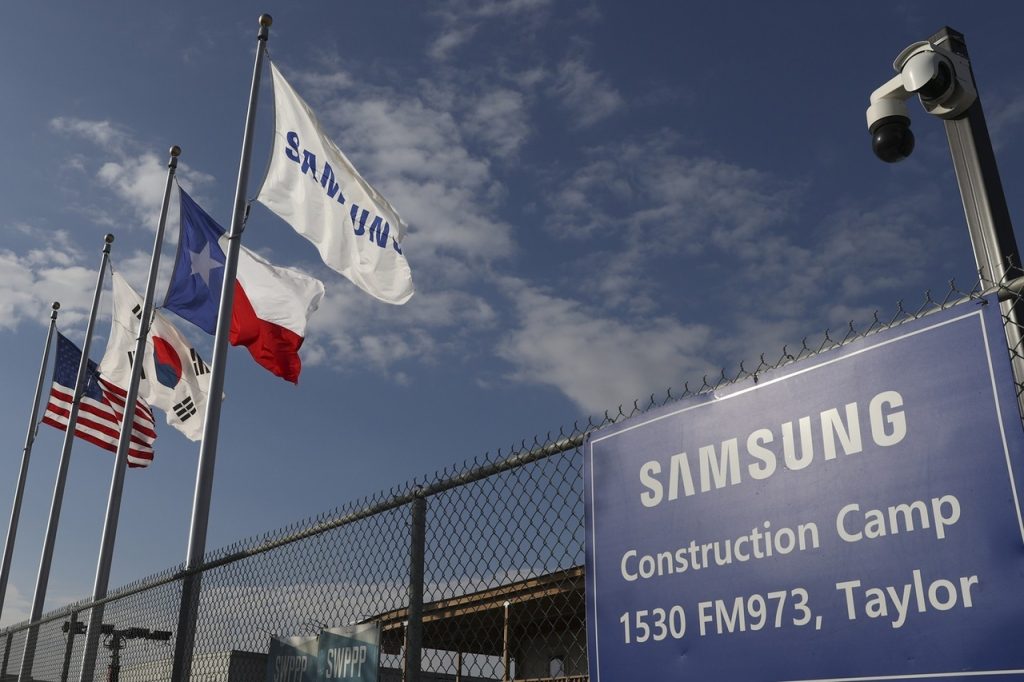
A recent Bloomberg report on Tuesday confirmed Apple’s early-stage discussions with Intel regarding its chip manufacturing capabilities. Concurrently, Apple executives have toured Samsung’s new foundry facility under construction in Taylor, Texas, which is slated to commence operations in the latter half of this year.
Sources familiar with the deliberations indicate that no definitive orders have been placed yet, and engagements with both potential suppliers are still in their preliminary stages.
During Apple’s recent earnings call, CEO Tim Cook informed investors about a shortage of advanced processors vital for iPhones and Macs, acknowledging this supply constraint is impacting the company’s growth.
Cook elaborated, stating, “We have less flexibility in the supply chain than we normally would.” He further clarified that “the primary constraint is the availability of the advanced nodes our SoCs (systems on chip) are produced on, not memory,” predicting several months would be required to achieve a supply-demand equilibrium.
This supply squeeze is primarily driven by the escalating demand for artificial intelligence (AI) chips. Companies like Nvidia and AMD, among other leading chip designers, have significantly absorbed TSMC’s cutting-edge production capacity. This intense demand has left even Apple, a prominent global silicon purchaser, struggling to secure its desired volume. While Apple is already diversifying some production to TSMC’s Arizona facility, expecting approximately 100 million chips from there this year, this volume only represents a small fraction of its extensive annual device shipments.
For Samsung, securing an Apple processor contract would serve as a high-profile validation for its foundry division, which currently holds under 10 percent of the global market and has historically lagged TSMC in production yield. The Taylor fab, bolstered by a significant 23 trillion won ($15.8 billion) long-term supply agreement with Tesla signed in July last year, represents Samsung’s most substantial US foundry investment.
Any potential agreement, however, is anticipated to commence on a smaller scale. An industry insider noted, “Apple is unlikely to immediately entrust Samsung with the complete main SoC production for its flagship A-series and M-series chips.” Instead, a “phased dual-sourcing strategy appears more plausible, where chips for older or mid-tier iPhones and iPads might first be tested at Samsung’s Texas foundry.”
The last instance of both companies sharing Apple’s main processor production was in 2015, when the A9 chip for the iPhone 6s was manufactured across Samsung’s 14-nanometer and TSMC’s 16-nanometer lines. Discrepancies in battery life under intensive usage subsequently sparked the “chipgate” controversy, leading Apple to consolidate its processor production solely with TSMC from the A10 Fusion onwards.
mjh