
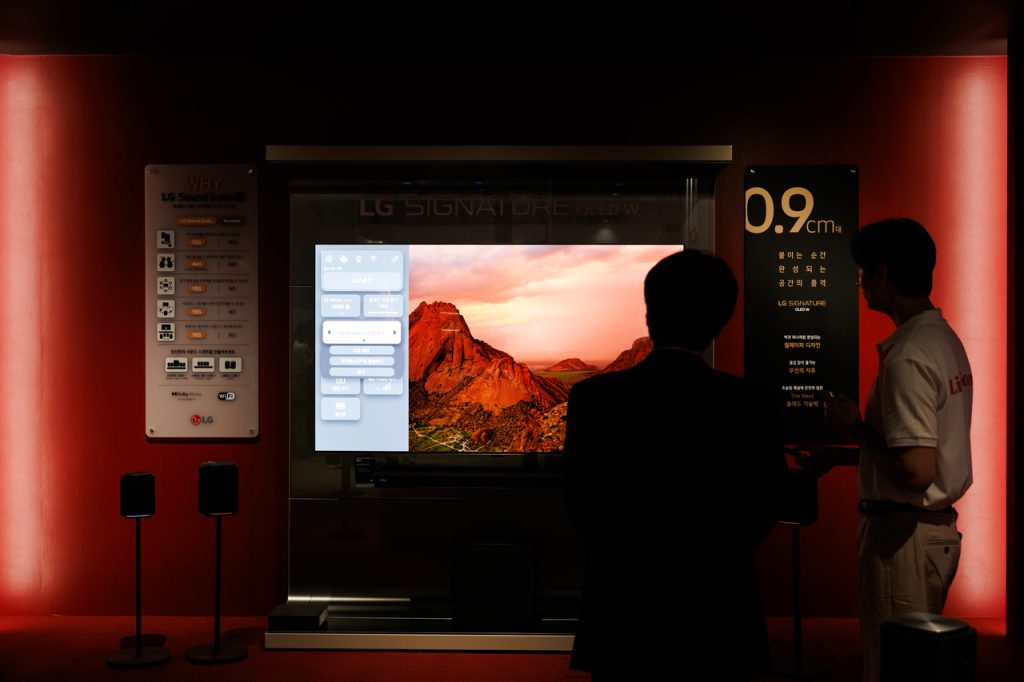
South Korea experienced a significant rebound in its global OLED market share in 2025, marking the first increase in nearly a decade. This surge highlights how domestic display manufacturers are solidifying their leadership in advanced, high-end OLED technologies, despite intense competition from Chinese producers.
According to the Korea Display Industry Association, leveraging data from industry tracker Omdia, Korea’s OLED market share reached 68.7 percent in 2025. This represents a robust 1.5 percentage point increase from the previous year, underscoring a pivotal shift in the global display landscape.
This growth is particularly noteworthy as it reverses a steady decline seen since 2015, the year China first entered the OLED market. While South Korea has been a dominant force in the OLED sector since pioneering mass production in 2007, its market share had faced increasing pressure from aggressively expanding Chinese panel makers in recent years.
Remarkably, this market share gain occurred against the backdrop of an overall contraction in the global OLED market. Total OLED sales worldwide fell to $36 billion in 2025 due to softer demand. However, Korean firms successfully bucked this trend, achieving superior performance driven by the escalating adoption of OLED panels in advanced IT devices, premium automotive displays, and a surge in demand for low-temperature polycrystalline oxide (LTPO) panels.
Industry experts attribute these impressive gains to South Korea’s unwavering technological leadership. In the mobile display segment, Korean companies have pioneered cutting-edge color-on-encapsulation technologies. For large-screen televisions, they are spearheading the transition to innovative Primary RGB tandem structures, widely recognized as fourth-generation OLED technology.
The strategic expansion of OLED technology into higher-value applications has also been crucial in broadening market demand. Beyond traditional smartphones and televisions, OLED adoption is rapidly accelerating across various premium segments, including high-performance gaming monitors, flexible rollable laptops, and sophisticated automotive displays. This diversification is significantly strengthening the market position of Korean manufacturers.
Meanwhile, Chinese competitors have maintained rapid growth within their domestic market, primarily by focusing on the mass production of more cost-effective OLED panels. Nevertheless, industry analysts suggest that Chinese firms continue to face substantial hurdles in effectively penetrating the high-end OLED segment, primarily due to a persistent and notable technology gap with their Korean counterparts.
Despite the remarkable achievements in OLED, South Korea’s overall display market share saw a slight decrease to 31.7 percent in 2025. This decline, however, reflects a strategic, industry-wide pivot away from lower-margin LCD production, prioritizing higher-value, more profitable OLED product development and manufacturing.
The broader display market is projected to continue experiencing significant pressures. Industry forecasts anticipate a 4.6 percent contraction, with global sales expected to reach $128.8 billion in 2026. This challenging outlook is largely influenced by ongoing geopolitical tensions in the Middle East and rising semiconductor production costs.
“The recent uptick in market share is a clear testament to the sustained investment in next-generation technologies and the relentless innovation demonstrated by Korean companies, even as China rapidly advances its capabilities,” stated Lee Seung-woo, vice chairman of the Korea Display Industry Association.
Looking ahead, the long-term outlook for Korean OLED firms remains distinctly positive. With groundbreaking new IT products—such as advanced foldable smartphones and laptops—scheduled for release in 2026, alongside the world’s first mass production of 8.6-generation OLED panels, industry officials are confident that Korean manufacturers will further solidify their supply advantage through enhanced cost competitiveness and superior advanced manufacturing capabilities.
stlee0329


