Goldman Sachs and JPMorgan Eye Kospi Soaring to 8,000+ Amid AI-Driven Memory Boom and Easing Tensions
South Korea’s benchmark Kospi index has reached a new intraday peak, surpassing its previous record set just prior to the recent geopolitical flare-up. This robust performance is driven by a combination of easing global tensions, a surge in foreign investment, and an optimistic outlook from leading investment banks on the burgeoning AI-driven memory chip sector.
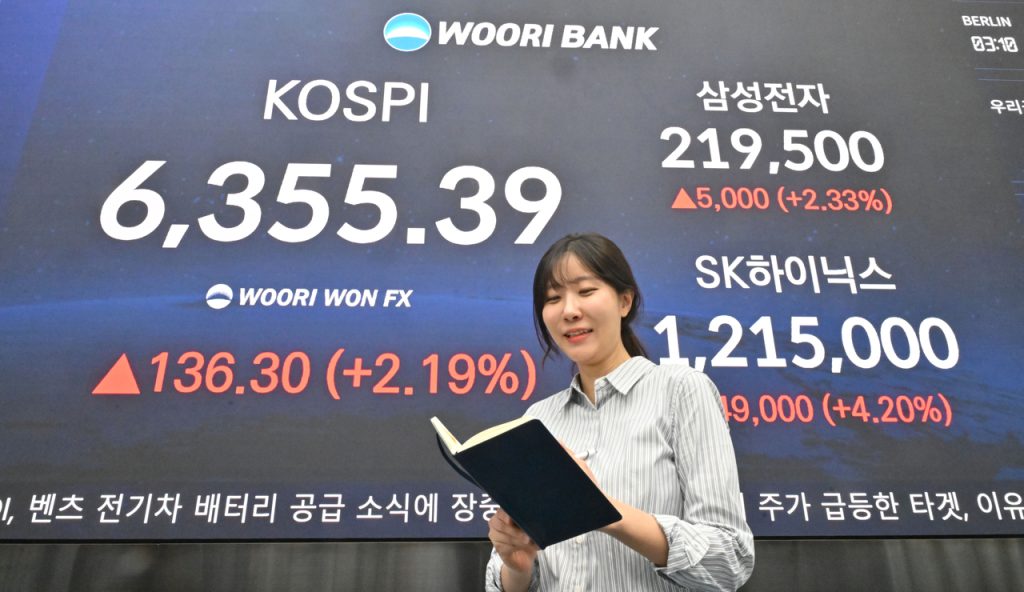
On Tuesday, the Kospi began trading strong, crossing the 6,300 threshold at 6,302.54, marking a 1.34 percent increase from the preceding day. The index quickly broke its former intraday high of 6,347.41 and continued its upward trajectory, peaking at 6,370 points during the session. By 2 p.m., the Kospi maintained its impressive gains, standing at 6,364.82, up 2.34 percent.
This significant rally was predominantly fueled by foreign investors, who net bought shares totaling 983.3 billion won ($670 million). Institutional investors also contributed substantially, adding 594.4 billion won worth of equities. In contrast, retail investors were net sellers, offloading 1.47 trillion won.
Leading the charge were South Korea’s large-cap stocks, particularly in the semiconductor industry. Samsung Electronics saw a rise of 1.75 percent to 218,250 won, while chip giant SK hynix advanced 4.46 percent to 1.21 million won.
Shares of SK hynix, a key player in the AI memory market, notably surpassed the 1.2 million won mark, touching an intraday high of 1.22 million won. This milestone comes ahead of its highly anticipated first-quarter earnings release on Thursday, where the company is projected to announce a record operating profit exceeding 40 trillion won, underscoring the strong demand for AI-related semiconductors.
Beyond the tech sector, other major Korean companies also posted solid gains. Hyundai Motor increased by 2.85 percent to 542,000 won, and LG Energy Solution surged an impressive 10.02 percent to 472,000 won.
The current upward trend follows a period of significant volatility. Prior to recent Middle East tensions, the Kospi had been on a strong rally, breaking past 6,300 in late February. However, the subsequent geopolitical uncertainty led the index into a downturn, falling to 5,042.99 on March 31, triggering trading curbs as risk-averse sentiment dominated the market.
Since April, the South Korean market has demonstrated a remarkable recovery. Improved risk appetite, buoyed by hopes of de-escalating geopolitical tensions, has propelled the index back upwards.
Amid this strong rebound, major foreign investment banks are showing increased confidence in the Korean benchmark. Goldman Sachs, on Monday, significantly raised its 12-month Kospi target from 7,000 to 8,000. The firm cited robust performance driven by upward earnings revisions, specifically noting the strong demand in AI-related semiconductors. Despite this optimism, Goldman Sachs highlighted that Korean equities continue to trade at a discount compared to their global and regional counterparts.
Similarly, JPMorgan also expressed a bullish outlook, raising its Kospi target to an ambitious 8,500 from its earlier forecast of 7,500 in early February. The bank concurrently increased its base-case target to 7,000 from 6,000.
A JPMorgan report emphasized the enduring strength of the Korean market’s fundamentals, stating, “With key fundamentals of the Korean market remaining on track for now, this opens up space for the Kospi to build further on recent momentum.” The report specifically pointed to favorable memory cycle conditions, ongoing governance reforms, and strong thematic growth as key drivers.
While chip stocks like SK hynix and Samsung Electronics have been instrumental in leading the current Kospi rally, the JPMorgan report offered a cautionary note. It suggested that traditional investment rules from previous market cycles might not apply directly to the unique gains seen in memory stocks today.
“Given the uniqueness of this cycle, applying preemptive rules-of-thumb from previous cycles should be done with care, and it may be preferable to be too late than too early in exiting positions here,” the report advised, suggesting a cautious and adaptive investment strategy in the current environment.
silverstar