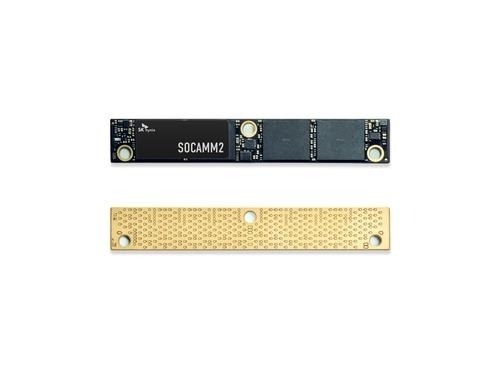
SK hynix Inc., a global leader in memory semiconductors, announced Monday the commencement of mass production for its groundbreaking next-generation memory module specifically engineered for advanced artificial intelligence (AI) servers. This strategic move aims to significantly solidify SK hynix’s dominant position within the rapidly expanding AI infrastructure market, powering the future of AI computing.
Central to this innovation is the 192GB SOCAMM2 module, meticulously developed using SK hynix’s cutting-edge sixth-generation 10-nanometer-class LPDDR5X low-power DRAM technology. This high-performance module is particularly optimized for seamless integration with Nvidia Corp.’s revolutionary Vera Rubin AI platform, ensuring unparalleled compatibility and efficiency for next-generation AI workloads.
The SOCAMM2 module represents a paradigm shift, ingeniously adapting mobile-oriented low-power memory solutions for demanding server environments. It is meticulously designed to function as the primary memory solution for highly sophisticated AI servers, offering a unique blend of high density and power efficiency crucial for modern AI deployments.
Highlighting its superior capabilities, SK hynix confirms that this innovative product delivers more than double the bandwidth and achieves over 75 percent improved power efficiency when compared to conventional RDIMMs (registered dual in-line memory modules). These substantial advancements make the SOCAMM2 module an ideal choice for the most rigorous and high-performance AI operations, from complex neural network training to real-time inference.
As a pivotal development from the South Korean semiconductor powerhouse, this new memory solution is poised to effectively address persistent memory bottlenecks commonly encountered in the training and inference phases of colossal large language models (LLMs) featuring hundreds of billions of parameters. By overcoming these critical limitations, the SK hynix SOCAMM2 module promises to dramatically enhance overall system performance and accelerate the evolution of artificial intelligence technologies.