
Korean Convenience Stores Innovate with Food, Sports, and AI for Future Growth
Since their advent in South Korea during the late 1980s, convenience stores have long thrived on the principle that an expanding network of locations naturally attracts a larger customer base.
However, this foundational premise appears to have reached its limits, evidenced by a notable decline in South Korean convenience store numbers, falling from 54,852 in 2024 to 53,266 last year. Concurrently, sales growth among the four leading chains — CU, GS25, Emart24, and 7-Eleven — has decelerated significantly, dropping from 8 percent in 2023 to 3.9 percent in 2024, and further to a mere 0.1 percent in 2025.
In response to these market dynamics, the Korean convenience store industry is strategically pivoting from a focus on sheer scale to a more specialized and focused approach.
An industry official affirmed, “The era of competing solely on store count has concluded.” They elaborated that the subsequent phase of competition within the South Korean retail landscape will increasingly revolve around the unique purpose and experience embedded within each convenience store location.
Food has historically served as a core attraction for convenience stores, and with the global rise of K-food and Korean cuisine, several chains are now proactively bringing these distinct flavors and experiences to the forefront of their retail strategies.
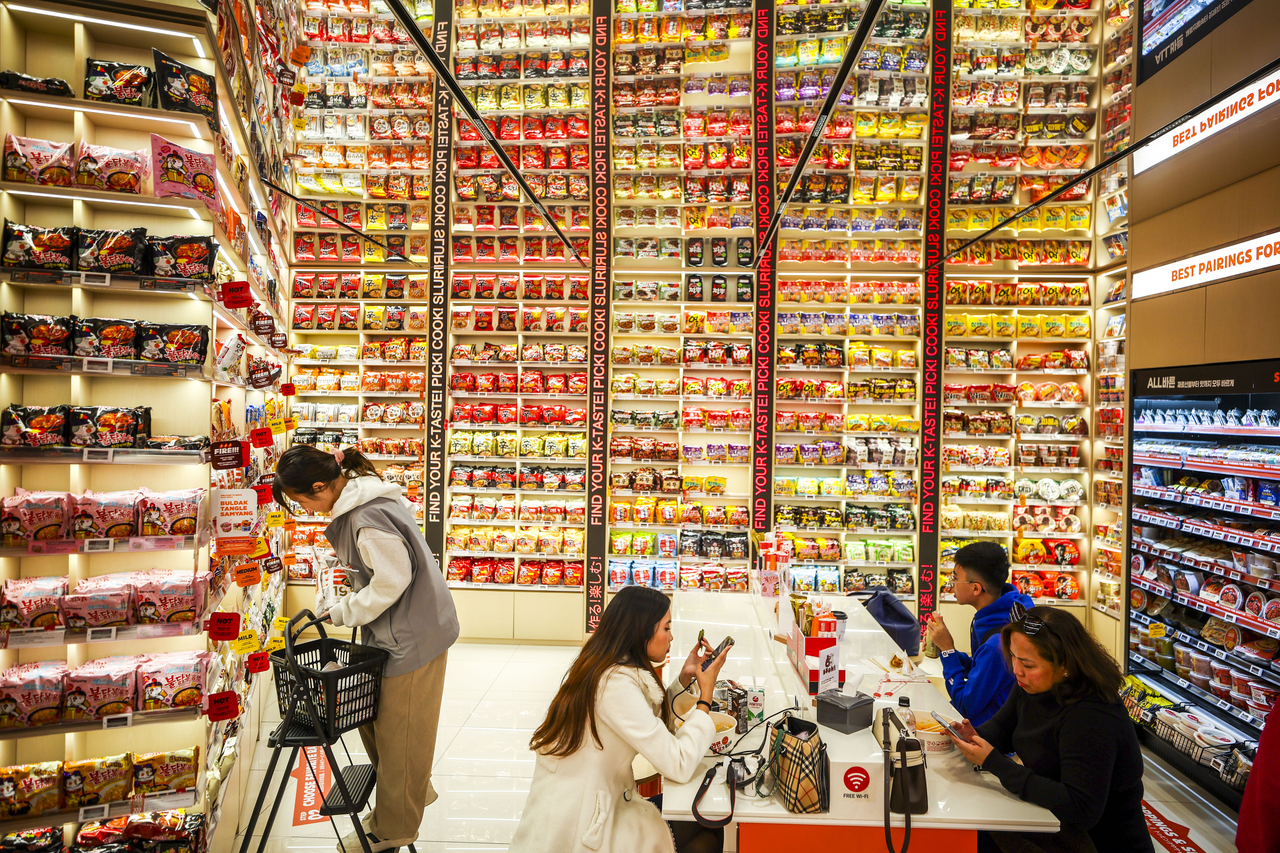
Just last month, Emart24 launched its innovative “K-Food Lab” in Myeong-dong, Seoul, dedicating this two-story outlet to the immersive experience of ramyeon and Korean food culture. This unique concept store is designed as a curated dive into Korean culinary traditions, with a pronounced emphasis on noodles.
The ground floor of the K-Food Lab features a diverse array of K-beauty products, official K-pop merchandise, and popular K-food gift sets. Ascending to the upper level reveals the store’s most captivating attraction: a magnificent, floor-to-ceiling display wall, standing 2.8 meters high and showcasing an astonishing 170 varieties of noodles.
This comprehensive selection includes offerings from major domestic manufacturers, regional Korean specialties, and international imports from countries like Japan and Indonesia. For ease of navigation, the noodles are meticulously organized by spice level across four distinct color-coded tiers, with clear signage provided in Korean, English, Chinese, and Japanese to cater to a global clientele.
Emart24 emphasized that its curated selection predominantly features packaged ramyeon rather than cup varieties, aiming to deliver a more authentic Korean culinary experience. A company official explained, “We sought to reflect how foreign visitors aspire to prepare ramyeon, mirroring the methods they’ve witnessed Koreans using in popular K-dramas.”
Shifting focus from the bustling, tourist-centric streets of Myeong-dong, the trendy neighborhood of Seongsu-dong attracts a more style- and trend-conscious demographic. Here, BGF Retail, the parent company of the CU convenience store chain, is making a strategic bet on a sweeter market segment.
Opened in February, the innovative CU Seongsu Dessert Park offers a dessert selection approximately 30 percent more extensive than a typical CU outlet. This unique store expertly combines the chain’s consistently top-selling dessert items with a dedicated, interactive space where customers can creatively assemble their own personalized dessert creations.
Remarkably, within just two months of its grand opening, overseas payment methods constituted 32 percent of the store’s total sales, an impressive figure more than 15 times the national average of 2 percent for convenience stores in South Korea.
A CU official commented, “As global interest in Korean desserts continues to surge, this new concept store highlights CU’s exceptional capabilities in product development and its agility in responding to evolving market trends.” They further announced, “We intend to continuously refine our innovative dessert offerings and significantly expand our export operations to promising international markets, including Hawaii, Mongolia, and Malaysia.”
Convenience Stores Embrace Sports Culture: Catering to Active Lifestyles and Fan Engagement
Beyond culinary innovations, some convenience store chains are boldly departing from their traditional food-centric identities, opting instead to tailor their store concepts to appeal to activity-driven consumers and specific lifestyle niches.
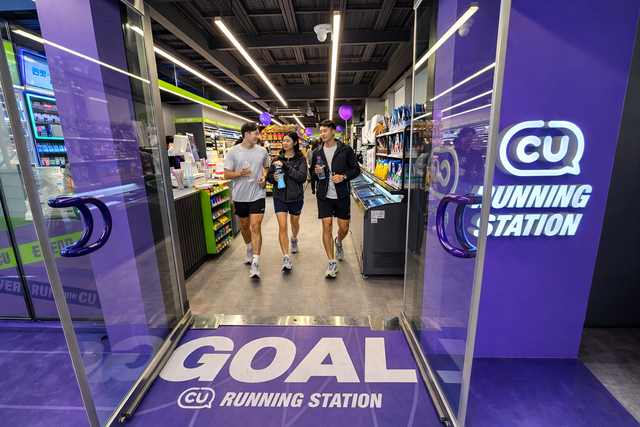
In March, BGF Retail strategically capitalized on the burgeoning running boom that is currently sweeping across Korea’s urban parks and recreational areas.
The “Running Station” at Yeouido Hangang Park, situated along the iconic Han River, is uniquely outfitted. Beyond a standard assortment of snacks and refreshments, it offers essential amenities for active runners, including secure lockers, dedicated changing rooms, and well-equipped powder rooms.
Within this specialized CU outlet, a dedicated zone prominently features a comprehensive range of running-related products, spanning from energy supplements and protective gear to essential post-run care items. Complementing this, the store hosts a rotating sports brand pop-up and offers a unique loyalty program that allows runners to convert their accumulated mileage into valuable store credit.
As the popularity of running continues to accelerate, BGF Retail plans to strategically expand this innovative concept across 18 additional sites along the Han River, thereby establishing a robust network of dedicated running hubs along Seoul’s most frequented outdoor routes.
While CU is focused on establishing specialized stations for active runners, its competitor, GS25, is strategically developing immersive, stadium-like spaces designed specifically for passionate sports fans.
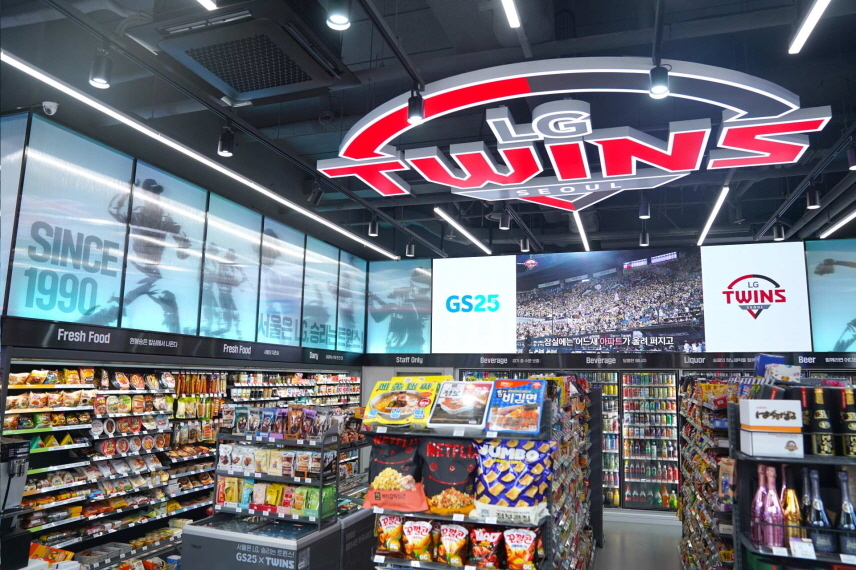
Catering to enthusiastic baseball fans, GS25 successfully operates two flagship convenience stores in Daejeon, vibrantly themed around the Hanwha Eagles. Additionally, a prime location near Seoul’s iconic Jamsil Baseball Stadium has been creatively transformed into an official outpost for the beloved LG Twins.
This proven formula — incorporating vibrant team colors on the walls, displaying authentic memorabilia on the shelves, and screening exciting game highlights — has proven highly replicable. Consequently, GS25 is now successfully applying this engaging model across various professional football clubs, including Ulsan HD FC and FC Seoul.
A GS Retail official proudly stated, “GS25 has consistently led the way in innovative baseball marketing, pioneering the industry’s first team-themed convenience stores.” They further emphasized the company’s intention to build upon this strong momentum as public interest in professional sports continues its significant growth across South Korea.
Despite the undeniable success and strategic importance of these specialty concept stores, a more profound and transformative competition is likely unfolding within data centers. Both BGF Retail and GS Retail are strategically leveraging advanced artificial intelligence (AI) to meticulously analyze insights and precisely shape the future of their retail operations.
Industry experts underscore the critical role of AI for convenience store chains, highlighting its essential capacity to convert complex data-driven decisions into tangible, measurable performance improvements at the operational level.
BGF Retail is actively pursuing sustained growth and operational excellence through a comprehensive, company-wide integration of AI technologies.
At a shareholder meeting in March, BGF Retail CEO Min Seung-bae articulated the company’s ambitious vision: “We are committed to embedding AI capabilities across every facet of our operations, encompassing marketing, logistics, and supply chain management. Concurrently, we will launch extensive company-wide research and development initiatives to practically apply these advancements and consistently deliver tangible, impactful results.”
A notable example of this innovative approach is a new AI-powered in-store kiosk designed to analyze a customer’s personal color profile. This technology then intelligently recommends suitable cosmetic shades and facilitates the creation of customized beauty products, offering a highly personalized shopping experience.
Meanwhile, GS Retail is strategically anchoring its advanced AI strategy around comprehensive behavioral data analysis, aiming to significantly sharpen decision-making processes across its expansive operations.
At their shareholder meeting in March, GS Retail CEO Hur Suh-hong articulated their strategic direction: “Our objective is to establish a virtuous cycle rooted in authentic customer behavior data. Simultaneously, we are committed to significantly expanding our investment in cutting-edge AI and various digital tools to robustly strengthen our overall operational competitiveness and market position.”
Currently, the company is actively integrating advanced AI-driven systems into various aspects of its store management, notably including automated ordering solutions for optimizing food item inventory and freshness.


