
South Korea’s Central Bank Pivots to Monetary Tightening, Signals Further Rate Hikes Ahead to Combat Inflation
In a significant policy shift, the Bank of Korea (BOK) increased its benchmark interest rate for the first time in over three years on Thursday. This pivotal move by South Korea’s central bank comes as robust economic growth provides policymakers the necessary space to tackle persistent inflation pressures head-on.
The BOK’s monetary policy board unanimously approved a 0.25 percentage point increase in the benchmark rate, bringing it to 2.75 percent. This decision marks the end of a year-long pause in the central bank’s monetary policy cycle, signaling a decisive shift towards tighter financial conditions.
This latest BOK rate hike is its first since January 2023, a period when borrowing costs were also raised to curb surging inflation. That previous tightening followed the massive liquidity expansion and ultra-loose monetary policies implemented during the Covid-19 pandemic era.
Mirroring the previous tightening cycle, the Bank of Korea’s hawkish stance directly addresses mounting inflationary pressures. Surging global oil prices, exacerbated by the ongoing conflict involving Iran, are significantly contributing to the rise in domestic consumer prices across South Korea.
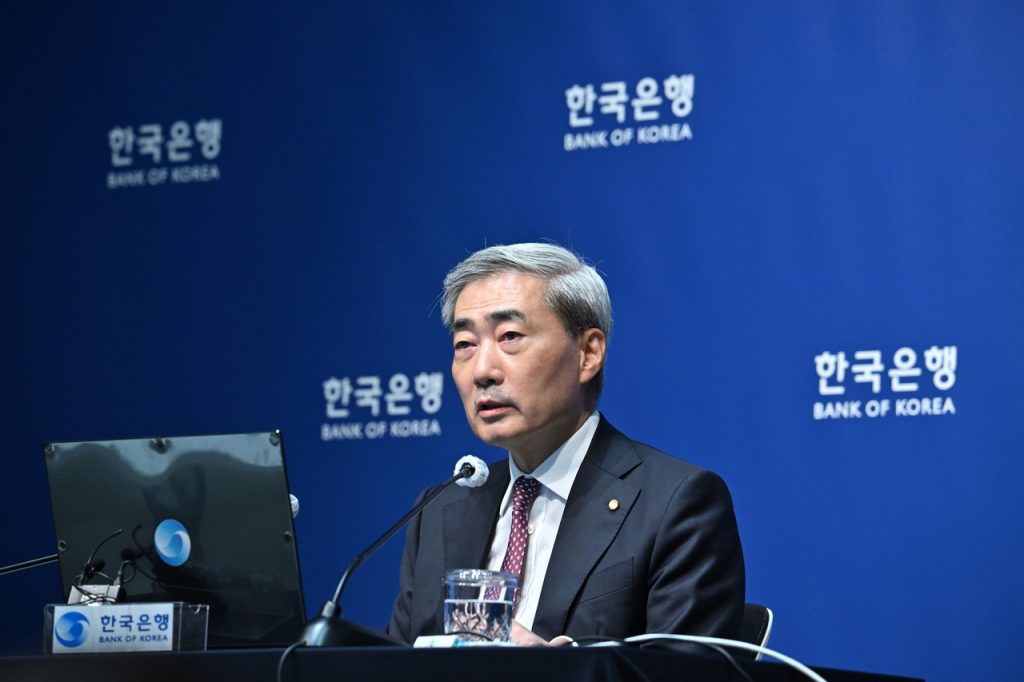
Speaking at a press briefing following the policy meeting, BOK Governor Shin Hyun-song stated, “Inflation is expected to remain above the target level for a considerable period.” He explicitly signaled that more interest rate hikes could be implemented in the near term to bring price stability.
Governor Shin further emphasized the central bank’s commitment, stating, “We will continue our policy response until we are confident that inflation is converging sustainably toward the target,” referencing the Bank of Korea’s crucial 2 percent inflation goal for the South Korean economy.
This steady acceleration in South Korea’s price growth highlights persistent inflationary pressures. Year-on-year inflation has risen significantly, from 2.2 percent in March to 2.6 percent in April, then exceeding the 3 percent mark to reach 3.1 percent in May and 3.2 percent in June. This 3.2 percent increase represents the fastest pace of inflation recorded since December 2023, underscoring the urgency of the BOK’s actions.
“Regarding future policy moves, Governor Shin clarified that “The pace and extent of further tightening will be determined based on incoming data, including second-quarter GDP figures,” though he refrained from specifying a timeline for the next potential interest rate hike.
Optimism surrounding the sustained semiconductor-led boom has also helped to alleviate concerns that higher interest rates might adversely impact South Korea’s overall economic growth trajectory.
Governor Shin expressed confidence in the nation’s economic resilience, stating, “The Korean economy is expected to maintain solid growth, with exports and investment continuing to post robust gains on the back of the semiconductor upcycle. Additionally, private consumption is gaining strength as household income conditions improve.”
Despite the central bank’s earlier projection in May of 2.6 percent economic expansion for this year, Governor Shin now forecasts that actual growth is likely to surpass this estimate. Corroborating this positive outlook, the Finance Ministry recently revised its 2026 growth forecast upward from 2.6 percent to 3 percent for the South Korean economy.
Governor Shin directly addressed the earlier projection, asserting, “Based on current assessments, the 2.6 percent forecast is too low.” He further indicated, “It will likely be revised up by a significant margin in August,” reinforcing the optimistic economic outlook.
This significant shift in South Korea’s monetary policy stance also occurs against a backdrop of the Korean won’s prolonged weakness when compared to the US dollar, often referred to as the greenback.
Crucially, this latest BOK rate hike has narrowed the interest rate differential between South Korea’s benchmark rate and the US Federal Reserve’s policy rate to a 1 percentage point gap. This marks the first instance in over three years that this significant differential has reached such a level, influencing capital flows and currency stability.
Although the Korean won has recently strengthened in trading sessions, moving below the psychologically significant 1,500-won-per-dollar threshold due to a decisive shift in the Federal Reserve’s rate outlook, the persistent interest rate differential continues to exert structural downward pressure on the Korean currency, posing a challenge for policymakers.
Looking ahead, market analysts widely anticipate that the Bank of Korea will likely maintain its benchmark interest rate unchanged in August. This pause would allow policymakers crucial time to thoroughly assess the full impact of Thursday’s rate increase and evaluate incoming economic data before potentially delivering another hike in October.
Lim Jae-kyun, an analyst at KB Securities, supported this view, stating, “We continue to expect the BOK’s next rate hike in October rather than a back-to-back move in August.” He elaborated, “An August hike would require clearer evidence that higher oil prices are feeding into broader inflation across the economy, impacting wages, services prices, and inflation expectations more broadly.”
Echoing this sentiment, Kim Myoung-sil, an analyst at IM Securities, suggested that the Bank of Korea is likely to reassess both the inflation and growth outlook within its updated August forecasts. This comprehensive review would precede any decision to raise the benchmark rate again in October, ensuring a data-driven approach to South Korea’s monetary policy.
silverstar


