Global Smartphone Market Hits Decade Low: Q2 Shipments Weakest Since 2013 as Surging Memory Prices Squeeze Industry and Consumers
Global smartphone shipments witnessed their weakest second quarter since 2013, primarily due to a severe memory supply crunch impacting the industry. Despite this challenging landscape, Samsung Electronics successfully reclaimed the top spot from its rival Apple in the global smartphone market during this period.
Preliminary data from Counterpoint Research, released Tuesday, indicated that Samsung secured a dominant 24 percent share of global shipments, surpassing Apple, which held 20 percent. This marks a notable shift from the first quarter, where Apple led with 21 percent against Samsung’s 20 percent.
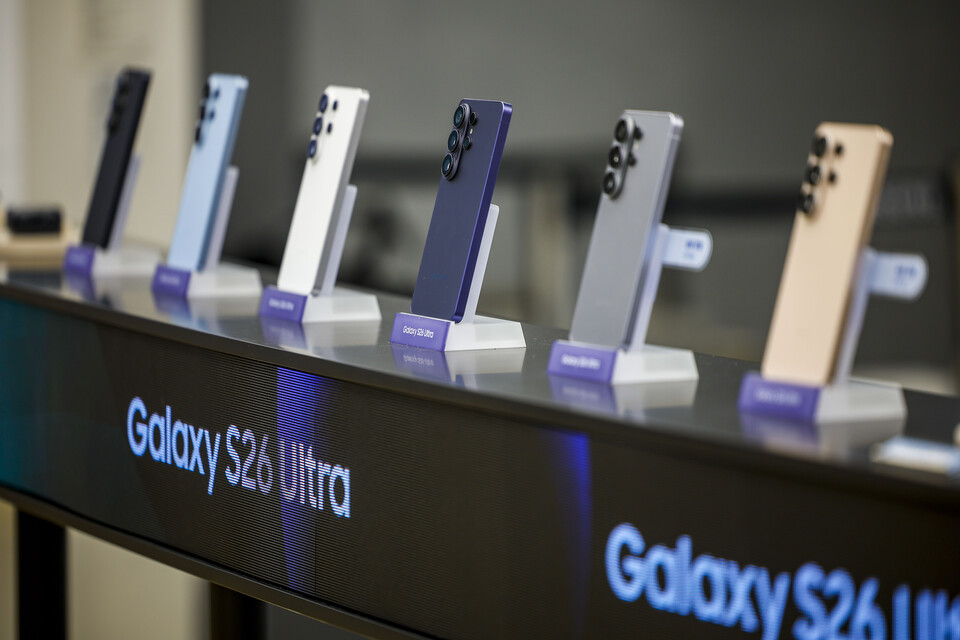
Samsung’s market gains were largely attributed to its strategic approach of relatively restrained price increases and robust promotional campaigns across key growth regions like India and the Middle East. Furthermore, strong performance of its flagship Galaxy S26 series significantly contributed to its success.
Notably, demand for the Galaxy S26 Ultra was exceptionally strong, with consumers drawn to its innovative privacy display and cutting-edge artificial intelligence (AI) features, as reported by Counterpoint.
In contrast, Apple experienced a 3 percent year-over-year increase in its smartphone shipments, driven by consistent demand for its iPhone 17 series. A key factor in Apple’s stability was its strategic decision to maintain pricing, diverging from many other major manufacturers.
Despite individual brand performances, the broader smartphone market saw a substantial contraction. Global smartphone shipments plummeted by 11 percent year-on-year, cementing the second quarter as the weakest for the industry since 2013.
Counterpoint analysts directly attributed this market decline to critical shortages of essential components such as DRAM and NAND flash memory. This scarcity stems from chipmakers prioritizing the escalating demand from AI data centers, consequently diverting supply away from the smartphone sector.
“The resulting higher component prices have significantly inflated smartphone production costs, which in turn has exerted considerable downward pressure on consumer demand for new devices,” stated the market tracker.
For some manufacturers, memory costs have surged by an alarming four to five times compared to a year ago. This dramatic increase means that memory and storage components now constitute over 60 percent of the production costs for certain budget smartphones, and more than 30 percent for premium models. Additional pressure also arises from foundry bottlenecks and other semiconductor supply chain constraints.
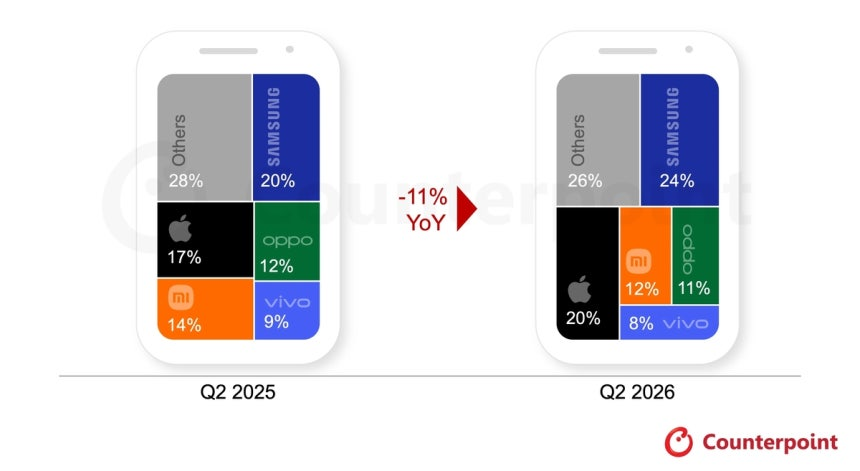
In a separate analysis, Omdia also positioned Samsung at the forefront of the smartphone market with a 22 percent share, with Apple following closely at 20 percent.
Omdia’s data further revealed that several prominent Chinese smartphone makers lost significant market share. Xiaomi’s share declined to 11 percent from 15 percent year-over-year, Oppo saw its share drop to 10 percent from 12 percent, and Vivo experienced a slip from 9 percent to 8 percent.
The repercussions of rising costs were particularly pronounced in the sub-$400 smartphone segment. In this category, thin profit margins combined with high consumer price sensitivity provided manufacturers with minimal flexibility to transfer the escalating component costs to end-users.
“While smartphone manufacturers are anticipating a near-term market correction, projections suggest that memory prices are improbable to start declining before the second half of 2027,” stated Le Xuan Chiew, a research manager at Omdia. He added, “Even then, it’s unlikely they will revert to their pre-2025 levels.”
Omdia further projects that the shipment decline will intensify throughout the second half of the year, as supply constraints are expected to persist, impacting even major product launches and the crucial year-end shopping season. The market tracker also predicts that continued price-hike policies from major suppliers will significantly influence the market.
Responding to the economic pressures, Samsung initiated price increases for its Galaxy S26 series, launched in February, thereby concluding a multi-year price freeze. Additionally, in April, the company unusually raised the retail price of its 512-gigabyte Galaxy Z Fold7 and Flip7 by 94,600 won (approximately $64) in Korea, an unexpected move for devices less than a year old.
Similarly, Apple implemented price adjustments in June, increasing costs for select MacBook and iPad models by $100 to $300.
The severity of the component shortage was underscored by Apple CEO Tim Cook, who likened the situation to a “once-in-a-century flood.” He remarked on the unprecedented speed and magnitude of price increases, suggesting the potential for further hikes.
Even historically price-competitive Chinese brands like Vivo, Oppo, and Xiaomi have been compelled to raise their prices, with increases ranging from 100 yuan to 500 yuan (approximately $14 to $70), marking a significant departure from their traditional affordability strategy.
As a direct consequence of these rising prices, price-sensitive consumers are increasingly likely to delay new smartphone purchases or opt for more affordable models and refurbished phones, according to Runar Bjorhovde, a senior analyst at Omdia.