
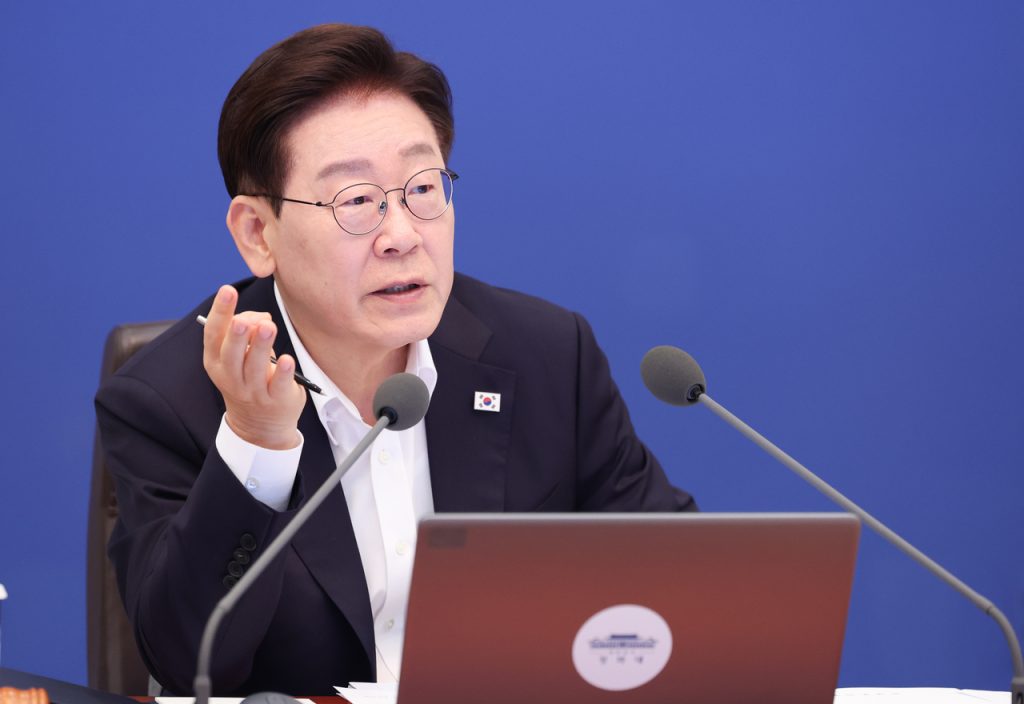
President Lee Jae Myung, in a significant address on Tuesday, urged comprehensive national efforts to boost South Korea’s potential economic growth rate to 3 percent. This ambitious target is to be achieved through aggressive price stabilization measures and the vigorous development of innovative growth engines across key sectors.
Speaking during a crucial Cabinet meeting, President Lee highlighted the nation’s strong economic performance in the first half of the year. He specifically cited a remarkable surge in exports, particularly driven by the high-performing semiconductor sector, as a positive indicator for future growth.
During the meeting at Cheong Wa Dae, the presidential office, Lee remarked, “Recent forecasts indicate that this year’s real growth rate could indeed reach 3 percent, propelled by our outstanding export performance and increased capital investment.” This statement underscored the current economic momentum.
He further emphasized the long-term vision, stating, “We must systematically elevate our potential growth rate to 3 percent. This requires concerted efforts to stabilize both consumer prices and the property market, alongside fostering ‘super-gap’ and ‘game-changing’ growth engines that will redefine our economic landscape.”
This renewed call for economic expansion comes amidst pressing concerns. Projections suggest that South Korea’s potential growth rate could plummet to an unprecedented low of approximately 1.5 percent next year. The country’s central bank has even warned that without intervention, this vital rate might fall into the zero percent range by the 2040s, highlighting the urgency of the President’s directives.
For clarity, the potential growth rate represents the maximum sustainable increase in a country’s Gross Domestic Product (GDP). It reflects the economy’s capacity to grow by fully utilizing all available labor, capital, and other resources without sparking inflationary pressures.
President Lee stressed the critical importance of the upcoming second half of the year, asserting that its trajectory would significantly influence South Korea’s economic direction for the next three decades. He underscored the imperative to accelerate a “grand economic transformation” during this pivotal period.
He specifically tasked Cabinet members with uniting their strengths to make this year a landmark. Their collective efforts are aimed at propelling South Korea towards ambitious national goals: achieving a 3 percent potential growth rate, becoming one of the top four global trade powers, and reaching a per capita income of $50,000.
Additionally, President Lee shared insights from his recent international engagements. He provided an update on his participation in last week’s North Atlantic Treaty Organization (NATO) summit and his subsequent state visit to Mongolia, highlighting South Korea’s expanding global diplomatic footprint.
He reported “considerable achievements” from these visits, particularly noting advancements in securing vital critical mineral supply chains. Furthermore, he emphasized successful expansions in international cooperation concerning defense capabilities and cutting-edge industrial technologies.
Concluding his remarks, President Lee articulated a broader vision: “For the Republic of Korea to achieve even greater leaps and sustain continuous growth, it is essential to have a more stable and peaceful world order providing the foundational support.”


