
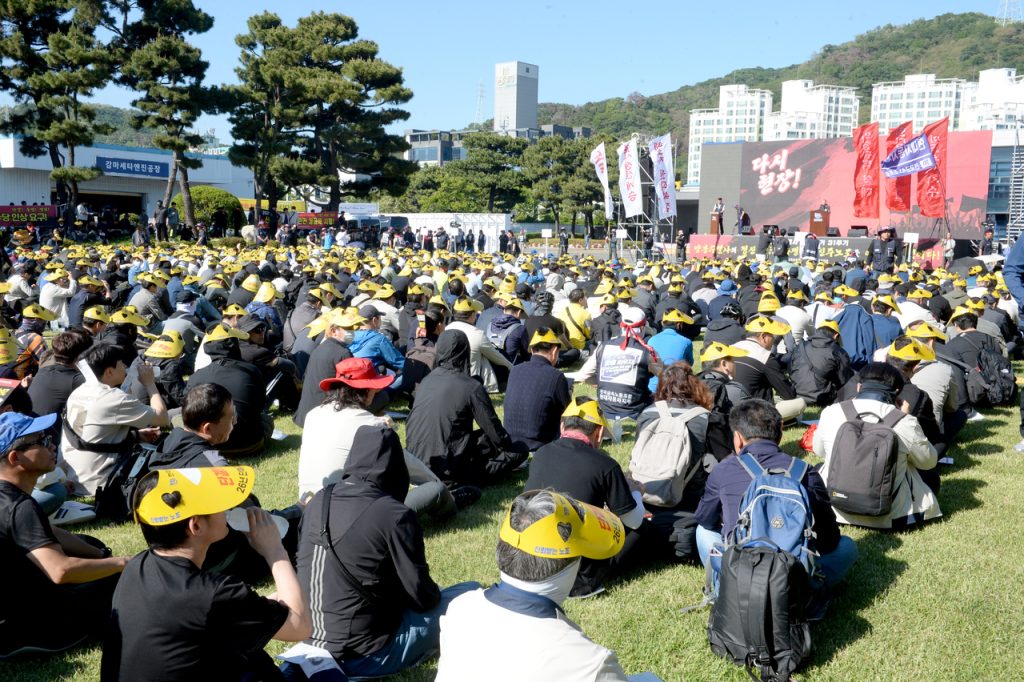
Hyundai Motor Strike: Production of 5,000 Vehicles at Risk Amid Spreading Auto Industry Labor Tensions
Hyundai Motor’s union initiated a three-day partial strike on Monday after wage and bonus negotiations with management reached an impasse, raising significant concerns about potential production disruptions and supply chain delays for South Korea’s leading automaker.
Members of the Hyundai Motor branch of the Korea Metal Workers’ Union announced a two-hour work stoppage at the end of each shift, effective from Monday through Wednesday.
Daytime shift workers will conclude their shifts at 1:30 p.m., two hours earlier than scheduled, while evening shift employees will finish at 10:10 p.m. Given the company’s dual-shift operation, this action could halt production lines for up to four hours daily, totaling 12 hours over the three-day period.
This marks the second consecutive walkout by Hyundai Motor employees during their annual wage talks, highlighting persistent labor challenges.
Employees outside the main vehicle assembly lines, including those in sales, maintenance, and research at the Hyundai Namyang research center, will determine their participation based on local worksite conditions. The Union also plans to join a nationwide walkout organized by the broader metal workers’ union on Wednesday.
Industry experts estimate that this partial strike could disrupt the production of approximately 5,000 vehicles and result in lost sales exceeding 200 billion won ($133 million). These figures are partly based on last year’s 16-hour partial strike, which reportedly impacted around 7,000 vehicles and cost over 300 billion won in sales.
The current strike adds considerable pressure on Hyundai Motor, particularly as it navigates global production and delivery schedules ahead of several key vehicle launches planned for the latter half of the year, including the Genesis GV90 and refreshed versions of the Genesis G80, G90, and Hyundai Santa Fe.
This industrial action commenced after a final round of intensive negotiations failed to yield a compromise, despite 15 rounds of talks held this year between the union and management.
The union’s demands include a monthly base pay increase of 149,600 won and a bonus equivalent to 30 percent of last year’s net profit, among other benefits.
In response, management has offered an 89,000 won raise, a bonus worth 350 percent of monthly base pay, 10 million won in cash, and 15 shares of Hyundai Motor stock.
Choi Yeong-il, Hyundai’s head of domestic production and chief safety officer, expressed regret over the walkout in a statement on Friday. He emphasized that the company would not improve its offer simply because the union had chosen to strike.
“Past strikes have only resulted in irreversible production losses, lost wages, and harsh criticism from our customers and the public,” Choi stated. “We are well aware that the company has never made an additional offer or compensated workers for wages lost solely due to a union strike.”
Despite the ongoing walkout, both parties are reportedly continuing informal negotiations in an effort to reach a settlement. The union is expected to review the status of these talks on Thursday before deciding whether to extend the strike or escalate its broader labor campaign.
This year’s auto industry wage talks were already anticipated to be more challenging than usual. Substantial performance bonuses tied to operating profit at major tech companies like Samsung Electronics and SK hynix have elevated workers’ expectations across the entire manufacturing sector.
However, automakers face tighter margins to meet such demands due to increasing US tariffs and a slowdown in global vehicle sales, creating a significant gap that is likely to complicate ongoing negotiations.
Labor tensions are not confined to Hyundai; they are spreading across other Korean automakers as well. Kia’s union held a rally last Thursday, declaring an intensified campaign and demanding a bonus equivalent to 30 percent of the company’s operating profit for the current year.
Unionized workers at GM Korea have initiated a refusal of overtime work, while Renault Korea’s union is currently preparing to hold a vote to authorize a potential strike.
sahn


