Hyundai Motor Union Secures Strike Right Amidst Landmark Bonus Demands, Fueled by Samsung Deal & New Labor Laws
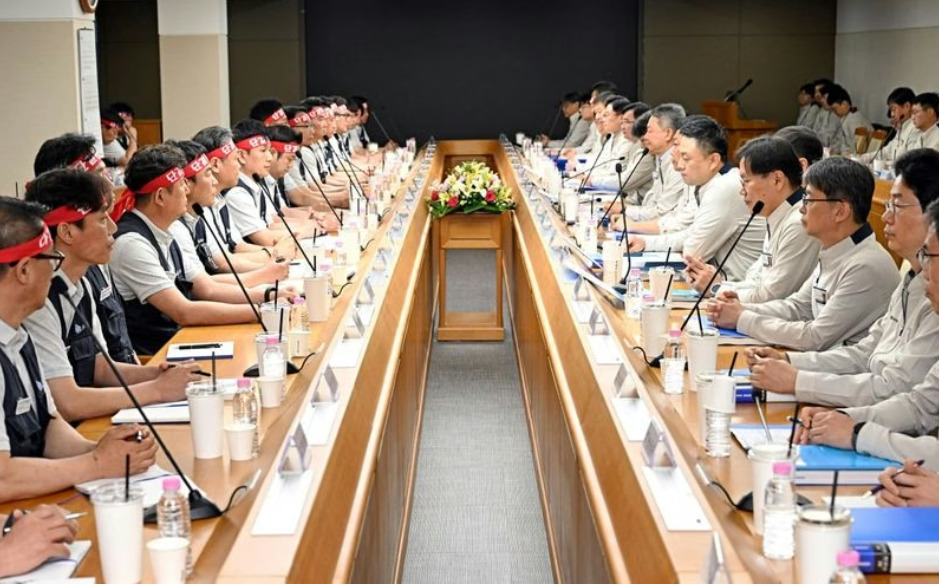
Hyundai Motor Co.’s influential labor union has successfully secured the right to strike, a move that significantly escalates its long-standing demand for a “30 percent of net profit” bonus. This assertive stance gains considerable momentum in the wake of Samsung Electronics’ groundbreaking agreement on employee bonuses, signaling a potential shift in corporate labor relations across South Korea.
With 39,668 members, the Hyundai Motor union’s recent strike authorization vote on Wednesday saw an overwhelming 92.03 percent in favor of a walkout. Having now secured the legal mandate to strike – a vote that historically always passes – the union holds significant leverage. The decision to initiate a full-scale industrial action will hinge directly on the advancement of ongoing wage and bonus negotiations with company management.
Since 2004, the Hyundai union has consistently advocated for a substantial 30 percent share of net profits in almost every annual negotiation, with the exception of 2020 during the unprecedented economic uncertainty of the COVID-19 pandemic. Historically, management has resisted these direct profit-sharing demands, opting instead for one-off bonus packages that typically combined a percentage of monthly base pay, a fixed cash payment, and company shares.
However, industry analysts now suggest that the union’s decades-long pursuit of direct profit-sharing could prove to be a high-stakes, potent leverage strategy this year. This shift is primarily due to the significant reshaping of the South Korean corporate bonus landscape, directly triggered by the landmark agreement at Samsung Electronics.
Following months of intense labor disputes, Samsung Electronics’ labor and management reached a pivotal agreement last month. This deal established a special bonus pool, specifically for its Device Solutions semiconductor division, amounting to “10.5 percent of operating profit.”
This milestone Samsung deal has subsequently generated a significant ripple effect across numerous Korean corporate peers. It has effectively redirected labor union focus nationwide, moving away from discretionary, one-off bonuses dictated by management towards more transparent, profit-linked compensation formulas.
Legal experts highlight that while previous judicial precedents strictly excluded profit-sharing bonuses from the scope of legitimate strike agendas, the controversial “Yellow Envelope Act”—officially implemented in March 2026—has profoundly altered this legal landscape for labor disputes in Korea.
Crucially, by expanding the permissible scope of justifiable labor disputes to encompass “business management decisions that affect working conditions,” the new law establishes a critical foothold. This allows unions to persuasively argue that profit distribution directly impacts employee working conditions, making it a legitimate cause for industrial action and strikes.
Professor Kim Pil-su, an automotive engineering expert at Daelim University, strongly argues that fundamental decisions regarding how a company’s profits are allocated—between shareholder dividends and employee bonuses—are the prerogative of management and shareholders, not labor unions.
“Bonuses can only be distributed after a company has fulfilled all its financial obligations, including commitments to creditors, shareholders, tax payments, and essential future investments like research and development,” Professor Kim explained.
“The union’s current demand effectively seeks a share of corporate earnings before these critical financial commitments and strategic investments have been adequately addressed,” he further elaborated.
Kim also underscored crucial fundamental structural differences between the capital-intensive semiconductor and automotive manufacturing sectors. He noted that automakers typically operate on significantly thinner profit margins, making double-digit operating profit figures a rarity in their industry.
“Should management agree to a fixed-percentage net profit bonus formula, it would establish an irreversible and potentially far-reaching precedent,” he warned. Professor Kim added that this contentious dispute could result in a prolonged standoff between labor and management, potentially culminating in a disruptive actual strike.
After enjoying seven consecutive years of peaceful wage agreements without strikes, Hyundai’s labor union did stage a partial walkout in 2025, indicating a growing willingness to engage in industrial action.
While the likelihood of the union successfully securing its ambitious demand for a bonus equivalent to 30 percent of net profit remains significantly slim, the financial implications are staggering. If such a demand were granted, Hyundai Motor would face bonus payments exceeding 3 trillion won (approximately $1.9 billion), considering the company’s net profit of 10.3 trillion won last year.
This considerable demand further exacerbates pressure on Hyundai Motor, which is already grappling with a significant 15 percent tariff imposed by the United States. Furthermore, despite achieving a record 186 trillion won in revenue last year, the company’s operating profit regrettably declined by 19.5 percent.
Another critical negotiation point emerging in these talks is the union’s strong demand for guarantees regarding employment stability and working conditions. This is a direct response to Hyundai’s accelerated adoption of artificial intelligence (AI) and robotics within its manufacturing processes—a new and pressing issue that had not previously surfaced in prior rounds of wage negotiations.
The union’s proactive call for a “full monthly salary” system is also strategically viewed as a preemptive safeguard. This measure anticipates the future widespread deployment of advanced Atlas humanoid robots, which are currently being prepared for integration into Hyundai’s production facilities. As increasing automation assumes more production tasks and potentially reduces workers’ hours on the factory floor, the current hourly wage structure could inevitably lead to reduced earnings for employees.
By guaranteeing a stable, fixed monthly income, the union explicitly aims to protect its members from the potential negative financial impacts of these technological advancements.
hyejin2