South Korean stocks experienced a significant recovery on Wednesday, surging over 3 percent as investors eagerly bought into leading semiconductor shares. This notable rebound comes after the market endured one of its most substantial declines on record during the preceding session. Concurrently, the local South Korean currency saw a weakening trend against the US dollar.
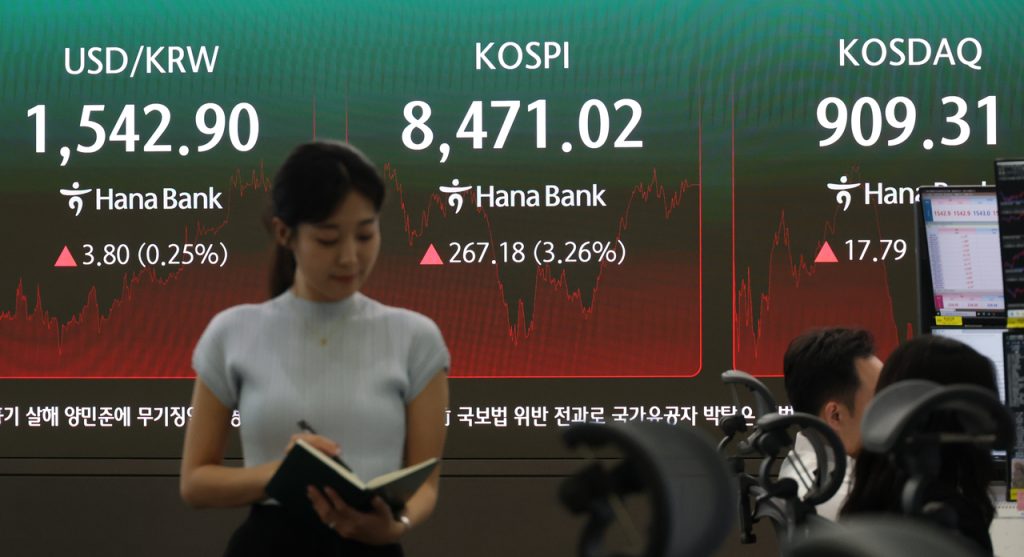
Following a period of volatile trading, the benchmark Korea Composite Stock Price Index (KOSPI) closed higher, adding 267.18 points, or 3.26 percent, to reach 8,471.02. The KOSPI, which initially opened with gains, briefly dipped into negative territory due to heavy selling pressure from foreign investors, nearing the critical 8,000-point threshold. However, robust buying activity from both retail and institutional investors ultimately propelled the index to reverse course and secure a strong close for the day.
Market activity was robust, with a substantial trade volume of 413.4 million shares, valued at 53.78 trillion won ($34.81 billion). Throughout the session, gaining stocks significantly outnumbered declining ones, with 514 advances against 366 losses. Foreign investors were net sellers, offloading 4.66 trillion won worth of shares. In contrast, domestic retail investors demonstrated strong confidence, net purchasing 2.63 trillion won, while institutional investors also contributed significantly with 1.92 trillion won in net buys.
Overnight in the United States, Wall Street markets closed lower. This was largely influenced by sharp declines in memory chip and broader semiconductor stocks, which dampened overall investor sentiment amidst ongoing concerns within the artificial intelligence (AI) sector. This global tech sector performance often casts a shadow on Korea’s export-driven economy, highlighting interconnected market dynamics.
Commenting on the market’s turnaround, Lee Kyung-min, an analyst at Daeshin Securities, noted, “The KOSPI moved into positive territory driven by bargain hunting, following the steep decline observed on the previous day.” However, Lee also highlighted persistent investor caution. This prudence is particularly evident ahead of key economic events, including Micron Technology’s upcoming earnings announcement and the release of the US personal consumption expenditures (PCE) price index for May, both of which could signal future market directions and influence global sentiment.
Within the Seoul market, individual large-cap shares presented a mixed performance. Leading chipmakers showed varied but generally positive trends: Samsung Electronics surged impressively by 9.84 percent to 340,500 won, while SK Hynix saw a 0.98 percent increase, closing at 2.58 million won. Conversely, SK Square, the parent company of SK Hynix, experienced a slight dip of 1.8 percent, ending at 1.79 million won.
Samsung Electro-Mechanics, a key electronic components manufacturing affiliate of Samsung Electronics, also recorded a decrease, shedding 1.31 percent to 1.96 million won. In the automotive sector, top carmaker Hyundai Motor slightly declined by 0.39 percent to 509,000 won. Meanwhile, leading battery manufacturer LG Energy Solution posted gains, rising 0.97 percent to 365,500 won, reflecting resilience in the electric vehicle supply chain amidst broader market fluctuations.