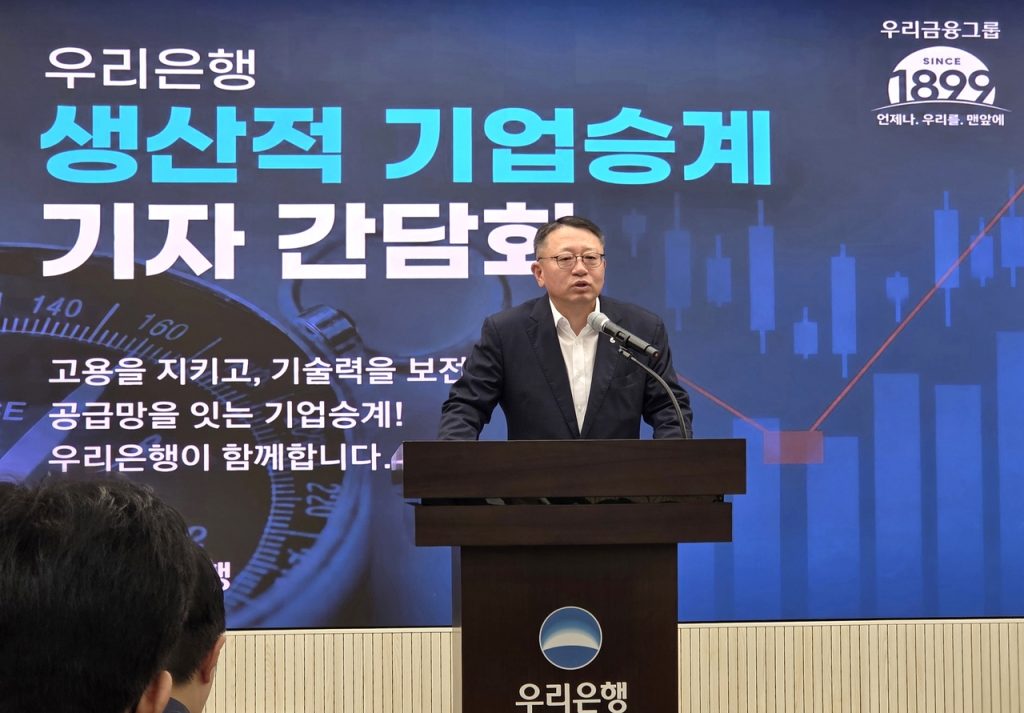
Woori Bank Unveils W3 Trillion Support for Korean SMEs Amid Founder Succession Challenges
Woori Bank is pioneering a new banking frontier by proactively addressing corporate succession for South Korea’s small and medium-sized enterprises (SMEs). This initiative is framed as a critical economic imperative, directly impacting job preservation, technological innovation, and supply chain resilience, particularly as Korea’s pioneering first-generation business founders increasingly face challenges in identifying clear successors.
During a press conference held Monday in central Seoul, Woori Bank CEO Jung Jin-wan emphasized the bank’s unwavering commitment to fostering “productive corporate succession.” This strategic focus aims to safeguard the viability of countless businesses, preventing their unnecessary closure or downsizing, and ensuring continued economic contribution.
“Beyond being a paramount concern for individual enterprises, effective corporate succession stands as a critical national economic task,” stated Jung. “It is intrinsically linked to preserving invaluable jobs, retaining specialized technologies, and maintaining stable industry supply chains across the nation. Woori Bank is dedicated to facilitating the secure and stable transfer of these vital jobs, advanced technologies, and robust industrial foundations.”
In a groundbreaking move within the banking sector, Woori Bank established its dedicated Corporate Succession Support Center in February. This pioneering unit provides comprehensive advisory services for SMEs, leveraging a multidisciplinary team of experts specializing in accounting, tax planning, mergers and acquisitions (M&A), and corporate finance. Their guidance spans various succession pathways, including family successions, management buyouts, employee buyouts, and third-party sales, offering tailored solutions for every scenario.
To bolster this crucial initiative, Woori Bank has forged strategic partnerships with leading entities such as Kim & Chang, Samil PwC, and the Korea Technology Finance Corporation. These collaborations ensure integrated legal, tax, and financing support, providing SMEs with a holistic framework for successful transitions. Demonstrating significant early traction, the bank has already signed succession-related memorandums of understanding (MOUs) with 554 companies and has actively delivered specialized consulting services to 102 of these firms.
Jung further clarified that the bank’s agenda extends far beyond mere ownership transfer. He underscored the critical importance of technology retention, noting that many key industrial technologies are often deeply embedded within smaller, specialized supplier companies, making their continuity vital.
“Technological innovation isn’t solely the domain of large corporations,” Jung emphasized. “In fact, as we examine first- and second-tier vendors, it becomes evident that smaller companies frequently possess unparalleled specialization in critical core technologies, forming the backbone of various industries.”
Illustrating the systemic risk, Jung cited recent supply chain disruptions in the manufacturing sector, demonstrating how the instability or failure of even a single essential supplier can trigger widespread repercussions for larger companies. He cautioned that if succession challenges within these vital SMEs remain unaddressed, major corporations might ultimately be compelled to acquire their smaller suppliers. This scenario would be driven by the urgent need to safeguard critical technologies and maintain essential production networks, underscoring the preventative value of Woori Bank’s initiative.
The demographic insights from companies signing MOUs with Woori Bank powerfully underscore the immediate urgency of this issue. A striking 70.2 percent of their CEOs are aged between 50 and 69, with an additional 20.5 percent being 70 years or older. While a significant 52.7 percent express a desire to transition their businesses to their children, a substantial 43.7 percent have yet to formalize or even choose a specific succession methodology, highlighting a critical planning gap.
Jung firmly reiterated that successful corporate succession demands meticulous, long-term strategic preparation, emphasizing that it is far more complex than a mere rapid transfer of operational control.
“Effective succession planning is not a task that can be accomplished within a short timeframe of one or two years,” he elaborated. “It necessitates a comprehensive long-term perspective, requiring us to envision the company’s future over at least a decade and diligently manage the entire transition process over an extended duration.”
Looking ahead, CEO Jung announced that Woori Bank is poised to mobilize over 3 trillion won (approximately $2 billion USD) in robust financial support over the forthcoming five years. This extensive package will encompass guarantees, specialized investment banking-backed M&A assistance, flexible loans, and dedicated succession funds. Concurrently, the bank has set an ambitious initial target to deliver comprehensive succession consulting services to 2,500 firms within the identical five-year timeframe, solidifying its commitment to bolstering the Korean SME sector.
jwc