
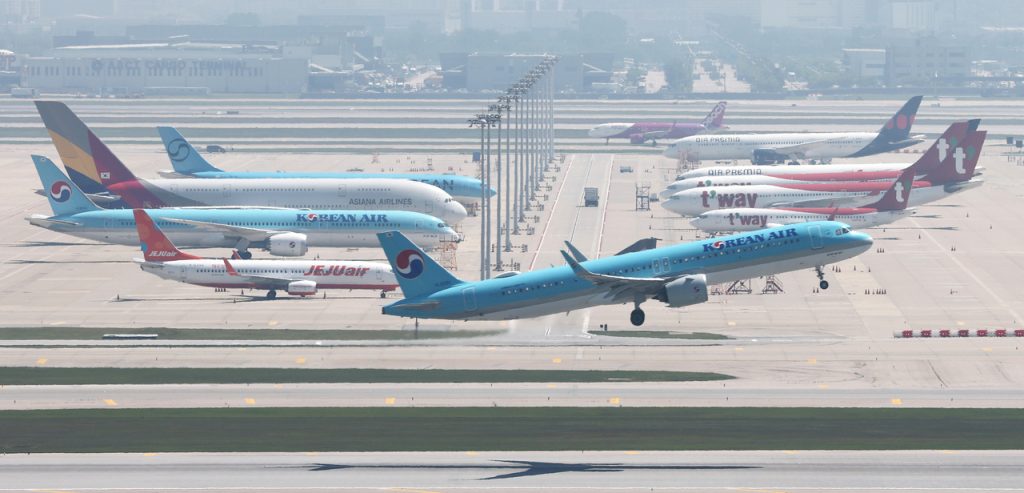
South Korea’s aviation sector experienced its most significant output decline in 52 months this April, primarily driven by a sharp increase in fuel surcharges. This surge in surcharges is largely attributed to the prolonged Middle East conflict, according to government data released Monday.
The aviation sector’s production index recorded 468.5 in April, marking a substantial 13.5 percent drop from the previous month. Data from the Ministry of Data and Statistics reveals this as the steepest on-month decline since December 2021, when the index fell by 14.2 percent.
Similarly, passenger transport output within the aviation sector saw a 14 percent decrease in April compared to March, also representing its sharpest on-month fall since December 2021. The statistics agency explicitly linked this steep decline in overall aviation output to reduced airline passenger demand, a direct consequence of escalating fuel surcharges.
Highlighting the impact, Korean Air, South Korea’s largest full-service carrier, significantly raised its international one-way fuel surcharges for April. These surcharges climbed to a range of 42,000 won ($27.86) to 303,000 won, a considerable increase from the 13,500 won to 99,000 won range seen in March.
This sharp rise in costs stemmed from the Mean of Platts Singapore (MOPS), a key benchmark for refined petroleum products in the Asia-Pacific region. MOPS averaged $214.71 per barrel between March 16 and April 15, pushing the monthly fuel surcharges into the highest possible Level 33 bracket.
In response to these soaring fuel costs and a noticeable drop in passenger demand, several local low-cost carriers have implemented emergency measures. These include reducing round-trip services and introducing initiatives such as unpaid leave for staff, reflecting the severe challenges facing the South Korean airline industry.


