Industry Minister Kim Jung-kwan Unveils Landmark First-Year Achievements: Record Exports, Key Tariff Deals, and AI-Driven Industrial Transformation
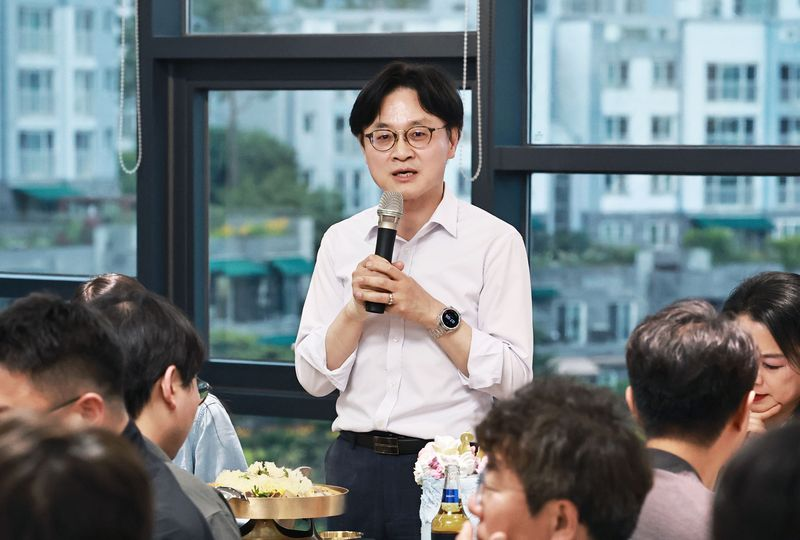
South Korea’s Industry Minister Kim Jung-kwan confidently projected the nation’s ascent into the top five global exporters this year. During a press briefing, Minister Kim underscored the government’s significant first-year accomplishments, including record-breaking export growth, a pivotal Korea-US tariff agreement, and a strategic push for AI integration across its manufacturing sector.
Minister Kim’s address also delved into other critical industrial matters, notably South Korea’s ambitious bid for Canada’s multibillion-dollar submarine project and the recent resolution of Samsung Electronics’ protracted bonus dispute.
Despite global economic uncertainties, Minister Kim expressed strong confidence in South Korea’s export trajectory, stating, “Although we need to remain cautious about external variables, exports are expected to exceed $900 billion this year.” This projected figure firmly positions Korea to achieve its goal of joining the world’s top five exporting nations.
The nation’s export prowess was evident last year, with South Korea recording an unprecedented $709.3 billion in exports, becoming only the sixth country to surpass the $700 billion threshold. This remarkable momentum has further accelerated in the current year, seeing exports through April surge by an impressive 40.9 percent year-on-year, reaching a new record of $306.5 billion.
Minister Kim proactively dispelled notions that this export surge is solely attributable to the semiconductor sector. He acknowledged, “Chip exports have risen about 140 percent, so many people say it is all because of semiconductors.” However, he emphasized, “But even excluding chips, other industrial sectors are posting solid growth of 14 to 15 percent,” highlighting broad-based economic expansion.
Regarding South Korea’s compelling bid for Canada’s substantial submarine project, valued at up to 60 trillion won ($40 billion), Minister Kim specifically underscored Korea’s advanced technological readiness and a comprehensive proposal for broader industrial cooperation.
Highlighting a key competitive advantage, Kim stated, “Unlike the competing German model, which is still in the design stage, our KSS-III submarines are already operational.” He further elaborated that Korea’s offer extends beyond military hardware, encompassing cooperation in cutting-edge hydrogen vehicles and various defense equipment.
While describing his recent meeting with Canadian Industry Minister Melanie Joly as “encouraging,” Kim prudently cautioned that Canada might ultimately lean towards European partners due to deeply rooted historical ties and NATO alignment.
Minister Kim also lauded Samsung Electronics’ successful agreement with its labor unions, a critical development that averted a potential strike. However, he offered a poignant warning: the long-term impact of this settlement could prove either “poison or medicine,” contingent on its perception by employees.
Reflecting on the broader industry landscape, he observed, “The current semiconductor cycle could become either a stepping stone or a stumbling block for Samsung.” Minister Kim expressed his aspiration, “I hope Samsung uses this settlement as a stepping stone toward becoming a true global leader,” emphasizing the importance of strategic foresight.
Beyond the impressive export growth, the Ministry of Trade, Industry and Energy (MOTIE) underscored four additional, pivotal policy achievements. These include the landmark Korea-US tariff agreement, comprehensive petrochemical industry restructuring, robust energy security measures implemented amidst Middle East conflicts, and the widespread integration of Artificial Intelligence (AI) across the manufacturing sector.
The crucial Korea-US tariff deal, finalized in November following over 30 intensive rounds of negotiations, has significantly mitigated uncertainty for South Korean exporters and fostered expanded cooperation in vital strategic industries, according to the ministry. To further solidify economic ties, Seoul has enacted a special law supporting Korean investment projects within the US and established an interim review system prior to the law’s full implementation.
When questioned about the precise timing of future US investment announcements by Korean companies, Minister Kim prudently refrained from providing specifics. He stated that the government must diligently evaluate each project’s commercial viability before public disclosure.
In the petrochemical sector, the ministry confirmed it is vigorously accelerating restructuring initiatives within an industry currently grappling with global oversupply. A significant first restructuring project, involving HD Hyundai Chemical and Lotte Chemical in Daesan, has already received approval, bolstered by over 2.1 trillion won in comprehensive financial, tax, and regulatory support. A second critical project, uniting YNCC and Lotte Chemical in Yeosu, is presently undergoing review.
Addressing evolving geopolitical landscapes, the ministry highlighted emergency measures implemented to mitigate Middle East energy risks. These strategies ensured South Korea secured May crude oil and naphtha imports at approximately 90 percent of previous year levels, crucially reducing its reliance on Middle Eastern crude from 70 percent to around 50 percent.
Pioneering advancements in manufacturing AI, the ministry proudly announced that its M.AX Alliance, established last September with over 1,000 participating companies, universities, and research institutes, is actively championing AI factory projects across 12 diverse industries. The government has ambitious plans to significantly expand the number of these advanced AI factories to over 200 by the close of the year.