Samsung Electronics Labor Dispute: Excluded Workers File Lawsuit Against Controversial Wage Deal
Despite an impending approval for Samsung Electronics’ tentative wage agreement, aimed at resolving a five-month labor dispute and averting a historic strike, a crucial segment of the tech giant’s workforce is initiating legal action to block the controversial deal.
Turnout in the union ratification vote for the Samsung wage agreement passed 86 percent as of Monday morning, the fourth day of balloting, according to the company’s largest union. The electronic vote is scheduled to close at 10 a.m. Wednesday, with widespread approval anticipated. Roughly 80 percent of that union’s eligible voters work in the semiconductor division, the primary beneficiary of the new agreement, which requires only a simple majority for ratification.
What profoundly divides the Samsung workforce is the significant disparity in compensation the new deal establishes. Signed last Wednesday, merely hours before a planned strike, the agreement introduces a special bonus specifically for the chip division, funded by 10.5 percent of an agreed measure of business performance, with no individual cap. Under current industry profit assumptions, memory-chip employees could each potentially receive close to 600 million won ($398,000) in combined incentives this year.
In stark contrast, workers in the consumer-electronics division, responsible for manufacturing Samsung smartphones, televisions, and home appliances, are set to receive 6 million won in company stock.
This substantial compensation gap has escalated the labor dispute into an open conflict between Samsung’s rival unions in South Korea. Korean firms can often host several competing unions, and a separate union, primarily comprising consumer-electronics staff, has rapidly grown from approximately 2,600 members to over 12,000 as employees, angered by the terms of the deal, joined in protest.
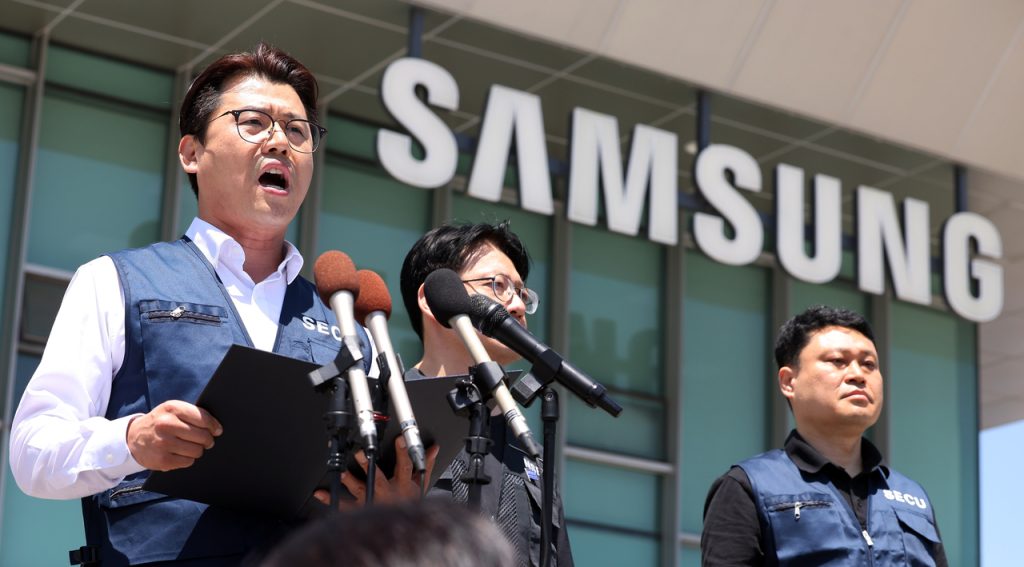
However, none of these protesting members are eligible to vote on the wage pact. The largest union, which holds exclusive bargaining authority, has excluded the consumer-electronics union from the ratification vote, asserting that it quit the joint negotiating bloc earlier this month – a stance supported by the Labor Ministry. The smaller union, condemning this exclusion as an abuse of discretion, confirms it has retained legal counsel to seek an injunction to halt the ongoing vote and a subsequent ruling to void the entire agreement.
The resentment surrounding the wage deal is not limited solely to the consumer-electronics sector. Foundry and chip-design employees, whose respective business units are currently classified as loss-making, stand to receive only a fraction of the bonus compensation compared to memory staff, as the special bonus is heavily weighted toward specific business-unit performance.
Choi Seung-ho, head of the largest union, announced he would subject his own leadership to a confidence vote in June, irrespective of the final outcome of the wage agreement. This signals the contentious nature of the deal, even among the very workers it is intended to reward.
The headline payout, in any case, remains conditional. The special bonus for the chip division is disbursed only when the unit achieves ambitious annual profit targets, under a framework designed to span a decade. It’s worth noting that the same division posted a multi-trillion-won operating loss as recently as 2023, during the last memory downturn.
A second significant challenge to the Samsung wage agreement is emerging from shareholders. A minority-shareholder advocacy group argues that committing a share of company profit to employees ahead of dividends and taxes is unlawful without explicit shareholder approval. The group plans to demand an extraordinary general meeting once it obtains the company’s shareholder register, a request Samsung has already granted.
mjh