Asia strategist Mixo Das keeps Korea as Asia top pick, backs Kospi 10,000 call on AI, earnings momentum
JPMorgan Chase & Co.’s leading Asia equity and quant strategist, Mixo Das, maintains a highly bullish outlook on South Korea’s stock market, asserting that the current Kospi rally has substantial room for further growth. This optimistic projection for South Korean equities is underpinned by a powerful confluence of factors: the escalating artificial intelligence (AI)-driven memory chip cycle, consistent corporate earnings upgrades, and ongoing governance reforms, solidifying Korea’s position as the bank’s top regional market pick.
In a May 10 report titled “Embracing the AI momentum; Kospi 10K?”, Das and his team at JPMorgan significantly revised their Kospi targets upwards. The new base, bull, and bear targets were set at 9,000, 10,000, and 6,000 respectively. This adjustment came merely weeks after an earlier upgrade to 7,000, 8,500, and 5,000, reflecting rapidly improving market conditions. JPMorgan’s report specifically highlights favorable memory-cycle dynamics, meaningful governance reforms, and robust thematic growth as key drivers for designating Korea as their preferred market in Asia.
“Recent evidence over the past 2-3 months has significantly improved the outlook for Korea’s equity market,” Das explained in a written interview with The Korea Herald. He further elaborated, “This unique combination of factors justified our substantial upward revision to the Kospi targets, as the market’s upside potential has increased meaningfully in a short period of time.”
AI Hardware Demand: The Primary Catalyst for Korea’s Rally
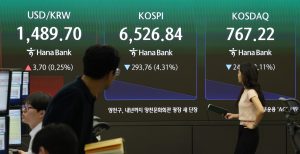
The recent Kospi upgrade coincides with a historic market run, largely powered by major technology players like Samsung Electronics and SK Hynix. The benchmark index nearly tripled in less than 18 months, notably breaching the 8,000 mark for the first time on May 15, showcasing the strong upward trajectory of South Korean stocks.
While acknowledging the role of Korea’s structural re-rating, Das emphasized that global demand for advanced AI hardware remains the predominant force behind the market’s rally. “Both elements are present, but the current rally is primarily driven by Korea’s unique position as a liquid AI hardware proxy outside the US and Taiwan,” he stated. However, he also noted, “the ongoing improvement in corporate governance is also a meaningful anchor for the market’s re-rating, attracting inflows from both foreign and local investors.”
The memory sector forms the bedrock of JPMorgan’s bullish call. It now accounts for approximately 50 percent of the Kospi’s overall weight and has contributed roughly 70 percent of this year’s gains. This concentration undeniably strengthens Korea’s role as a direct AI proxy, though it also increases the market’s sensitivity to potential sector-specific shocks.
JPMorgan remains highly confident in the sustained momentum of the memory cycle. “We remain constructive on a ‘higher for longer’ memory upcycle,” Das affirmed. He pointed to several supporting factors: “AI-led demand continues to outstrip supply, inventory levels are tight, and High Bandwidth Memory (HBM) supply is securely locked up under multi-quarter price and volume agreements.”
Concerns over potential shortages are already leading customers to pull forward their 2027 demand, suggesting that the supply-demand gap could widen further. Das indicated that 2027 and 2028 are likely to remain part of this robust memory upcycle, benefiting from both average selling price and volume perspectives.
Beyond Memory Chips: Diverse Strengths in the Korean Market
Despite the significant influence of memory chips, Das stressed that the current South Korean stock market rally is not solely dependent on Samsung Electronics and SK Hynix. “Korea’s story is not purely a one-factor market,” he highlighted, noting that the Kospi, excluding these two semiconductor giants, has also delivered strong returns and outperformed the regional benchmark.
Beyond the memory sector, other areas of the Korean market are also demonstrating robust performance. Industrials have shown the strongest earnings upgrades, commodity-exposed sectors are experiencing positive revisions, and banks are benefiting from a recovery in net interest margins, increased fee income, and well-contained credit costs, diversifying the market’s strength.
Corporate Governance Reforms: A Crucial Long-Term Anchor
While perhaps not the immediate spark, corporate governance reform continues to be a pivotal pillar supporting the market’s re-rating, with holding companies and insurers identified as key beneficiaries. “Governance reform is an ongoing re-rating support rather than a completed process,” Das explained. “We believe the re-rating is roughly halfway through in terms of eliminating the governance discount,” indicating further potential upside from these structural changes.
Investor Dynamics and Potential Market Risks
The next phase of the rally may hinge on a more decisive return of longer-term foreign investors. JPMorgan’s analysis reveals that while hedge funds and macro investors have increased their Korea exposure in the second quarter, active long-only investors have yet to significantly re-enter the cash market, suggesting room for further institutional inflows.
Das also noted that retail investors provided some support, particularly by capitalizing on market dips in March. However, retail flows have stabilized in the second quarter, showing a shift towards more defensive stocks. For now, he concluded, retail participation appears to be episodic rather rather than forming a durable new foundation for the market.
Despite the strong momentum, the rally is not without its risks. Valuations are now elevated, returning to historical highs. Investors are closely monitoring energy-related macro risks and the potential for a peak in memory chip average selling prices. However, Das identified the rapid speed of the market’s ascent as the most significant near-term concern.
“The strongest bear case is near-term vulnerability after a rapid rally,” Das cautioned. He elaborated that “the rapid upside move in Korean equities has led to poor market breadth, elevated relative strength index spreads, and rising implied volatility,” signaling potential for short-term corrections.