
Moody’s Ratings Warns: Korean Banks’ Capital Buffers Face Pressure Amid Shareholder Demands and Policy-Driven Lending Expansion
Seoul, Korea – Despite a generally robust banking system, Moody’s Ratings issued a cautionary statement on Tuesday, highlighting that growing demands for shareholder returns combined with government-backed lending expansion could strain the capital buffers of Korean banks. This assessment comes as South Korea’s “corporate value-up campaign” has propelled shareholder distributions closer to international benchmarks, with major financial groups now adopting clearer capital targets.
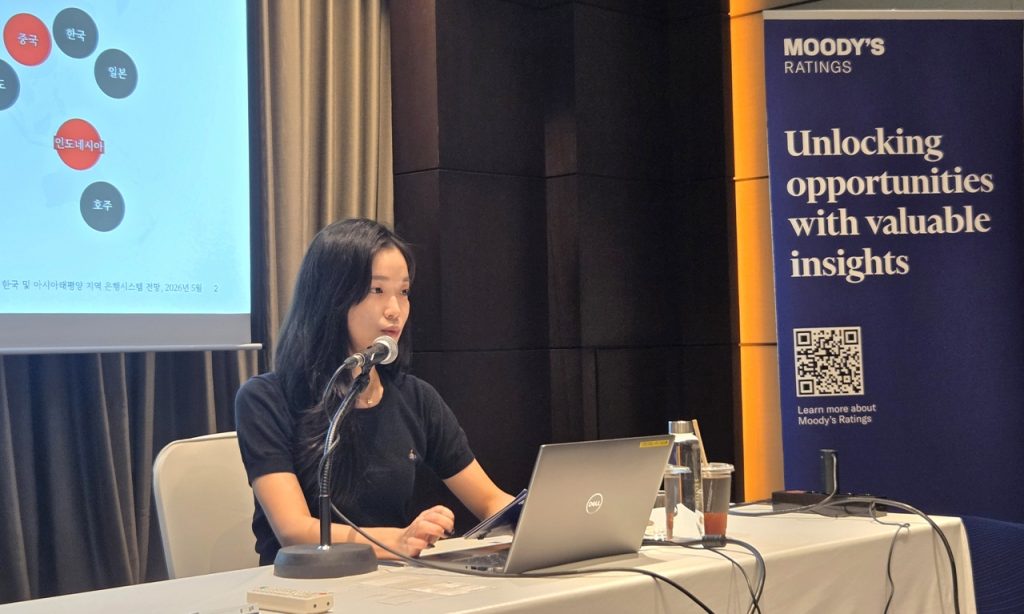
“The value-up policy itself brings positive aspects,” remarked Arlene Sohn, assistant vice president and analyst at Moody’s financial institutions group, during a media roundtable held in Seoul. She elaborated that major financial groups have established common equity tier 1 (CET1) ratio targets averaging around 13 percent, which Moody’s considers a “solid” level for financial stability.
However, Sohn cautioned about potential rising pressure on bank capital. This risk escalates particularly if the earnings contributions from nonbank affiliates diminish, potentially compelling banks to increase dividend payouts to maintain their elevated shareholder returns.
Furthermore, Moody’s pointed out that government initiatives aimed at fostering productive and inclusive finance could steer lending away from historically lower-risk mortgages. This shift towards corporate loans, small businesses, and borrowers with lower credit ratings would inherently increase risk-weighted assets, subsequently impacting both capital adequacy and overall profitability for Korean financial institutions.
Sohn specifically noted the significant surge in Korean banks’ shareholder returns, which had previously lagged behind global counterparts. She recalled that Japanese banks’ dividend payout ratios were approximately 40 to 50 percent several years ago, while Korean banks’ ratios stood at a comparatively lower 20 to 30 percent during the same period, illustrating the recent rapid increase.
Moody’s characterized South Korea’s financial sector as being tightly regulated by global standards, particularly concerning household lending controls. The agency also underscored that this strict oversight reflects a strong government commitment and willingness to support the banking system effectively during periods of financial stress. “We evaluate Korea as a high-support system,” Sohn affirmed.
The ratings agency further reported that recent fluctuations in the stock market and Korean won volatility have had only a limited impact on the liquidity and capital ratios of the nation’s banks.
Nevertheless, Sohn emphasized that structural weaknesses persist for Korean banks, primarily relating to profitability and liquidity. She cited their reliance on loan-heavy business models and comparatively smaller liquid-asset buffers when benchmarked against many global peers.
In February, Moody’s had revised its outlook on Korea’s banking system from negative to stable. This positive adjustment was based on expectations of stronger economic growth, largely driven by AI-related semiconductor exports and supportive fiscal expansion.
Despite the stable outlook, Sohn identified ongoing risks for the sector, including currency volatility, uncertainties surrounding US tariffs, and potential weaknesses within regional housing and commercial real estate markets.
jwc


