
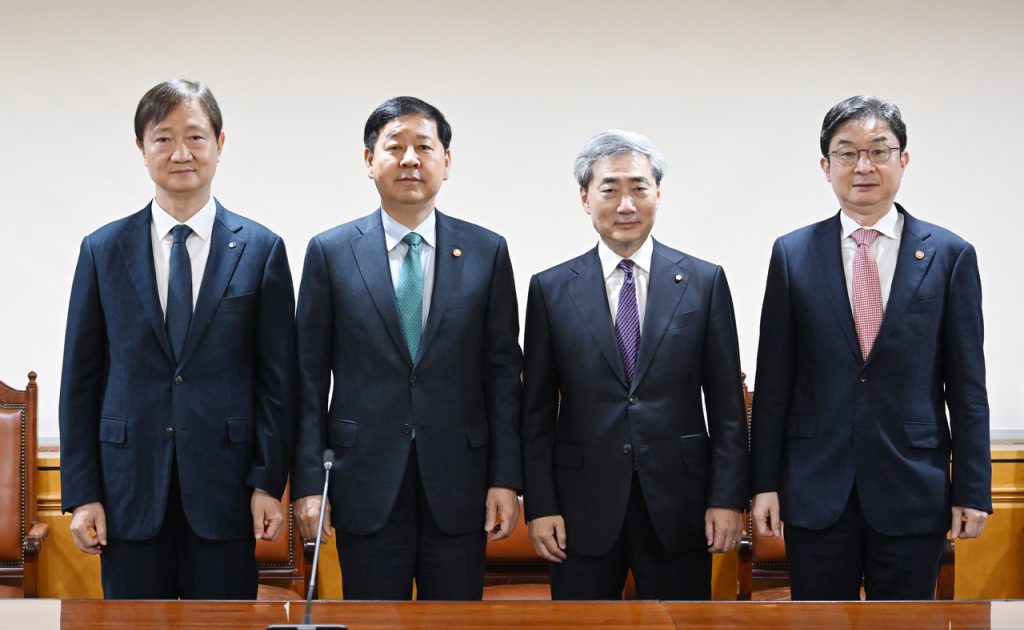
Top South Korean economic and financial policymakers on Thursday urged the swift resolution of a burgeoning labor dispute at Samsung Electronics Co., cautioning that any potential strike action could jeopardize the nation’s economy amidst a critical semiconductor supercycle.
Finance Minister Koo Yun-cheol, alongside other key financial authorities, issued these joint remarks during a crucial meeting convened to assess the potential economic fallout from an impending walkout by Samsung Electronics workers, as confirmed by the Ministry of Finance and Economy.
Distinguished attendees at the high-level meeting included Bank of Korea Governor Shin Hyun-song, Lee Eog-weon, Chairman of the Financial Services Commission, and Lee Chan-jin, Governor of the Financial Supervisory Service, underscoring the gravity of the situation.
In an official statement, the finance ministry conveyed that “participants voiced profound concern that a potential strike by Samsung Electronics employees could present a substantial risk to national economic growth, vital exports, and overall financial market stability.”
The statement further emphasized, “They underscored the critical need to prevent any industrial action and advocated for the issue’s immediate resolution through principle-based, fair negotiations.”
Despite two days of intensive government-led mediation talks, considered a final attempt to avert the industrial strike planned for May 21, Samsung Electronics and its employee representatives were unable to reach a conclusive agreement on Wednesday.
The union’s demands include performance bonuses amounting to 15 percent of the company’s robust operating profit, coupled with the removal of current payout caps and the formal institutionalization of the bonus system, especially given Samsung’s record-breaking earnings driven by the global artificial intelligence (AI) boom.
Conversely, management put forward a proposal to allocate 10 percent of operating profit towards bonuses, in addition to a one-time special compensation package, which they assert surpasses prevailing industry standards.


