
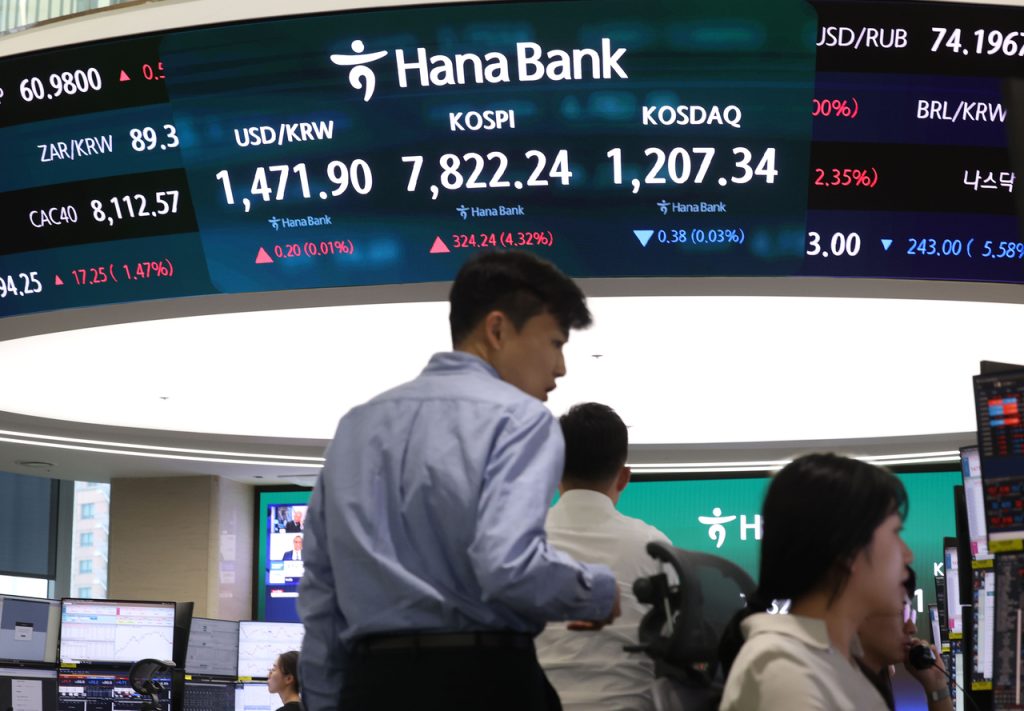
The South Korean stock market achieved a new record high on Monday, with the benchmark KOSPI index decisively surpassing the 7,800-point threshold. This remarkable fifth consecutive winning session was largely fueled by a robust bull run in semiconductor shares, even as geopolitical concerns persisted regarding a potentially troubled peace deal between the United States and Iran.
Specifically, the benchmark Korea Composite Stock Price Index (KOSPI) witnessed a substantial surge of 324.24 points, marking a 4.32 percent increase. It closed at a fresh record high of 7,822.24, having earlier touched an intraday peak of 7,899.32.
This historic fifth consecutive record-breaking session positions the KOSPI firmly on a trajectory towards the unprecedented 8,000-point milestone, signaling strong market momentum.
Driven by this impressive market bull run, the combined market capitalization of South Korea’s main KOSPI exchange and the secondary KOSDAQ bourse collectively exceeded 7,000 trillion won (approximately $4.75 trillion) for the very first time in history on Monday.
This significant achievement follows earlier milestones, as the combined market capitalization of KOSPI and KOSDAQ had previously topped 4,000 trillion won on January 2nd and surged past 6,000 trillion won by April 27th, illustrating rapid growth.
Trading activity was robust, with investors exchanging 723.4 million shares valued at a substantial 50.2 trillion won during Monday’s session alone.
Domestic retail investors and institutional players were net buyers, acquiring local shares totaling 2.9 trillion won and 630 billion won, respectively. Their buying power effectively counteracted a notable 3.5 trillion-won sell-off by foreign investors.
The primary catalyst for Monday’s significant market surge was a sharp increase in the value of large-capitalization semiconductor stocks. This rally occurred even amidst heightened concerns that peace negotiations between the United States and Iran were nearing a breakdown.
Earlier in the day, US President Donald Trump had deemed Iran’s peace offer unacceptable, further intensifying fears of a prolonged Middle East crisis and its potential global implications.
Despite these geopolitical headwinds, investor confidence and a “risk-on” appetite were significantly buoyed by optimism surrounding the sustained growth in semiconductor demand. This demand is closely tied to the accelerating artificial intelligence (AI) infrastructure investment cycle and recent robust tech sector gains observed on Wall Street, noted Lee Kyoung-min, an analyst at Daishin Securities.
Lee Kyoung-min further projected that South Korea’s monthly semiconductor exports are anticipated to achieve an all-time high in May, reflecting robust global demand for advanced chips.
Supporting this forecast, government data released earlier Monday revealed that Seoul’s chip exports for the first 10 days of the month soared by nearly 150 percent year-on-year, reaching a record-breaking $8.54 billion.
This positive sentiment for technology stocks was also echoed globally; on Friday, major US stock indexes closed higher, significantly propelled by surges in both semiconductor and artificial intelligence (AI)-related shares.
Notable performances included Micron, which soared 15.49 percent, AMD jumping 11.44 percent, and Nvidia experiencing a 1.75 percent increase, underscoring the strong sector-wide growth.
However, Lee Kyoung-min cautioned that the KOSPI’s impressive ascent is predominantly being driven by gains concentrated within a limited number of key semiconductor and other large-capitalization shares, suggesting a somewhat narrow market breadth.
Indeed, on Monday, a significant 735 companies within the KOSPI index experienced declines, contrasting sharply with only 147 companies that registered gains, highlighting this concentrated growth.
Among the top performers, market leader Samsung Electronics soared by 6.33 percent, reaching 285,500 won, while its major chipmaking competitor, SK Hynix, skyrocketed an impressive 11.51 percent to 1.88 million won. Both companies achieved new all-time high valuations.
AI investment firm SK Square also saw substantial gains, jumping 8.11 percent to close at 1.19 million won.
The automotive sector also performed strongly, with industry giant Hyundai Motor climbing 5.38 percent to 646,000 won. Its affiliate, Kia, escalated 6.2 percent to 174,700 won, and auto parts manufacturer Hyundai Mobis expanded 8.64 percent to 553,000 won, showcasing broad strength across the Hyundai Motor Group.
South Korean shipbuilders experienced a bullish session, buoyed by news that South Korea and the United States had signed a memorandum of understanding aimed at advancing bilateral shipbuilding cooperation and innovation.
Leading companies in the shipbuilding sector saw significant increases: HD Hyundai Heavy rose 4.1 percent to 685,000 won, Hanwha Ocean added 3.49 percent to 130,500 won, and HD Korea Shipbuilding gained 4.87 percent, closing at 474,000 won.
Conversely, not all sectors participated in the rally. Electrical shares notably lost ground, primarily due to profit-taking sentiment following their recent strong performance and rally.
Key players in the electrical sector saw declines, with HD Hyundai Electric dropping 2.92 percent to 1.36 million won and LS Electric decreasing by 2.88 percent to 304,000 won.
Other significant declines included leading battery maker LG Energy Solution, which dipped 1.78 percent to 468,000 won, and power plant manufacturer Doosan Enerbility, pulling back 1.23 percent to 128,000 won, indicating mixed performance outside the core tech rally.


