An escalating labor dispute at Samsung Electronics, centered on bonus distribution, is capturing significant global attention. Concerns are mounting that potential disruptions at the world’s largest memory chip manufacturer could send ripples throughout the vital global semiconductor supply chain.
The union is pushing for the elimination of caps on performance-based bonuses and demanding payouts equivalent to 15 percent of operating profit, a sum estimated around 45 trillion won ($31 billion). Should negotiations fail, the union has announced plans for a walkout on May 21, commencing with a rally near Samsung Chairman Lee Jae-yong’s residence in Yongsan-gu, Seoul.
The stakes are high, impacting not only Samsung’s financial performance but also the stability of an already strained global tech ecosystem, which increasingly relies on advanced AI chips.
Production Risks and Global Supply Chain Concerns
Fears of significant disruption are fueled by the immense scale of Samsung’s chip manufacturing operations. Industry estimates suggest that a complete shutdown of its chip plants could cost the company tens of billions of won per minute, equating to approximately $677 million daily.
However, the actual production impact might prove less severe than initial projections suggest.
“Semiconductor manufacturing lines are heavily automated, roughly 90 percent, meaning the direct impact of a strike is likely to be contained,” an anonymous former semiconductor engineer commented. “Our clients are well aware of this level of automation.”
Unlike industries that are highly labor-intensive, semiconductor fabrication plants (fabs) are engineered for continuous operation with minimal human intervention, making them inherently more resilient to work stoppages.
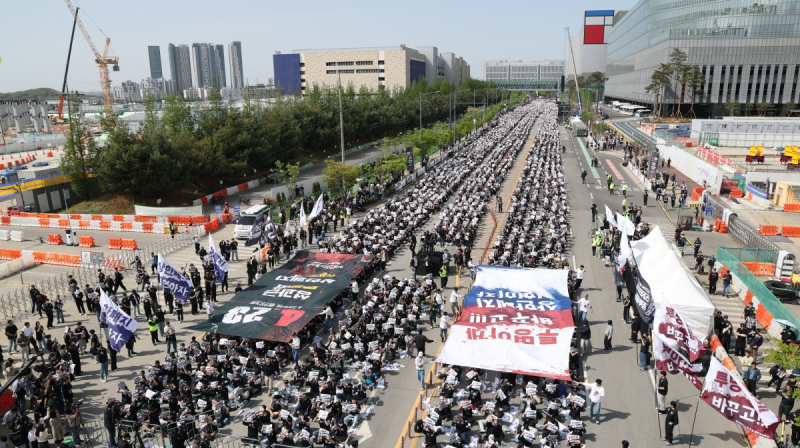
Nevertheless, even limited labor action has already caused efficiency dents. During a recent overnight rally involving approximately 40,000 union members at Samsung’s expansive Pyeongtaek chip complex in Gyeonggi Province, memory fabs reportedly experienced an 18.4 percent decline in production performance, while foundry lines saw a sharper plunge of 58.1 percent during the shift, according to union reports.
The timing of this dispute is particularly critical. The semiconductor market is currently navigating a period of tight supply, especially for the advanced memory components crucial for AI servers and accelerators.
Samsung holds a pivotal position within this ecosystem, alongside key competitors like TSMC and SK hynix. Any prolonged disruption, even a partial one, carries the risk of exacerbating existing supply bottlenecks.
KB Securities estimates that a potential strike could disrupt approximately 3 percent of the global memory chip supply.
Despite this, concerns that competitors such as SK hynix or TSMC could quickly capitalize on Samsung’s challenges might be overstated.
Much of Samsung’s production output is governed by long-term supply agreements. Furthermore, inventory buffers strategically placed across the supply chain could help absorb short-term shocks, as noted by Kim Yang-paeng, a researcher at the Korea Institute for Industrial Economics and Trade.
“In the short term, it’s exceptionally challenging for customers to drastically alter suppliers due to established contracts and rigorous qualification processes,” Kim explained.
Moreover, leading-edge semiconductor capacity across the industry is already largely fully booked, leaving minimal room for rivals to readily absorb sudden shifts in demand.
Still, Samsung’s resolution of the dispute could significantly influence future contracts, especially given that supply stability remains a top priority for major clients such such as Nvidia and AMD.
“Global big tech clients might start exploring alternative suppliers like TSMC as a strategy to diversify risk,” stated Song Heon-jae, an economics professor at the University of Seoul. “In the semiconductor industry, where process verification demands enormous investments of time and money, customers who choose to leave are notoriously difficult to win back.”
The more immediate financial impact, however, could manifest in profitability. Citigroup’s analysis suggests that integrating the union’s demands into earnings forecasts could potentially lower Samsung’s operating profit projections for 2026 and 2027 by an estimated 10 to 11 percent.
Rival Approaches to the AI Profit Boom
Beyond immediate production concerns, the dispute illuminates a broader industry-wide debate on how to fairly share the substantial profits generated by the current AI boom.
Samsung’s labor union contends that inadequate bonuses could accelerate talent departures, particularly to rival SK hynix, which has emerged as a leader in advanced AI memory technologies.
“Even now, new employees are forming study groups as soon as they join the company, specifically to prepare for moving to SK hynix,” shared one Samsung chip employee.
Other leading chipmakers, however, employ diverse compensation structures that do not directly link payouts to annual operating profit.
Last year, SK hynix notably removed caps on performance bonuses through a labor agreement. This pact guarantees employees incentives tied to 10 percent of operating profit for the next decade, a structure that has led to unusually large payouts during the recent AI memory boom.
Conversely, major US chipmakers like Nvidia lean more heavily on stock-based compensation and long-term incentives, which are directly correlated with company valuation and growth.
At Nvidia, the dramatic surge in share prices during the AI boom has significantly boosted employee wealth. CEO Jensen Huang has consistently highlighted employee compensation as a critical strategic investment for the company’s future.
Samsung management, meanwhile, emphasizes that sustaining its technological leadership necessitates continuous and substantial spending on research and development (R&D) and facility upgrades.
The company has announced plans to invest 110 trillion won this year in R&D and capital expenditures as it intensifies its efforts to solidify its leadership in AI semiconductors.
“The concept of distributing a fixed percentage of operating profit can certainly be meaningful from the perspective of employee motivation,” commented Kim Yong-jin, a business professor at Sogang University. “However, the criteria for such distributions need to become far more sophisticated and nuanced.”