South Korean Won Recovers to Pre-Conflict Levels as Kospi Surges to Record Highs
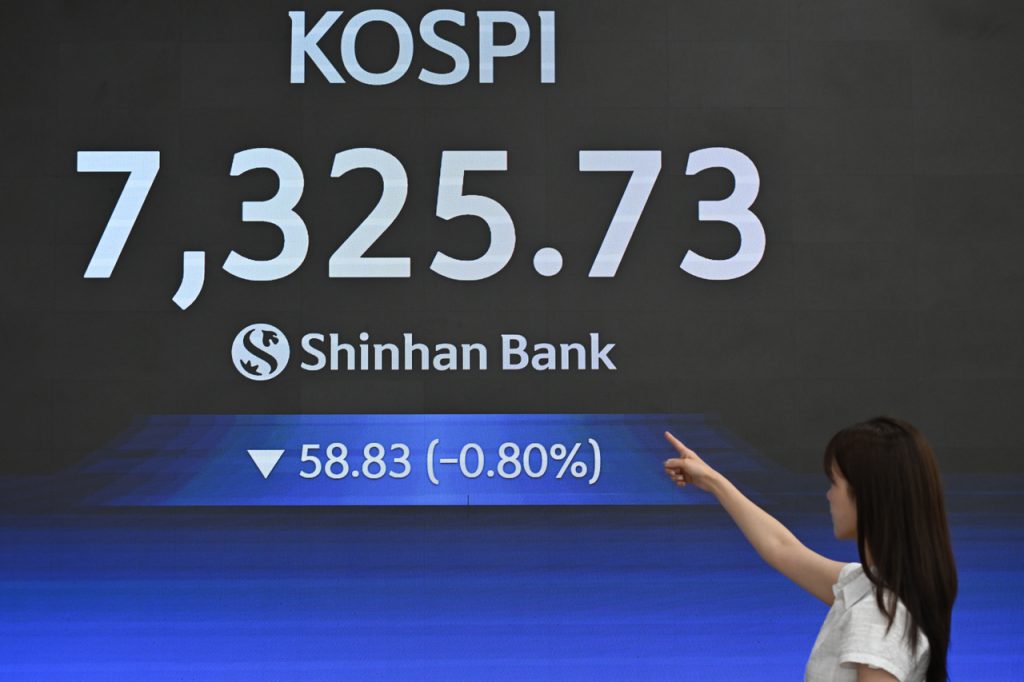
South Korea’s benchmark stock index, the Kospi, achieved an unprecedented milestone on Thursday, surpassing the 7,500-point mark for the first time in intraday trading. This significant surge extended the impressive gains recorded in the previous session, reflecting a strong upward momentum in the Korean stock market.
Despite reaching this historic peak, the index experienced considerable intraday volatility, oscillating between gains and losses as the session progressed.
Opening strongly at 7,499.07, a 1.55 percent increase from its previous close, the Kospi immediately renewed its intraday record high, which stood at 7,426.6 just a day earlier. The index quickly breached the 7,500 threshold, climbing to an impressive 7,531.88 in early trading. This followed a remarkable Wednesday session where the index had surged over 6 percent, breaking past the 7,000 mark for the very first time.
However, the momentum proved fleeting; after its brief stint above 7,500, the Kospi rapidly reversed course, dipping into negative territory and falling to an intraday low of 7,257.89. Throughout the trading day, the index repeatedly fluctuated between positive and negative gains, demonstrating significant investor indecision. By 2 p.m., the Kospi had settled at 7,400.32, registering a modest 0.21 percent gain for the session.
The role of foreign investors, often key market movers in the South Korean stock market, significantly shifted. After spearheading Wednesday’s breakthrough rally with a substantial 3.1 trillion won ($2.1 billion) in net purchases, foreign capital turned into a net seller on Thursday, thereby capping further upside potential for the index.
Thursday’s session witnessed massive trading volumes, underscoring the strong market activity. Retail investors exhibited robust confidence, net buying 5.6 trillion won in shares. This was largely counteracted by offshore investors, who aggressively offloaded a net 6.11 trillion won worth of shares. Meanwhile, institutional investors played a stabilizing role, becoming net buyers with purchases totaling 469 billion won on the main board.
Individual bellwether stocks also saw significant action. Samsung Electronics and SK Hynix, South Korea’s two preeminent semiconductor giants, both reached fresh record highs in early trading, touching 277,000 won and 1.648 million won per share, respectively. However, their performances diverged later in the session, reflecting the broader market’s mixed sentiment.
By the afternoon, Samsung Electronics settled flat at 266,000 won, while SK Hynix managed to hold onto gains, rising 0.75 percent to 1.61 million won. SK Square, the primary stakeholder in SK Hynix, experienced a slight dip, edging down 1.1 percent to 1.07 million won. Conversely, automotive giant Hyundai Motors demonstrated notable strength, climbing 4.18 percent to 573,000 won, indicating sector-specific positive momentum.
In contrast to the main board, the tech-heavy secondary Kosdaq index faced downward pressure, standing at 1,199.26 as of 2 p.m., marking a 0.90 percent decline for the session.
Despite the intraday fluctuations, market analysts remain optimistic about the overall trajectory of the South Korean market. They suggested that the current environment indicates healthy sector rotation rather than a broad market reversal, with the underlying upward momentum largely remaining intact.
“The market’s volatility widened after the Kospi briefly topped the 7,500 mark in early trading, primarily due to investors locking in profits, particularly in the artificial intelligence value-chain and defense sectors,” explained Kang Jin-hyuk, a prominent analyst at Shinhan Securities.
Adding to this positive outlook, Lee Jae-won, an analyst at Yuanta Securities, commented, “The uptrend for major players like Samsung Electronics and SK Hynix is expected to remain robust as their earnings estimates continue to show upward revisions, signaling sustained strength in the semiconductor sector.”
Concurrently, the South Korean Won (KRW) displayed significant strength, appreciating into the 1,440-per-dollar range – a level not seen since February 27, prior to the outbreak of the Middle East conflict. This resurgence in the Korean currency is largely attributed to an improving global risk appetite, fueled by increasing expectations for a ceasefire agreement involving the US and Iran.
The won opened strongly at 1,448.6 against the US dollar in onshore trading, marking a solid 6.5 won appreciation from the previous session’s close. By 2 p.m., it maintained a firm position, trading at 1,451.33 per dollar, reflecting sustained investor confidence in the Korean economy and a broader softening of the dollar against major currencies.
silverstar