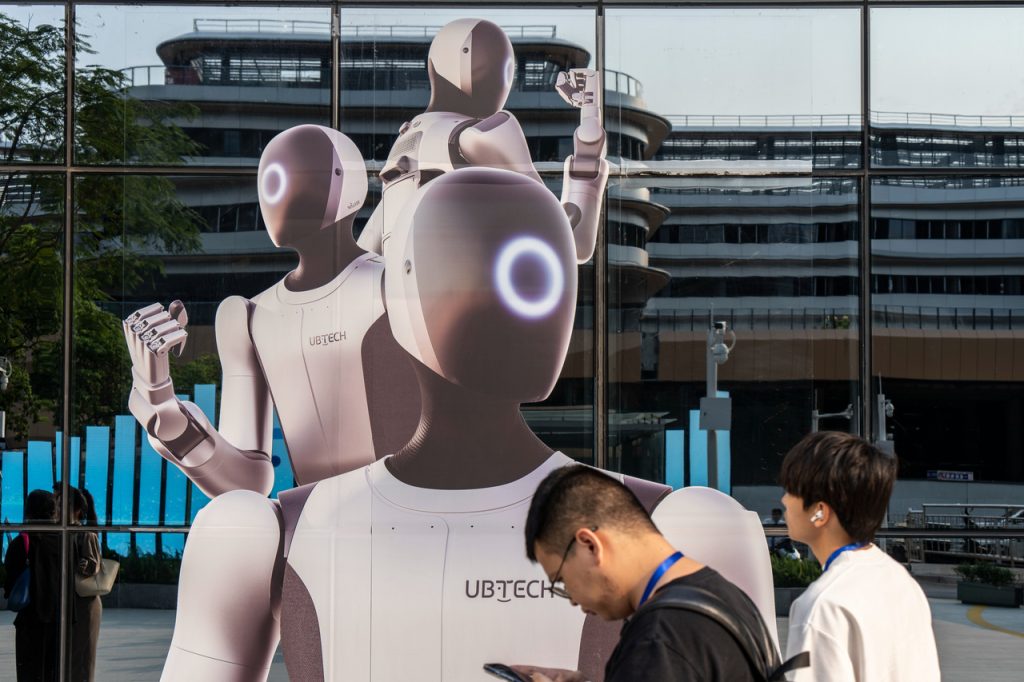
State backing, talent scale, and integrated supply chains propel China’s leadership in humanoid robotics
China has firmly established itself as the global leader in the rapidly expanding field of humanoid robotics. As this sector emerges as the next frontier in advanced manufacturing, nations like Korea, the US, and other international rivals are intensifying their efforts to catch up.
This dominance is the result of years of strategic, coordinated policy support, extensive academia-driven research, and highly integrated industrial ecosystems—a successful blueprint that closely mirrors China’s rise to prominence in the electric vehicle industry.
“China’s impressive progress in robotics is not attributable to a single factor,” observed Li-Wei Zhang, a distinguished professor of mechanical engineering and automation at Fuzhou University, who has collaborated extensively with local robotics firms.

In an exclusive written interview with The Korea Herald, Professor Zhang underscored three critical pillars underpinning China’s leadership in humanoid robot development: consistent government backing, a robust and deep talent pipeline, and a comprehensively integrated value chain.
China’s strategic policy advantage in robotics began significantly earlier than Korea’s concerted efforts under its 4th Intelligent Robot Basic Plan (2024-2028).
While Korea’s initial robotics policies, dating back to 2009, primarily focused on foundational groundwork, China moved decisively to secure technological leadership. This began with its ambitious Made in China 2025 initiative in 2015, followed by the comprehensive Robot Industry Development Plan (2016-2020), and more recently, the “Guiding Opinions on the Innovation and Development of Humanoid Robots” plan introduced in 2023.
“While strong policy is crucial, strategic timing holds equal importance,” Zhang stated, drawing parallels to China’s early strategic entry into the electric vehicle (EV) sector, which followed a similar trajectory of early government support and investment.
He further highlighted the immense significance of regional industrial clusters strategically located across key cities such as Beijing, Shanghai, Shenzhen, and Hangzhou. Each hub specializes in distinct segments of the robotics ecosystem, ranging from advanced AI and core component manufacturing to complex system integration.
“These vibrant clusters generate a powerful demonstration effect,” Zhang explained, describing them as essential testbeds for both innovative policy experimentation and rapid prototyping in robot development.
China’s sheer scale advantage is equally pronounced when it comes to nurturing and deploying talent within the robotics industry.
Annually, roughly 12 million students graduate from Chinese universities, with over 5 million—or a staggering 41.7 percent—specializing in crucial science, technology, engineering, and mathematics (STEM) fields.
In stark contrast, Korea produces approximately 600,000 graduates each year, with STEM majors estimated at around 34 percent. This highlights a substantial disparity in both the proportional representation and absolute numbers of skilled professionals entering the workforce.
Professor Zhang emphasized the close collaborative relationships between Chinese universities and leading robotics firms like UBTECH and Leju Robotics, fostering a dynamic feedback loop that significantly accelerates commercialization and innovation.
“Researchers and engineers engage in direct collaboration with companies, enabling remarkably rapid iteration from initial prototype concepts to full-scale mass production of advanced robotics solutions,” he explained.
China’s most substantial structural advantage lies within its sophisticated industrial ecosystem for robotics.
The nation has successfully constructed a complete, end-to-end value chain encompassing raw materials, critical components, and the assembly of finished humanoid robots. Core parts—including high-precision sensors, powerful actuators, and dexterous robotic hands—are predominantly manufactured domestically, facilitating faster development cycles and greater control over production.
In key innovation hubs like Shenzhen, dense networks of specialized suppliers empower companies to swiftly test, refine, and iterate on their products, dramatically shortening the time to market for new robotic technologies.
China’s lead is increasingly validated and evident through compelling market data and industry statistics.
As of 2025, China is home to more than 140 dedicated humanoid robot manufacturers, collectively accounting for an impressive 84.7 percent of global shipments, according to robust industry estimates cited by Professor Zhang.
By comparison, US players in the humanoid robotics space largely remain at an earlier stage of commercialization. Tesla’s Optimus robot, for instance, has produced fewer than 1,000 units in its pilot runs, while Figure AI shipped approximately 150 units in the past year.
Chinese robotics firms are also demonstrating aggressive expansion and rapid product diversification. Over 300 distinct humanoid robot models had been unveiled by the end of 2025, Zhang noted, referencing official government data.
Leading Chinese players are strategically carving out distinct market niches: Unitree specializes in advanced quadruped and humanoid robots, Agibot focuses on highly dexterous robotic systems, UBTECH excels in diverse industrial applications, and Leju leads in innovative wheeled humanoid platforms.
Boston Dynamics remains a technological frontrunner
Despite the current market disparity, Professor Zhang highlighted the formidable technological prowess and innovative strength of Boston Dynamics, the renowned US-based robotics unit owned by Hyundai Motor Group.
“Boston Dynamics has consistently led the field for two decades and continues to maintain a highly competitive edge,” he affirmed, pointing to its exceptional engineering capabilities and strategic partnerships with tech giants like Nvidia and Google DeepMind.
The company has ambitious plans to significantly scale up production of its cutting-edge Atlas humanoid robot, aiming for an impressive 30,000 units annually by 2028.
However, Zhang suggested that partnership-based manufacturing models may ultimately prove more successful than the vertically integrated approaches currently pursued by companies such as Hyundai, Tesla, and XPeng.
He cited a recent pioneering collaboration between Leju Robotics and Dongfang Precision, which strategically separates design and manufacturing processes to achieve lower costs and enhanced production flexibility. These two firms commenced operations at China’s first automated humanoid robot factory in Guangdong in March, boasting an annual production capacity of 10,000 units.
While legitimate concerns regarding potential job displacement due to automation persist, Zhang affirmed that the humanoid robotics industry’s long-term trajectory remains overwhelmingly positive and transformative.
“Humanoid robotics will ultimately generate entirely new categories of employment, including essential maintenance, service, and support roles,” he stated, adding that both China and Korea are poised to significantly benefit from the sector’s anticipated expansion and maturation.
hyejin2