
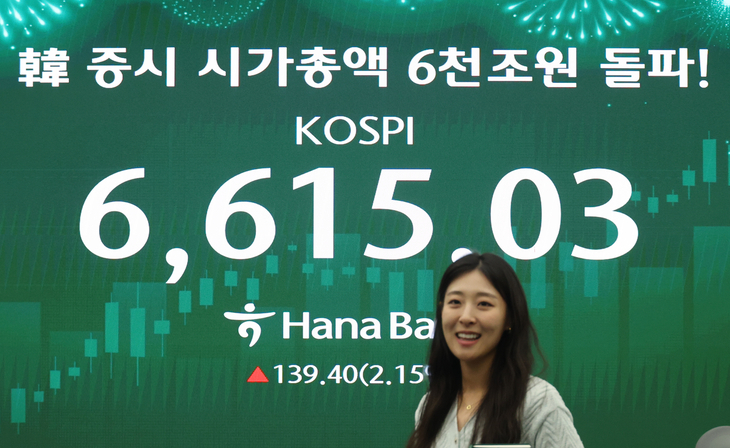
South Korea’s stock market has impressively ascended to become the eighth largest globally by market capitalization, recently surpassing the United Kingdom. This remarkable achievement is largely attributed to a robust market rally, significantly boosted by strong semiconductor industry performance and supportive government policies.
Data released by the Korea Exchange on Tuesday confirmed that the combined market capitalization of the benchmark Kospi and tech-heavy Kosdaq reached an unprecedented 6,101 trillion won (approximately $4.1 trillion) as of Monday’s market close.
Specifically, the main Kospi index contributed a substantial 5,421 trillion won to this total, while the Kosdaq index added 679 trillion won, highlighting broad market strength.
This global comparison firmly places South Korea’s equities market ahead of the UK, which holds a market cap of around $3.99 trillion. Korea now ranks eighth worldwide, following economic powerhouses such as the US, China, Japan, Hong Kong, India, Canada, and Taiwan.
The current year has witnessed an exceptional surge in local equities. The Kospi index has rallied an impressive 56.97 percent year-to-date, with the Kosdaq also experiencing significant growth of 32.49 percent. This momentum has propelled the combined market capitalization to expand by over 50 percent within the same period.
The primary catalysts for these substantial gains include heightened earnings expectations within the semiconductor sector, fueled by the booming artificial intelligence (AI) industry, alongside proactive government initiatives aimed at invigorating the domestic equity market.
Financial analysts suggest that this upward trend for Korean equities is likely to continue. They point out that Korean stocks remain fundamentally undervalued compared to their global counterparts, primarily because corporate profits have grown at an even faster pace than share prices.
Lee Young-won, an analyst at Heungkuk Securities, elaborated, stating, “Explosive growth in semiconductor earnings has pushed valuations to historically low levels, creating an attractive investment landscape.” He further added, “As confidence in the sustainability of these strong earnings builds, a recovery in price-to-earnings (P/E) ratios is anticipated, potentially driving the Kospi into the mid-7,000 range this year.”
For clarity, the price-to-earnings (P/E) ratio is a widely used metric for valuing a company’s share price. A lower P/E ratio typically indicates that shares are relatively inexpensive when weighed against a company’s profits, suggesting potential for future appreciation.
Echoing this sentiment, Kim Jun-young of iM Securities highlighted the continuous sharp increase in earnings estimates, predominantly led by the robust semiconductor industry.
“Operating profit for Kospi-listed firms is now projected to hit approximately 800 trillion won this year,” he stated, projecting further growth of 20.6 percent to an estimated 959 trillion won in the upcoming year.
This optimistic outlook suggests that South Korea’s equity market is poised to enter a significant re-rating phase, underpinned by strengthening economic fundamentals and sustained, growing investor interest.
jylee


