
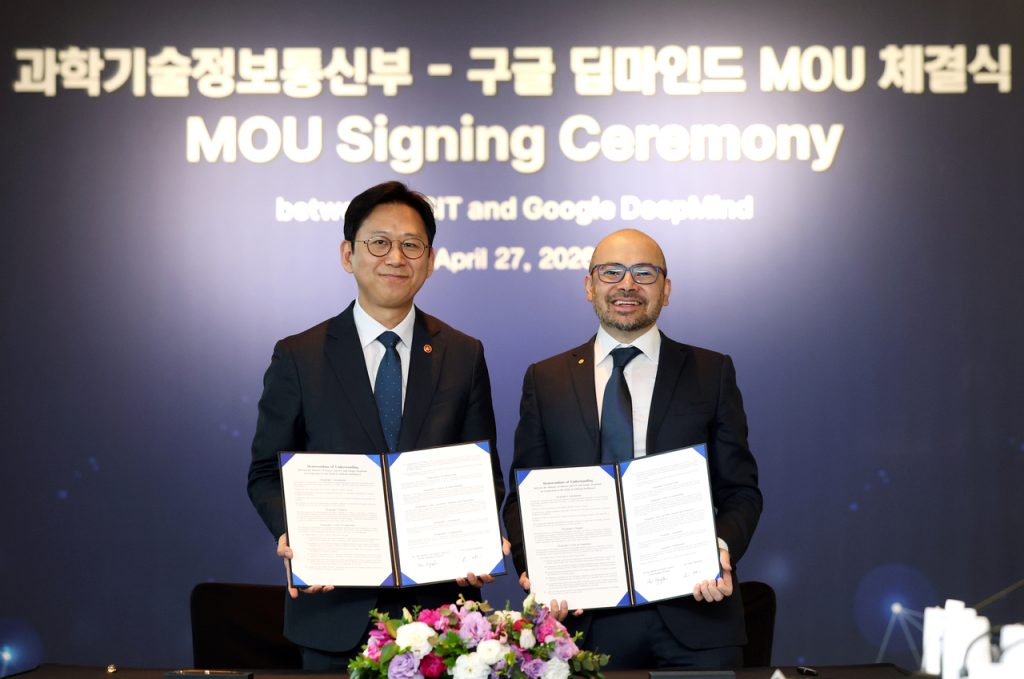
Seoul’s Ministry of Science and ICT (MSIT) announced Monday a landmark agreement with Google DeepMind, committing to advance cutting-edge artificial intelligence (AI)-powered scientific research, cultivate top-tier AI talent, and champion the responsible development and use of AI technology.
Deputy Prime Minister and ICT Minister Bae Kyung-hoon, alongside Demis Hassabis, the renowned co-founder and CEO of Google DeepMind—architects behind the revolutionary AlphaGo—officially signed the memorandum of understanding (MOU) in Seoul. This significant event solidifies closer strategic cooperation between South Korea and Google DeepMind, a global leader in artificial intelligence research and innovation.
The signing ceremony took place at the prestigious Four Seasons Hotel Seoul, a venue famously remembered as the site where Google DeepMind’s groundbreaking AlphaGo challenged Korean Go master Lee Se-dol in 2016. That pivotal match remains a defining moment in the global narrative surrounding the capabilities and future of artificial intelligence.
According to the MSIT, this latest agreement holds profound meaning, coinciding with the upcoming 10th anniversary of the historic AlphaGo match. It aims to significantly build upon that powerful legacy through enhanced cooperation in advanced science and technology.
Google DeepMind has consistently demonstrated AI’s transformative potential in scientific discovery, notably through AlphaFold, its revolutionary protein structure prediction model. For this monumental achievement, Demis Hassabis shared the 2024 Nobel Prize in Chemistry, underscoring AI’s impact on scientific breakthroughs.
Crucially, this partnership is deeply integrated with Korea’s ambitious “K-Moonshot” project. This national strategic program leverages artificial intelligence and advanced science and technology to tackle major national challenges and dramatically enhance research productivity across various sectors.
The Korean government harbors an ambitious target: to double research productivity in science and technology by 2030, powered by AI. By 2035, the K-Moonshot initiative aims to successfully address 12 critical national missions spanning eight strategic technological areas, including advanced biotechnology, innovative materials, future energy solutions, physical AI, space exploration, cutting-edge semiconductors, and quantum technology.
Through this agreement, the MSIT and Google DeepMind are set to collaboratively explore pivotal cooperation in high-impact domains such as life sciences, advanced weather and climate modeling, and sophisticated AI systems specifically engineered to accelerate scientific discovery and innovation.
The newly established National Science AI Research Center, slated to commence operations next month, will emerge as a central platform for this groundbreaking collaborative work. Both parties are committed to fostering extensive joint research initiatives, facilitating vital researcher exchanges, and focusing on the rigorous development and validation of advanced AI models and tools. Further areas of collaboration include optimized utilization of scientific data and strategic partnerships centered on AI-driven bio innovation research hubs.
Furthermore, the partnership will actively pursue invaluable internship opportunities for bright and promising Korean AI researchers. This initiative will provide them direct exposure to Google DeepMind’s world-class research environment, nurturing the next generation of AI innovators.
In a significant move, Google intends to establish an AI campus within Korea, specifically designed to broaden cooperation with leading universities, independent researchers, and innovative startups. This dedicated campus is projected to become a pivotal hub for AI-based science and technology collaboration, directly aligning with and reinforcing the objectives of the K-Moonshot project.
A crucial component of this comprehensive agreement also encompasses cooperation on the vital areas of AI safety and governance. The MSIT and Google DeepMind are committed to undertaking joint research on robust safety frameworks and essential safeguards for advanced AI models. They will also sustain ongoing discussions regarding cutting-edge testing methods and evolving safety frameworks, particularly in conjunction with Korea’s nascent AI Safety Institute.
“While AlphaGo dramatically unveiled the AI era a decade ago, we are now transitioning into a transformative stage where AI is poised to resolve intricate scientific challenges and deliver a profound, tangible impact on people’s everyday lives,” stated Deputy Prime Minister Bae Kyung-hoon.
He further elaborated, “This MOU, signed today, represents a pivotal milestone for Korea, poised to significantly accelerate AI innovation driven by the K-Moonshot initiative. Concurrently, it will foster robust collaboration between our two institutions to advance global best practices and cutting-edge research dedicated to the development of safe and responsible artificial intelligence.”
Demis Hassabis remarked, “We are incredibly proud of our enduring connection with Korea, which served as the historic crucible for the AlphaGo match—the definitive moment that truly ignited the modern AI era. Our new, strategic partnership builds powerfully on that legacy, aiming to push the absolute boundaries of bio-innovation and advanced weather prediction, while simultaneously dedicated to exploring the crucial guardrails and ethical frameworks essential to guide the responsible and beneficial development of AI.”
To ensure robust progress and effective implementation, both parties will establish a dedicated joint working group to diligently follow up on this comprehensive agreement. Structured engagement will include quarterly video meetings and annual in-person gatherings to meticulously discuss specific project initiatives and detailed implementation plans.
yeeun


