
Hyundai Accelerates US EV Market Challenge to Tesla with Diverse Electric Vehicle Lineup
Hyundai Motor’s electric vehicle (EV) sales in the U.S. surged in March, driven by rising oil prices and increasing consumer demand, intensifying its competition with market leader Tesla.
Industry sources reported that Hyundai’s U.S. EV sales climbed approximately 40 percent in March compared to the previous month. The popular Ioniq 5 crossover SUV spearheaded this growth, achieving 4,425 units sold – a 37 percent increase from 3,234 in February. The Ioniq 9 SUV also demonstrated significant momentum, surging 79 percent to 905 units from 505 during the same period.
Consequently, first-quarter sales (January to March) for the Ioniq 5 reached 9,765 units, marking a 13.4 percent rise from 8,610 units a year prior. The Ioniq 9, another key Hyundai electric vehicle, achieved its highest monthly sales volume since September.
Automotive market analysts largely attribute the strong increase in Hyundai’s battery-electric vehicle (BEV) sales to elevated oil prices. This trend is encouraging consumers to transition from internal combustion engine (ICE) vehicles, even following the discontinuation of up to $7,500 in federal EV subsidies last September.
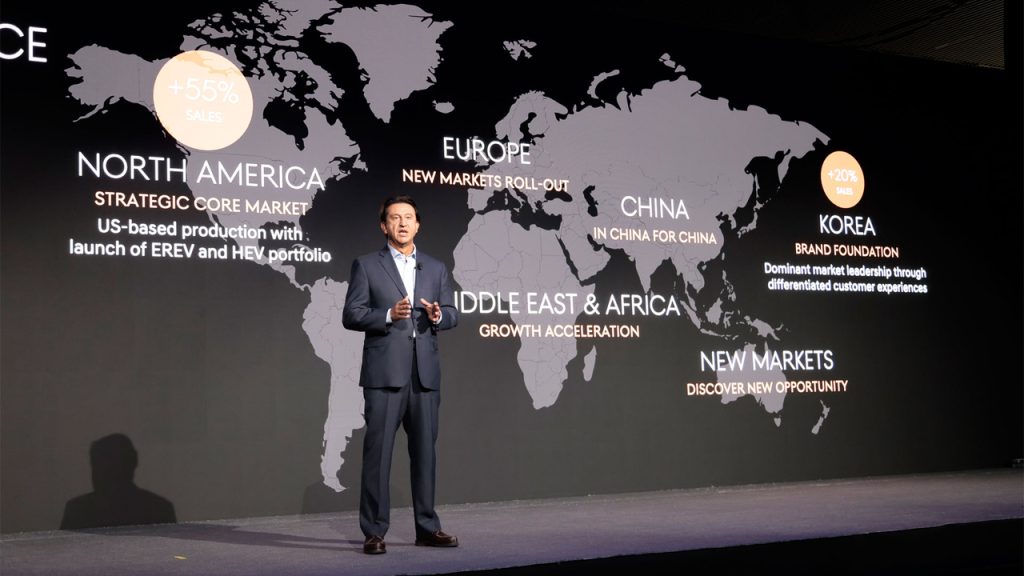
Recognizing this significant market shift, Hyundai Motor Company CEO Jose Munoz stated at the 2026 Milan Design Week on April 20th that “As fuel costs rise, consumers naturally seek more economical transportation alternatives.”
Specifically, U.S. gasoline prices have seen a sharp and sustained increase, exceeding the $4-per-gallon ($1.06 per liter) threshold in March for the first time in over three years. This escalation is largely due to supply chain disruptions stemming from ongoing Middle East conflicts. The American Automobile Association reported that the national average price for regular gasoline jumped 30 percent year-over-year to $4.099 per gallon ($1.08 per liter) as of Friday.
Automotive industry experts suggest that even with a resolution to current geopolitical tensions, the era of inexpensive oil may be concluding. Structurally higher fuel prices are anticipated to endure globally, particularly within the U.S. market, thereby strengthening Hyundai’s strategic initiative to broaden its electric vehicle lineup across the region.
Professor Kim Pil-su, an automotive engineering expert at Daelim University, commented, “In the U.S., the accelerated rise in fuel costs is significantly expediting the transition towards hybrid and electric vehicles. The robust demand for Hyundai’s Ioniq EV lineup, even without federal subsidies and despite EVs costing approximately 1.5 times more than traditional internal combustion models, underscores a distinct shift in consumer preferences.”
In the first quarter, Hyundai’s share of the U.S. EV market (excluding Kia) slightly increased from 5.6 percent to 6 percent year-over-year. Although still considerably lower than Tesla’s dominant 54.2 percent, Professor Kim observed that Hyundai, the South Korean automaker, is expanding its market presence through a more diverse EV lineup. This contrasts with Tesla’s strategy, which relies on a narrower range of core models like the Model 3 sedan and Model Y SUV, often with longer product cycles.
Conversely, Cox Automotive estimates indicate that despite its strong market share, Tesla’s U.S. sales declined during the January-March period, marking its third consecutive year of first-quarter decreases. The leading EV manufacturer, which exclusively produces battery-powered vehicles, sold 117,300 units, representing its lowest quarterly total since late 2021 and an 8.4 percent reduction compared to the previous year.
In a broader context, Hyundai Motor and Kia combined also experienced a 21.6 percent decrease in U.S. EV sales, totaling 18,086 units. However, robust demand for hybrid vehicles significantly mitigated this decline, with hybrid sales surging 53.2 percent to 97,627 units. This uplifted their combined total eco-friendly vehicle sales by 33.3 percent to 115,713 units, with eco-friendly models representing 26.8 percent of their overall sales.
Looking ahead, Hyundai is significantly increasing its local production efforts to solidify its presence in the competitive U.S. eco-friendly vehicle market. The company projects to boost its U.S. production share to over 80 percent by 2030. Its Georgia manufacturing plant is on track to achieve an annual production capacity of 500,000 units by 2028, assembling a diverse range of 10 models, encompassing both hybrids and electric vehicles.
hyejin2


