
University of Seoul Professor Warns Samsung Electronics Strike Risks Customer Confidence, Chip Competitiveness
Samsung Electronics faces significant long-term risks beyond immediate production losses if its labor union proceeds with a planned strike next month. An economist has cautioned that such a disruption could severely damage customer confidence, compromise supply chain reliability, and undermine Korea’s vital semiconductor competitiveness.
On Sunday, industry sources revealed that Professor Song Heon-jae, an economics expert at the University of Seoul, warned at a recent Ahnmin Policy Forum seminar about the severe financial impact of a chip plant shutdown. He estimated that a halt in Samsung’s chip production could cost the company tens of billions of won—equivalent to several million dollars—every minute, potentially reaching approximately 1 trillion won ($677 million) per day. A prolonged strike, Professor Song added, could reduce chip operating profit by as much as 10 trillion won.
Professor Song emphasized that the more critical danger isn’t the direct production downtime but the potential erosion of Samsung’s reputation as a dependable supplier in the global market.
“Major global tech clients might start seeking alternative suppliers like TSMC to diversify their risk,” Song explained. “In the semiconductor industry, where the process of verifying new suppliers demands immense time and financial investment, customers who switch are incredibly difficult to regain.”
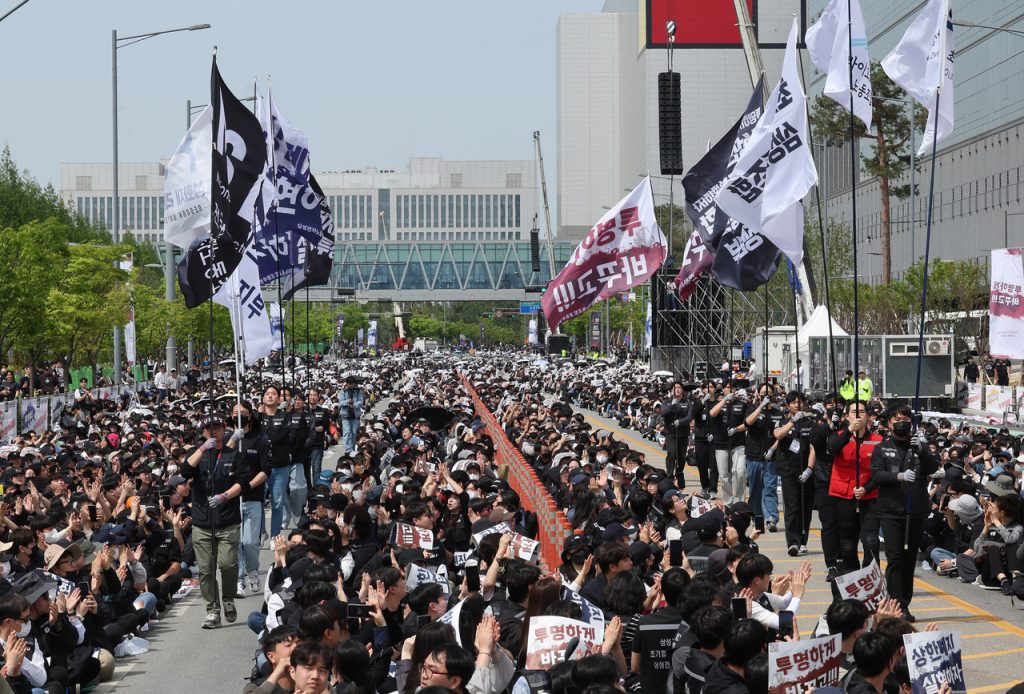
The joint labor action committee, representing the Samsung Electronics Labor Union, the National Samsung Electronics Union, and Samsung Electronics Labor Union Donghaeng, reported that production at the Pyeongtaek chip complex in Gyeonggi Province experienced disruption during the night shift. This occurred after tens of thousands of union members gathered for a rally at the site on Thursday.
According to the coalition, around 40,000 union members participated in the rally. During the 10 p.m. to 6 a.m. shift, “moving” – the union’s term for production performance – reportedly dropped by 18.4 percent in memory fabrication plants and a substantial 58.1 percent in foundry fabs.
Professor Song highlighted that key customers such as Advanced Micro Devices (AMD) and Nvidia prioritize supply stability above all else. Even a limited disruption, he noted, could deal a significant blow to Samsung’s credibility with these crucial partners.
The broader consequences, he further elaborated, might not immediately reflect in earnings reports. He cited potential risks including a decline in customer trust, market share losses as clients absorb switching costs, missed strategic opportunities in the fiercely competitive AI chip development race, the departure of critical talent, and a worsening “Korea discount” in investment perception.
“Semiconductor technology can rapidly lose its edge after falling behind by just one or two years,” Professor Song stated. “At a time when industry giants like Nvidia, TSMC, and Intel are locked in a battle for leadership in AI chips, Samsung cannot afford to divert valuable resources to internal disputes.”
During Thursday’s rally, the committee demanded the removal of the current cap on performance-based bonuses. They also announced plans to initiate a general strike from May 21 to June 7.
The unions are advocating for increased transparency in bonus calculations, the elimination of the existing cap that limits performance-based pay to 50 percent of annual salary, and a formal commitment to allocate 15 percent of operating profit specifically for the bonus pool.
The planned walkout is expected to commence with a gathering near the residence of Samsung Electronics Chairman Lee Jae-yong in Yongsan-gu, Seoul. The Samsung Electronics Labor Union filed a rally notification with the Yongsan Police Station on Friday for an event scheduled near Lee’s home at approximately 1 p.m. on May 21, marking the first day of the proposed strike.
While the notice listed about 50 participants, a union official indicated that the turnout could still change. The official also suggested that the event might resemble a press briefing on the strike plan more closely than a full-scale protest.
If implemented, this would be only the second general strike in Samsung Electronics’ history since its establishment in 1969, following a 25-day walkout that occurred in July 2024.
yeeun


