CJ CheilJedang, a leading South Korean food company, has unveiled its groundbreaking, fully automated production line dedicated to frozen gimbap. This strategic move aims to proactively address the escalating global appetite for this popular Korean rice roll.
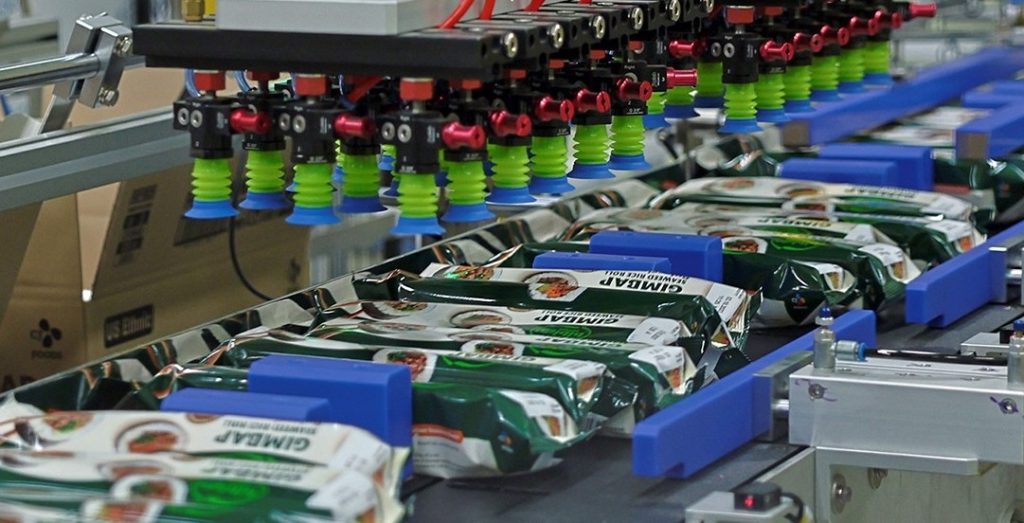
The state-of-the-art facility, located at the company’s Jincheon campus in North Chungcheong Province, is the culmination of an 18-month development initiative. The company engineered specialized equipment to automate every step of the gimbap production process, from precisely loading fillings into rice to meticulously slicing and packaging the finished rolls into trays.
CJ CheilJedang emphasized that the automated system is built according to strict international hygiene standards. The system is engineered to maximize production output and minimize inconsistencies in roll weight. Furthermore, the production line employs precise heat-treatment controls to optimize the texture and flavor of each ingredient, complemented by rapid-freezing technology to ensure sustained quality throughout distribution and storage.
This significant investment underscores the company’s commitment to meeting the growing demand for its Bibigo-branded frozen gimbap. Launched in 2023 as a key component of CJ CheilJedang’s Korean food globalization strategy, Bibigo gimbap is now available in six varieties across 25 countries.
Since its introduction, Bibigo gimbap has achieved impressive global sales, exceeding 8 million units. The brand has experienced an average annual revenue growth of approximately 130 percent. CJ CheilJedang has announced plans for further export expansion, specifically targeting markets in the United States, Europe, and Australia.
“This investment is not simply about expanding production capacity, but a strategic step to accelerate the global reach of K-food,” stated a company representative. “Our goal is to establish Bibigo gimbap as the definitive K-gimbap brand worldwide.”
The launch of the automated gimbap facility coincides with a significant milestone for CJ CheilJedang: for the first time, overseas food sales have surpassed domestic revenue. Overseas food sales reached 5.92 trillion won ($4 billion) of the food unit’s total annual revenue of 11.52 trillion won. This trend was particularly pronounced in the fourth quarter, with overseas food sales reaching a record 1.61 trillion won, while domestic revenue declined by 3.8 percent.