
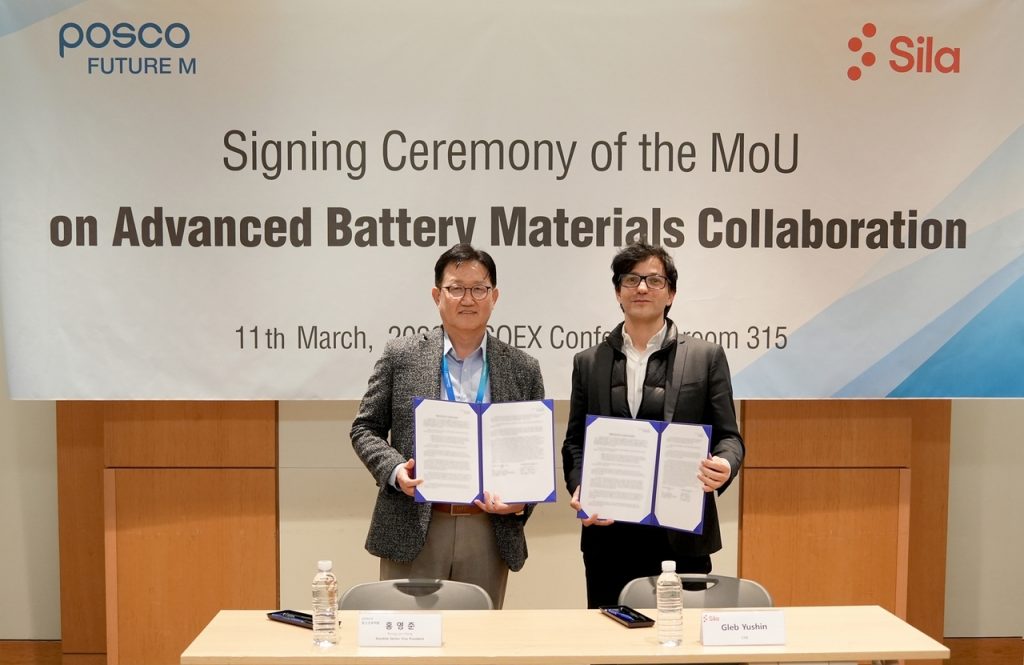
Posco Future M announced Friday a collaborative agreement with Sila, a leading US battery materials innovator, to advance the development of next-generation battery materials with a focus on enhanced battery lifespan. The partnership aims to improve electric vehicle (EV) performance and battery technology.
The memorandum of understanding was formalized on Wednesday in Seoul, with key representatives in attendance, including Hong Young-jun, Head of R&D Center at Posco Future M, and Gleb Yushin, Founder and Chief Technology Officer of Sila.
This strategic alliance will leverage Posco Future M’s profound knowledge in cathode, anode, and carbon materials alongside Sila’s pioneering silicon anode technology to expedite the creation of state-of-the-art battery components.
Silicon anodes possess the capability to store up to ten times more energy compared to conventional graphite anodes, presenting a significant opportunity to extend the driving range of EVs and enable faster charging capabilities. These advancements aim to enhance the performance of next-generation batteries.
A key challenge with silicon anodes lies in their substantial expansion during charging and discharging cycles, which can lead to structural degradation and a reduction in battery lifespan. The joint effort will concentrate on mitigating this issue through the application of carbon nanomaterial technologies to effectively manage expansion and boost overall battery durability. This will contribute to the development of high-performance batteries.
Currently, silicon anodes are typically incorporated in limited quantities — around 4 to 5 percent when mixed with graphite anodes — due to prevailing technical challenges. Ongoing industry-wide initiatives focused on improving silicon anode stability are expected to accelerate the widespread commercialization of batteries with higher silicon content. The collaborative development aims to push the boundaries of current battery technology.
The partnership will also delve into strategies for improving the cost-effectiveness of silicon anodes by integrating Posco Future M’s carbon material technologies. This effort targets the production of affordable, high-performance battery materials.
“Beyond technological innovation, we plan to broaden our collaboration across the entire battery supply chain,” stated Hong Young-jun.
Furthermore, at the InterBattery 2026 exhibition held in Seoul this week, Posco Future M showcased the latest research advancements from its partners, including Sila and all-solid-state battery startup Factorial Energy, within its dedicated Open Innovation zone. This demonstrated the company’s commitment to collaborative research and development in the battery industry.
hyejin2


