
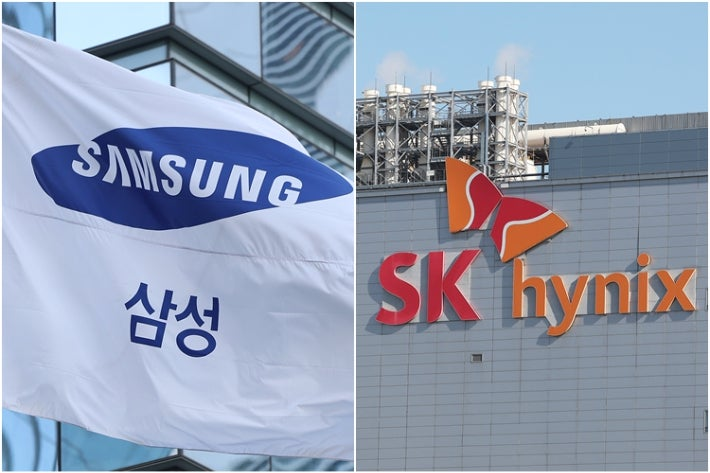
Despite a significant `semiconductor market selloff` that saw shares tumble, `single-stock leveraged exchange-traded funds (ETFs)` tracking `South Korea’s top chipmakers` have attracted over 7 trillion won (approximately $4.73 billion) in net inflows over the past month. This surge in `ETF inflows` highlights a counter-intuitive investment trend in the volatile `Korean stock market`.
According to data released by the `Korea Exchange` on Friday, a total of sixteen single-stock leveraged ETFs, including two inverse products, targeting `Samsung Electronics` and `SK hynix` collectively drew 7.34 trillion won in net inflows between June 16 and Wednesday.
The `Kodex SK hynix Single Stock Leverage ETF` led these investments, recording the highest inflow among all ETFs listed in Korea during this period, at 3.45 trillion won. It was closely followed by the `Kodex Samsung Electronics Single Stock Leverage ETF`, which attracted 1.51 trillion won. The `Tiger SK hynix Single Stock Leverage ETF` also saw substantial interest with 1.43 trillion won in inflows, while the `Tiger Samsung Electronics Single Stock Leverage ETF` added 693.8 billion won.
This robust investor interest occurred even as the underlying `chipmaker stocks` faced steep declines. Over the same period, `Samsung Electronics` experienced a 17.06 percent drop, and `SK hynix` shares fell by 9 percent. The `leveraged ETFs` themselves performed even worse, plunging more than 30 percent, with `Samsung Asset Management’s Kodex products` suffering losses exceeding 40 percent.
South Korea Implements New Curbs on Leveraged ETFs Amid Volatility Concerns
The role of `leveraged chip ETFs` in amplifying `market volatility` has prompted `Korean regulators` to introduce tighter restrictions on these financial products. The new measures aim to curb speculative trading and protect investors.
Under the revised `ETF regulations`, the `minimum deposit requirement` for investors engaging with these products will be tripled, rising from 10 million won to 30 million won. This move is expected to limit access for smaller, potentially less experienced, investors.
Furthermore, these ETFs will now be subject to a `minimum trading unit` of 20 shares, a significant shift from the previous one-share increment. This change is anticipated to dampen overall `trading activity` and reduce rapid price fluctuations.
Additionally, regulators have announced a suspension on `new listings` of `leveraged ETFs` tied to individual stocks, further tightening the market for these high-risk instruments.
However, market analysts are questioning the efficacy of these new curbs in deterring speculation. Kang Jin-hyuk, an analyst at Shinhan Securities, commented, “The market appears to be interpreting the measures as only a modest tightening of the existing regulations. Since the announcement, disappointment-driven selling in `Samsung Electronics` and `SK hynix` has emerged on the after-hours market,” suggesting the initial response has been muted or even negative for some underlying assets.
silverstar


