
Hiring across R&D, quality and global sales signals LG’s push toward external actuator supply
LG Electronics is significantly strengthening its robot actuator division, actively recruiting for six mid-career positions spanning research, development, quality assurance, and global sales. This strategic expansion is a clear indication of LG’s ambition to achieve its 2027 target of becoming a leading supplier of advanced motorized joints for other companies’ humanoid robots.
Robot actuators are sophisticated motorized joint modules that integrate a motor, gearing, and control electronics, essential for enabling the movement of humanoid limbs. These critical components typically constitute a substantial portion, 40 to 60 percent, of a humanoid robot’s total cost. Given that a single machine can utilize between 30 to over 50 actuators, the supply of these components is projected to be a major driver of near-term revenue in the robotics sector.
The current job postings, available on the company’s careers portal and closing between July 22 and July 26, encompass a wide range of expertise including driver development, quality management, systems engineering, overseas sales, and team-lead roles in both R&D and global sales. Notably, the R&D leader position requires a minimum of 10 years of experience in robot actuator development. For the sales lead, responsibilities include managing key accounts with “domestic and overseas robot makers, global Big Tech firms, and robotics startups,” as detailed in the job description.
This comprehensive hiring strategy is pivotal, illustrating the complete lifecycle a component navigates to establish a successful business venture: from initial design and rigorous validation to mass production, integration into customer designs, and subsequent pricing, shipping, and invoicing.
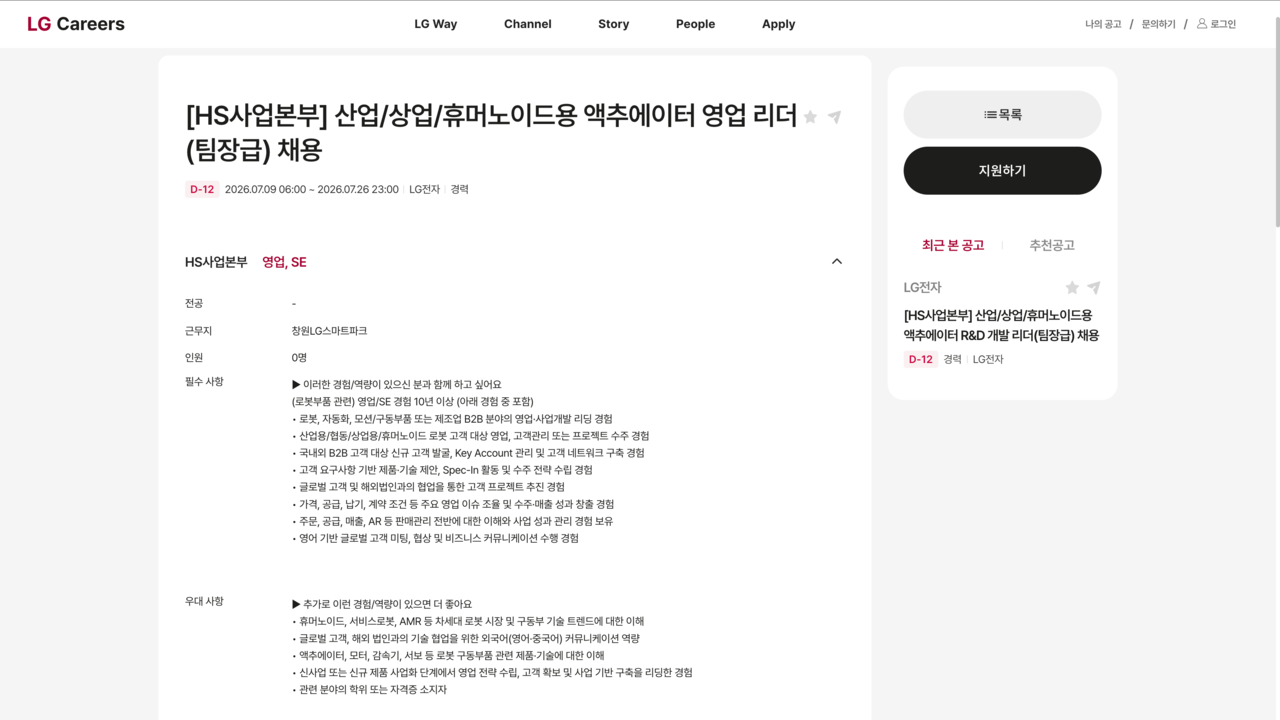
Significantly, two of the sales-focused postings require “business-level North American English” proficiency and a willingness for extended stays in the US for client engagements. This stipulation offers a clear indication of where LG anticipates securing its initial external customers. The systems engineer role is specifically designed to facilitate “spec-in” victories – the critical juncture when a customer commits to incorporating an LG component into their robot design. Such decisions, once made, are costly for buyers to reverse, typically guaranteeing years of orders for the supplier.
All six newly announced positions are based at LG Smart Park, the company’s advanced manufacturing complex located in Changwon, South Gyeongsang Province. These roles fall under the Home Appliance Solution division, the unit responsible for appliance manufacturing that also houses LG’s robust motor and actuator business. LG has clarified that these new hires will not report to the separate Robotics Business Center, which CEO Ryu Jae-cheol established on July 1 under his direct command to oversee the company’s finished-robot strategy.
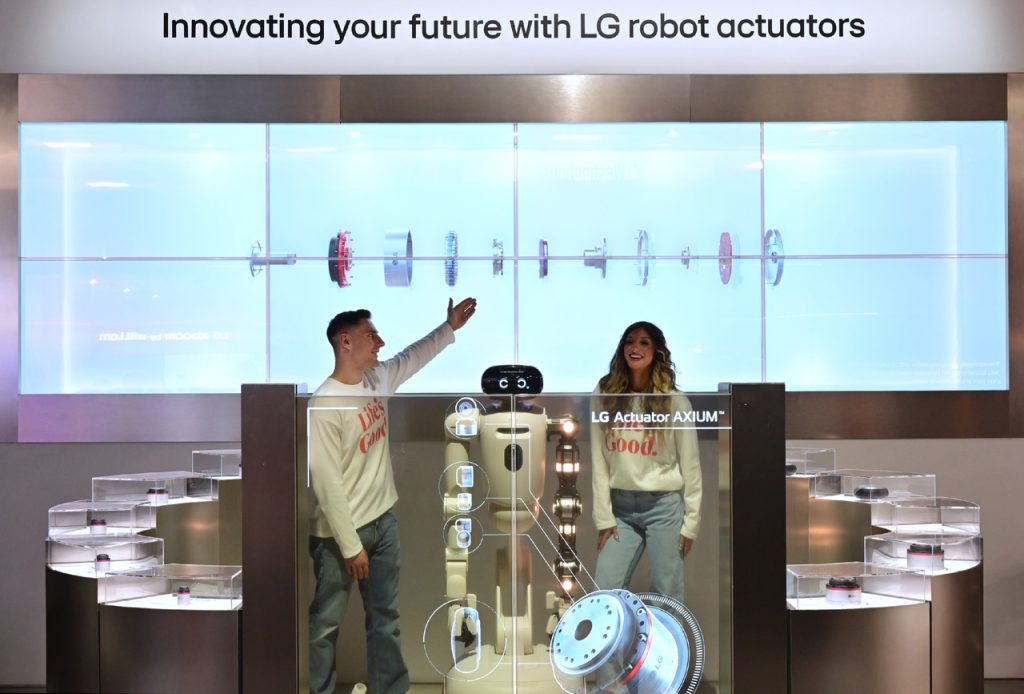
LG proudly unveiled its dedicated actuator brand, Axium, at CES 2026 in January. In an April LinkedIn post, CEO Ryu Jae-cheol outlined LG’s ambitious roadmap: completing a mass-production system this year, initially deploying these parts in its proprietary home robot CLOiD, then supplying “global partners” by 2027, and subsequently expanding into high-torque industrial applications by 2030. This strategic thrust leverages LG’s extensive manufacturing infrastructure, which produces approximately 45 million motors annually across seven sites in five countries, now being strategically reoriented into a potent components business.
This transformative journey isn’t being undertaken in isolation. LG has forged a crucial technology partnership with reducer specialist SPG. Furthermore, in June, LG committed to considering an equity stake in a new robot-actuator factory being constructed in Uzbekistan by Robotis, a prominent Korean manufacturer whose clientele includes industry giants like Tesla and China’s Unitree. Currently, LG holds approximately a 6.56 percent stake in Robotis.
mjh


