Hyundai Rotem has achieved a significant milestone by securing NATO’s stringent quality assurance certification for its acclaimed K2 main battle tank. This landmark achievement positions Hyundai Rotem as the first South Korean entity to earn such a qualification, signaling a robust potential boost for defense exports to NATO member countries.
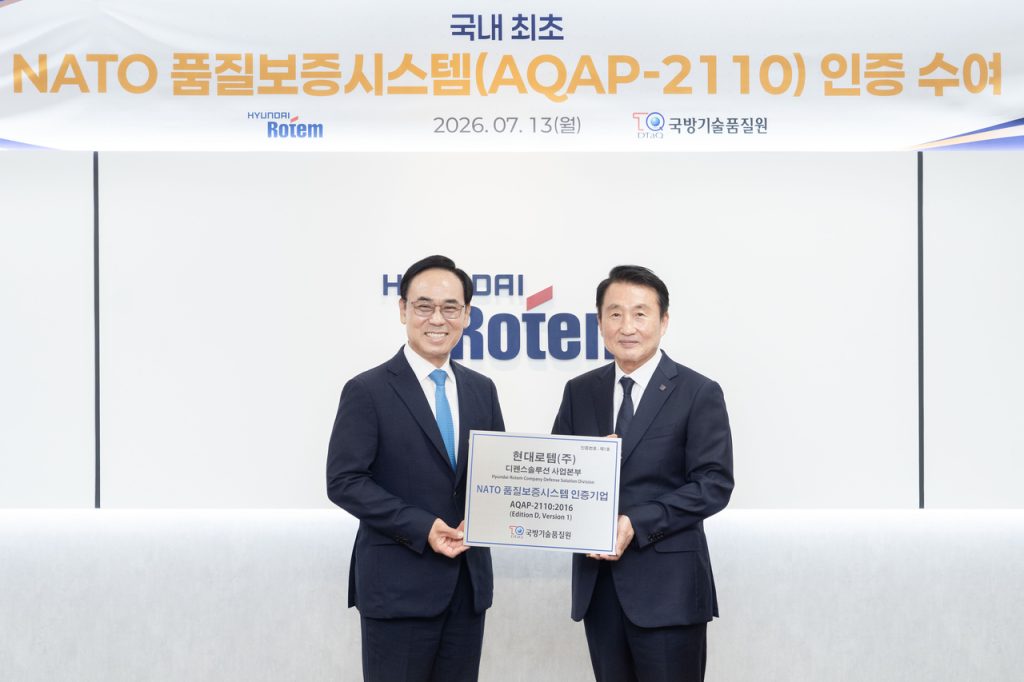
The defense and railway systems arm of Hyundai Motor Group, Hyundai Rotem, officially announced on Tuesday the receipt of the Allied Quality Assurance Publications 2110 (AQAP-2110) certification. The pivotal ceremony took place on Monday at their headquarters in Uiwang, Gyeonggi Province, with key representatives from the Defense Agency for Technology and Quality in attendance, underscoring the certification’s national importance.
The AQAP-2110 standard represents a critical quality management framework mandated for defense procurement across NATO member nations. This coveted certification is widely recognized as an essential prerequisite for any company aspiring to secure defense contracts or provide vital products and services to NATO alliance countries.
This makes Hyundai Rotem the trailblazing Korean company to successfully obtain this prestigious certification.
Furthermore, this marks the inaugural AQAP-2110 certification issued by the state-run Defense Agency for Technology and Quality (DATQ), following its recent authorization to certify companies under NATO’s comprehensive quality assurance system.
The certification specifically encompasses the formidable K2 main battle tank along with its diverse family of armored vehicles, which includes specialized recovery, bridge-laying, and mine-clearing variants. Hyundai Rotem has expressed its intent to strategically broaden the scope of certified products in response to evolving future market demands.
This certification serves as a definitive validation that the K2 main battle tank meets and exceeds NATO’s rigorous quality requirements, significantly enhancing Hyundai Rotem’s standing in competitive defense tenders among member states. The company anticipates this qualification will provide a crucial advantage in future bid evaluations and during critical contract negotiations.
This pivotal development aligns with a period of escalating NATO defense spending, largely propelled by heightened geopolitical tensions globally. NATO member nations collectively contribute approximately 55 percent of worldwide military expenditure, with many states now committing to increase defense spending closer to 5 percent of their gross domestic product. This trend promises to unlock substantial new opportunities for innovative defense manufacturers.
In a related strategic move, South Korea has recently initiated negotiations for a foundational procurement agreement with NATO. This initiative aims to significantly improve access for Korean defense companies to the alliance’s collectively funded procurement market, which is impressively estimated at an annual value of 15 trillion won ($10 billion).
A Hyundai Rotem official affirmed the company’s commitment, stating, “We are dedicated to strengthening our endeavors to penetrate global markets collaboratively with our valued suppliers, thereby significantly contributing to the enhanced competitiveness of Korea’s defense industry.”
sahn