
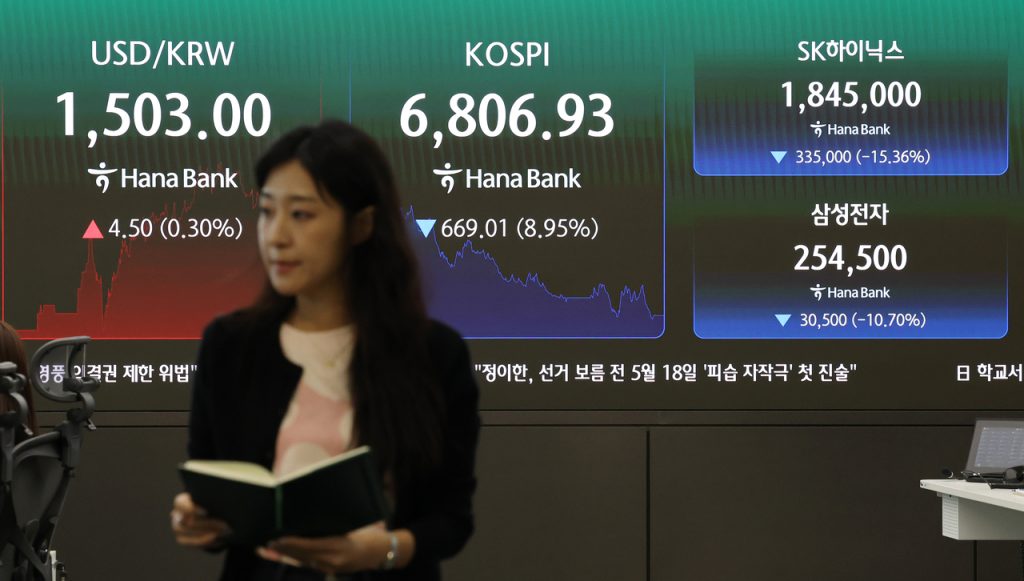
Seoul’s benchmark stock market experienced a significant downturn on Monday, with shares plunging by 9 percent. This sharp decline was primarily driven by investors engaging in profit-taking on technology stocks, further exacerbated by renewed geopolitical tensions in the Middle East. Concurrently, the Korean won weakened against the US dollar.
The Korea Composite Stock Price Index (KOSPI), the nation’s key benchmark, plummeted by 669.01 points, marking an 8.95 percent drop, to close at 6,806.93. The index had previously touched an intraday low of 6,783.43 during the session.
Trading activity for the day registered a moderate volume of 469.86 million shares, amounting to 39.8 trillion won ($26.5 billion) in value. The market saw a substantial imbalance, with declining stocks outnumbering gainers by a significant margin of 713 to 179.
Institutional investors offloaded shares worth a net 2.22 trillion won, while foreign investors engaged in net selling of 1.7 trillion won. In contrast, individual investors were net buyers, acquiring 3.9 trillion won worth of shares.
Following an initial opening drop of 0.85 percent, the KOSPI’s losses intensified, triggering a circuit breaker. This mechanism, designed to curb excessive volatility, temporarily halted trading of all KOSPI-listed stocks for a period of 20 minutes. This marked the seventh activation of such a measure within the current year, highlighting the severity of the market’s decline.
In contrast, US stock markets had shown resilience on Friday, bolstered by a multibillion-dollar share offering from South Korean chipmaker SK Hynix in the United States. The Dow Jones Industrial Average recorded a gain of 0.29 percent, and the tech-heavy Nasdaq Composite also advanced by 0.29 percent.
SK Hynix’s American Depository Receipts (ADRs), traded on the Nasdaq, concluded Friday’s session at $168 each, comfortably exceeding their initial offering price of $149.
Despite the successful debut of its ADRs in the US market, SK Hynix’s shares on the domestic exchange experienced a sharp fall. Analysts attributed this paradox to investors liquidating their local holdings to capitalize on profits and shift their investments towards the company’s US-listed ADRs.
Broader investor sentiment was also negatively impacted by escalating uncertainties in the Middle East. This followed a fresh exchange of strikes between the United States and Iran, intensifying concerns over the strategic Strait of Hormuz and its potential global economic repercussions.
“The introduction of the country’s new single-stock leveraged exchange-traded funds (ETFs) linked to major players like Samsung Electronics and SK Hynix continued to amplify volatility within the stock market,” noted a research report from Samsung Securities, pointing to another factor contributing to the turbulent trading environment.
The technology sector bore the brunt of the market downturn.
Market leader Samsung Electronics saw its shares plummet by 10.7 percent, closing at 254,500 won. Its prominent chipmaking competitor, SK Hynix, experienced an even steeper decline, falling 15.37 percent to 1,845,000 won.
Beyond the tech segment, top automaker Hyundai Motor recorded a decrease of 2.95 percent, settling at 444,000 won. Defense industry giant Hanwha Aerospace also saw its shares decline by 3.21 percent, closing at 936,000 won.
Amidst the widespread declines, a few companies managed to buck the trend. Leading battery manufacturer LG Energy Solution posted a modest gain of 0.77 percent, while prominent refiner SK Innovation climbed notably by 7.09 percent, reaching 110,200 won.


