
Supply, Not Demand, to Dictate Future Memory Chip Cycle: Analysts Foresee Continued Tightness
The global leaders in memory chip manufacturing – Samsung Electronics, SK hynix, and Micron Technology – are intensely expanding their production capacity. This aggressive ramp-up is a direct response to the soaring demand for artificial intelligence (AI) infrastructure, which consistently outstrips current supply.
Bolstering this trend, data from World Semiconductor Trade Statistics (WSTS) projects the global semiconductor market to expand by a remarkable 90 percent this year, reaching an estimated $1.51 trillion. Within this, the memory market is anticipated to experience an even more explosive surge of 250 percent, hitting $803.9 billion.
These three semiconductor giants are heavily investing in new fabrication plants, cutting-edge advanced packaging technologies, and advanced chipmaking equipment. Their objective is to secure critical production capacity well before new supplies can fully materialize. Even amidst speculation that the AI boom might be peaking, both industry executives and market analysts widely anticipate that supplies of high-bandwidth memory (HBM) and conventional DRAM will remain constrained for several years.
Underscoring the intensity of this demand, SK Group Chairman Chey Tae-won stated in recent interviews following SK hynix’s Nasdaq debut, “We announced that we would double our production capacity within five years, but every customer says that will not be enough.”
Collectively, the semiconductor industry’s investment this year is forecast to reach approximately 200 trillion won (about $129 billion USD), primarily driven by these three leading memory manufacturers.
Samsung Electronics Boosts Global Memory Production
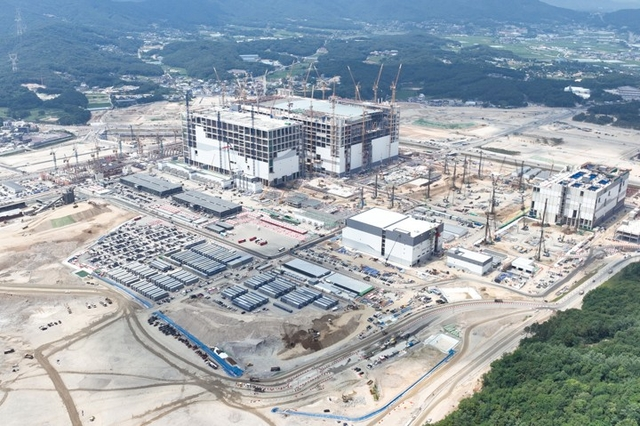
Samsung Electronics is significantly expanding its memory production footprint across South Korea. Key projects are underway in Pyeongtaek and Yongin, both in Gyeonggi Province, alongside plans for the southwestern integrated Gwangju-South Jeolla special city. Construction at its P5 complex in Pyeongtaek is progressing, and the company is actively working to accelerate the operational start of its inaugural Yongin fab to the second half of 2029 – a full one to two years ahead of its original schedule.
Furthermore, Samsung has committed to an massive 400 trillion won investment for two new memory fabrication plants within the proposed Gwangju semiconductor cluster. These state-of-the-art facilities are designed to substantially increase the production of advanced DRAM and other critical memory products specifically for AI servers.
SK hynix Fuels Expansion with Nasdaq Listing and Strategic Investments
SK hynix is leveraging the $26.5 billion secured from its recent Nasdaq listing to significantly boost its wafer production and advanced packaging capabilities. These funds will directly finance its first fabrication plant within the Yongin semiconductor cluster, the advanced P&T7 packaging plant in Cheongju, and the acquisition of additional extreme ultraviolet (EUV) lithography equipment. In a parallel move, SK hynix has also announced plans for a substantial 400 trillion won investment in two memory fabs within the planned Gwangju cluster.
Micron Technology’s Strategic US and Global Expansion
Micron Technology is likewise accelerating its investment strategy, driven partly by Washington’s initiatives to onshore more semiconductor manufacturing. The company has outlined plans to invest over $250 billion in the United States through 2035. This includes developing new memory fabrication plants in New York and Idaho, alongside expanding its existing facility in Virginia. Micron’s ambitious goal is to raise the proportion of its DRAM produced in the U.S. to 40 percent, a significant leap from its current single-digit share.
For the current year, Micron has allocated $11 billion for capital expenditure, representing a 120 percent increase year-over-year. The company is also poised to benefit from substantial U.S. government support, potentially receiving up to $20 billion in subsidies and tax incentives. Beyond the U.S., Micron is investing approximately 14 trillion won in Hiroshima, Japan, dedicated to expanding the production of next-generation DRAM and HBM.
Despite this monumental surge in investment from all major players, significant new memory chip production capacity is not projected to become fully operational until the latter half of 2027. This anticipated delay suggests that memory prices are likely to remain elevated in the interim.
Emergence of CXMT Amidst Supply Shortages
These persistent supply constraints are also creating a notable opportunity for China’s ChangXin Memory Technologies (CXMT). According to analysis from Counterpoint Research, CXMT’s global DRAM market share impressively climbed to 8 percent in the first quarter, up from just 3 percent a year prior. Reports even indicate that Apple has considered integrating CXMT chips into devices sold in China, aiming to optimize component costs.
CXMT itself is poised for further expansion, planning to raise 29.5 billion yuan (approximately $4.1 billion USD) via a listing on Shanghai’s STAR Market. These funds are earmarked for significantly expanding its 12-inch wafer production lines in both Hefei and Beijing.
The Critical Role of Capacity Growth in the Memory Market
Industry analysts are emphasizing that the long-term outlook for memory manufacturers will hinge less on short-term pricing fluctuations and more on their ability to rapidly expand production capacity.
Park Seung-young, Head of Portfolio Strategy at Hanwha Investment & Securities, articulated this perspective on 3PROTV, stating, “Supply matters more than demand in commodity memory. The key question is how fast capacity can grow.”
Park further elaborated that sustained higher production could maintain a positive market trajectory even if prices experience some softening. Conversely, prolonged periods of elevated memory prices might inadvertently encourage the entry of new competitors into the market.
He concluded, “Investors should closely monitor supply growth and production capacity, rather than focusing solely on price movements.”


