
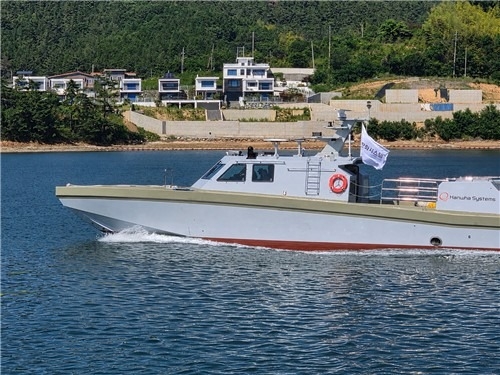
Hanwha Systems Co., a prominent defense subsidiary of Hanwha Group, has launched its advanced 30-ton-class unmanned surface vessel (USV) in Busan, marking the beginning of crucial sea trials. These comprehensive tests are designed to rigorously evaluate the vessel’s cutting-edge operational capabilities and performance.
The state-of-the-art USV commenced its sea trials in early June, following its successful launch near Gadeok Bridge. The vessel is currently undergoing extensive testing along a challenging maritime route that spans between Busan and Jangmok Port on Geoje Island, simulating diverse real-world conditions.
Key aspects of the ongoing trials include a meticulous assessment of the vessel’s autonomous navigation systems. This encompasses its ability to maneuver precisely through narrow waterways, ensure safe operations in challenging conditions with rough seas and strong winds, and demonstrate reliable long-range autonomous navigation over distances of several hundred kilometers.
This 30-ton unmanned vessel will serve as a critical testbed through the end of 2027, primarily to validate its artificial intelligence-based autonomous navigation technologies. Furthermore, its open software architecture is being evaluated to ensure full compliance with the stringent Unmanned Maritime Autonomy Architecture standards set by the US Navy, highlighting its potential for global interoperability.
Solidifying its leadership in the maritime defense sector, Hanwha Systems has also announced plans to introduce a larger, 140-ton-class USV by the close of this year. This strategic expansion is aimed at significantly strengthening the company’s competitive position within the rapidly evolving global market for advanced unmanned maritime systems.


