
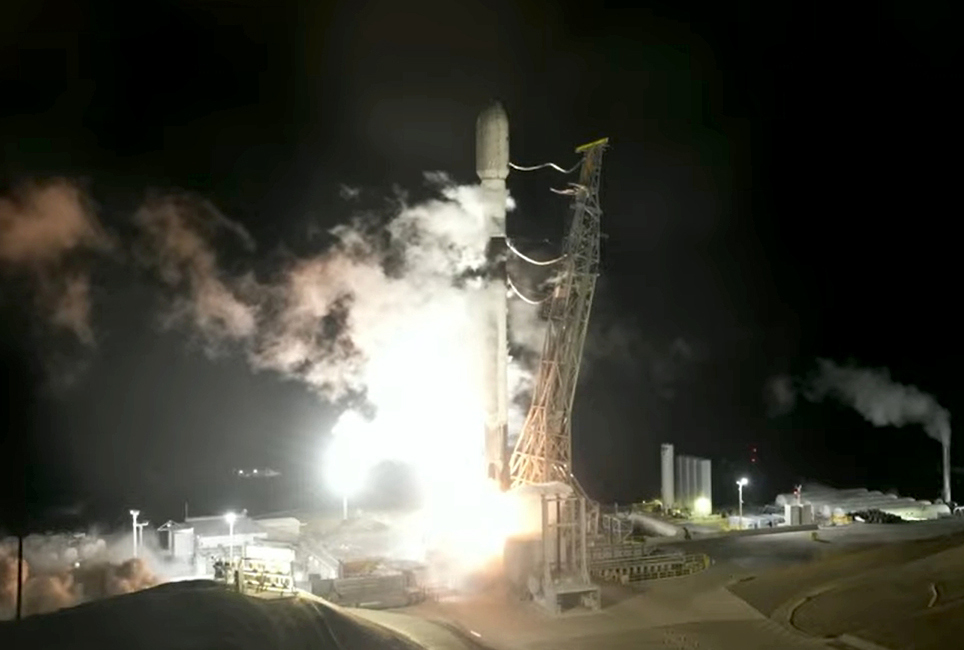
South Korea has achieved a significant milestone in its space endeavors with the successful launch and orbital insertion of its next-generation Earth observation satellite. The satellite, designed for critical environmental monitoring, was launched from the Vandenberg Space Force Base in California this Tuesday, as confirmed by the Korea AeroSpace Administration (KASA).
The advanced midsized satellite, designated No. 4, embarked on its journey aboard a SpaceX Falcon 9 rocket. The launch occurred at 12:12 a.m. Tuesday, California local time (4:12 p.m. Tuesday, South Korea time), as part of the Transporter-17 rideshare mission, which deployed a total of 81 payloads.
Demonstrating flawless execution, the South Korean satellite successfully separated from the launch vehicle approximately two hours and 30 minutes post-liftoff, at around 6:42 p.m. Tuesday (South Korea time). This critical maneuver was followed by its first communication with the Svalbard ground station in Norway just 23 minutes later, confirming its operational status in low-Earth orbit.
KASA underscored the launch as a pivotal achievement, significantly expanding South Korea’s burgeoning private-led satellite development capabilities. This success marks a new era for the nation’s space industry and its autonomy in critical data acquisition.
KASA Administrator Oh Tae-seog highlighted the strategic importance of this mission. “By independently securing satellite imagery and data needed for agriculture, forestry, climate, and disaster response, we have significantly strengthened the competitiveness of our private-led satellite industry and the country’s capabilities in utilizing satellite information,” Oh stated.
This cutting-edge satellite represents South Korea’s first dedicated asset for agriculture and forestry. It is engineered to support a broad spectrum of vital applications, including precise crop monitoring, efficient forest management, proactive disaster response, and in-depth climate analysis.
Equipped with a domestically developed wide-area observation camera, the satellite boasts the impressive capability to image the entire Korean Peninsula every three days, providing invaluable, up-to-date data for national planning and environmental stewardship.
Following its initial operational phase, which includes rigorous image calibration and data verification, the satellite is projected to enter full-scale service in the first half of 2027, contingent on the successful progression of its preliminary operations, KASA affirmed.


