
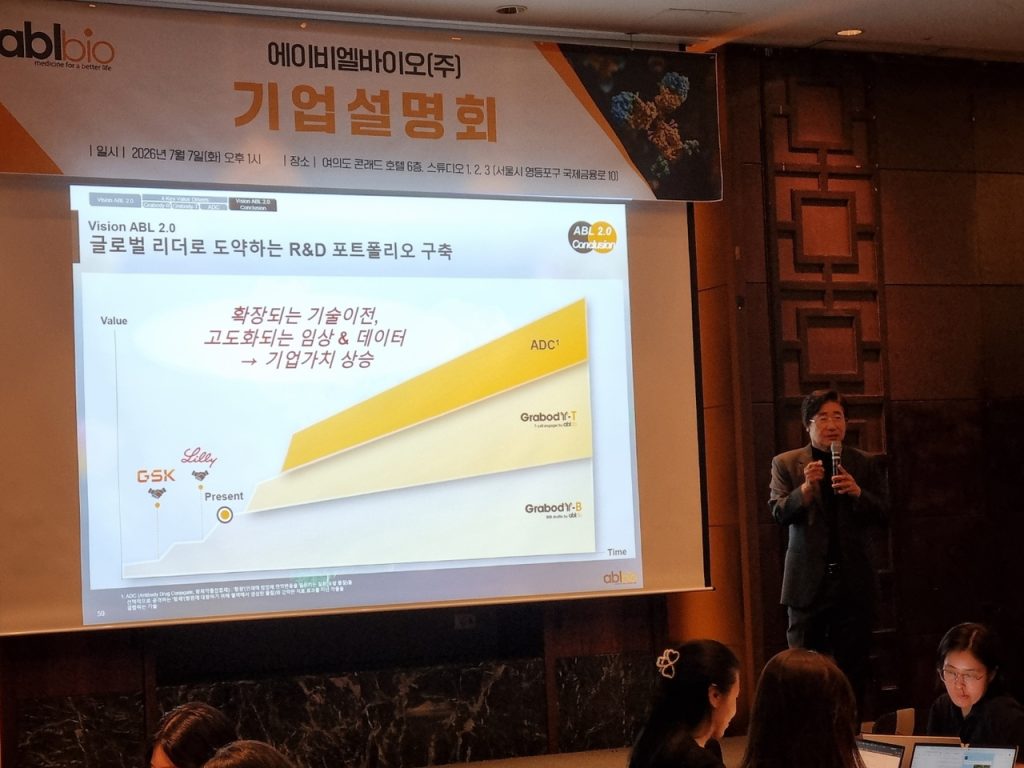
ABL Bio is strategically repositioning itself from a licensing-centric biotech firm to a formidable global drug developer, aggressively advancing its oncology pipeline and innovative proprietary platform technologies.
Addressing a press conference at the Conrad Seoul on Thursday, ABL Bio CEO Lee Sang-hoon articulated a bold new vision: “The ambition extends beyond securing another significant licensing agreement. Our ultimate objective is to build a company that can genuinely compete with leading global pharmaceutical corporations.”
This transformative vision emerges as ABL Bio navigates a pivotal phase for its flagship clinical asset, ABL111. This advanced bispecific antibody precisely targets Claudin 18.2 and 4-1BB, offering a promising therapeutic avenue for gastric cancer patients.
In a significant development, the Korean biotechnology pioneer recently secured US Food and Drug Administration (FDA) approval to propel ABL111 directly into a registration Phase 3 trial. This expedited pathway, granted under the FDA’s fast track program, bypasses the conventional Phase 2 study. The crucial Phase 3 study is slated to commence in December, undertaken in collaboration with China’s NovaRock Biotherapeutics.
CEO Lee highlighted that the FDA’s fast-track decision is expected to compress the development timeline by several years, substantially enhancing ABL Bio’s competitive edge within the rapidly evolving Claudin 18.2 therapeutic landscape.
While ABL111 represents a critical near-term growth driver, Lee emphasized that ABL Bio’s sustained future expansion is anchored in its innovative platform technologies. These platforms are designed not only to generate consistent partnership revenue but also to bolster internal drug discovery and development efforts. A cornerstone of this strategy is Grabody-B, the company’s renowned blood-brain barrier (BBB) shuttle platform, a key technology for enhanced drug delivery to the central nervous system.
“Industry interest in advanced brain delivery technologies has escalated dramatically,” Lee stated. “The focus has shifted from merely asking if drugs can penetrate the blood-brain barrier to demanding how effectively and safely they can achieve this crucial penetration.”
Lee further elaborated that ABL Bio is actively broadening the potential applications of its Grabody-B platform far beyond traditional antibodies. Current research is exploring its utility for delivering diverse biologics, including small interfering RNA (siRNA), enzymes, and fusion proteins, all of which have historically faced significant challenges in accessing the central nervous system.
Concurrently, ABL Bio is making strategic investments in next-generation oncology innovations, including advanced antibody-drug conjugates (ADCs) and T-cell engager platforms. The company is also robustly strengthening its clinical development and regulatory capabilities to proficiently support its global late-stage trials, according to Lee.
“Achieving clinical success remains paramount,” he affirmed. “However, our ultimate objective is to forge a company that continuously creates significant value through relentless innovation, strategic development, and successful commercialization.”
hwkan


