South Korea’s benchmark Kospi index experienced a significant downturn on Friday, plummeting nearly 6 percent as investors engaged in widespread profit-taking after recent robust rallies, particularly in artificial intelligence (AI) related stocks. Despite the stock market fall, the Korean won strengthened against the US dollar.
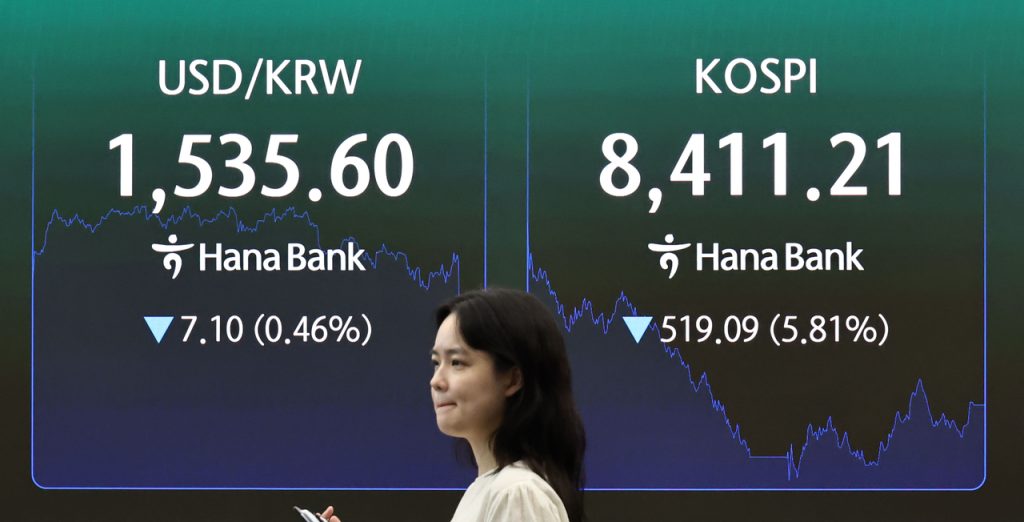
The Korea Composite Stock Price Index (Kospi) shed 519.09 points, or 5.81 percent, to close at 8,411.21. During the session, the index briefly dropped as low as 8,126.84, highlighting the sharp market correction.
This market rout followed a period of strong performance, with the Kospi having rallied by 5.42 percent on Thursday and an additional 3.26 percent rise on Wednesday, largely driven by investor enthusiasm for AI-related shares.
The dramatic decline saw the Kospi initially open 1.31 percent lower before accelerating its losses to over 8 percent. This sharp plunge prompted the bourse operator to activate a circuit breaker at 12:10 p.m., temporarily halting trading of Kospi-listed shares for 20 minutes to curb volatility.
Overnight trading on Wall Street presented a mixed picture for tech heavyweights. Micron Technology surged 15.7 percent on the back of strong earnings, while Apple shares dropped 6.1 percent after the company increased prices across many of its products, citing expensive memory chips as the reason.
Trading volume was exceptionally heavy, with 508.9 million shares exchanged, valued at 51.5 trillion won ($33.5 billion). Declining stocks significantly outnumbered gainers, with 777 issues falling against only 111 advancing.
Foreign investors and institutions were net sellers, offloading shares worth 4.6 trillion won and 3.8 trillion won, respectively. Conversely, individual investors actively bought the dip, scooping up a net 8.2 trillion won in shares.
“Investors are worried that excessively high memory chip prices could increase the cost of end-use products, potentially undermining overall demand for memory chips. This concern could discourage tech companies from expanding their large-scale AI investments,” explained Han Ji-young, an analyst from Kiwoom Securities.
Semiconductor shares bore the brunt of the sell-off, leading the market’s decline.
Industry leader Samsung Electronics, the world’s largest memory chipmaker, saw its shares tumble 5.3 percent to 339,500 won. Rival SK hynix, another major chip producer, slumped 8.36 percent to 2.67 million won. SK Square, the holding company for SK hynix, also plunged 9.43 percent to 1.72 million won, while Samsung Electro-Mechanics, a key electronic components manufacturing affiliate of Samsung Electronics, shed 0.2 percent to 1.99 million won.
Financial shares also experienced a downturn, with major banking group Hana Financial Group sinking 3.77 percent to 109,700 won, and Samsung Securities skidding 6.32 percent to 103,800 won.
In other corporate news, LIG Defense & Aerospace slid 5.16 percent to 735,000 won after announcing its plans to raise 500 billion won through a capital increase, aimed at expanding its domestic missile production facilities.